- Loading...
Choosing a country for custom fashion hardware manufacturing requires more than its reputation.
China, Italy, and France have documented suppliers of custom fashion hardware made from metal, with different examples of process breadth and design support. Other countries may suit particular components. The best choice depends on the part, production route, finish, supplier controls, and comparable project quotations.

The evidence supports a shortlist, not a universal league table. A garment factory may source a buckle rather than make it, and an office address may differ from the factory location. The comparison therefore needs to follow the metal component from design through production and inspection.
Which Countries Have Documented Custom Fashion Hardware Capabilities?
Apparel manufacturing strength is an incomplete guide to metal hardware. A useful country shortlist starts with suppliers that can show work on the actual component category.
Custom fashion hardware capability is documented in several countries, including China, Italy, France, India, Turkey, Taiwan, and Vietnam. The evidence differs by product: a zipper or snap line does not establish expertise in a cast bag lock, and a decorative jewellery workshop does not establish functional fastening performance.

Match the Component to Its Production Route
The first question concerns the part itself. A small stamped eyelet, a zinc alloy logo plate, a machined stainless clasp, and a moving bag closure require different equipment and development judgment. Their visible finish and installed function also create different inspection needs. Country level apparel data says little about those details.
The difference between garment assembly and hardware production matters. A clothing manufacturer can buy trims from a separate supplier, or coordinate their purchase under a full-package arrangement. In either case, the garment factory’s location does not identify who forms or finishes the metal. The hardware maker should be named when the component is critical to appearance or function.
Supplier capabilities provide a more useful starting point than national production totals. A China-based factory may offer several metals and forming methods; an Italian specialist may focus on bespoke leather-goods components; a French specialist may combine modeling, prototyping, and finishing. These are examples of individual production routes, so each proposed order still needs its own process evidence.
| Component need | Evidence that belongs on the shortlist |
|---|---|
| Custom bag lock or clasp | Similar mechanisms, tooling route, assembly, and operation samples |
| Logo plate or decorative trim | Detail retention, edge quality, attachment, and finish references |
| Snap, rivet, or eyelet | Matching attachment method, installation equipment, and retention checks |
| Zipper or pull | Compatible zipper system, pull construction, and functional testing |
Keep Specialist Options Open
India and Turkey also have specialists in buckles, bag fittings, and other metal accessories. Taiwan has garment-fastener specialists, while Vietnam has documented production of zippers, snaps, and buttons. These product-specific examples justify supplier investigation; they do not establish a national score or prove capability for every custom component.
The practical shortlist can change with the design. A decorated fashion buckle may lead to one set of factories; an attachment-sensitive snap may lead to another. The finished product’s country of assembly should not be allowed to hide the origin or capability of a critical metal part.
How Do China, Italy, and France Differ in Development and Production?
The three countries offer relevant examples, but their suppliers cannot be reduced to three fixed price or quality tiers. Compare the actual factory proposal.
Reviewed China-based suppliers describe broad metal and forming options. Italian specialists describe close collaboration on bespoke leather-goods details. A reviewed French specialist describes integrated modeling, prototyping, machining, and finishing. These are documented supplier-level capabilities, not guarantees for every factory in each country.

Compare the Work Behind the Sample
One China-based hardware manufacturer describes brass, zinc, stainless steel, and iron, along with casting, forging, CNC machining, wire forming, and stamping. That breadth is relevant when a collection includes several types of parts or a design needs a process change. It does not mean that another China supplier offers the same range. The proposed factory and process must be identified.
An Italian leather-goods hardware specialist describes cooperation between its technical team and clients’ style departments. Other Italian suppliers present custom buckles, closures, and footwear details. This is relevant when appearance, construction, and design iteration need close attention. It does not establish that every Italian supplier has the same material range, production capacity, or price.
A French metal-accessory specialist describes 2D and 3D modeling, CNC prototyping, decorative finishes, assembly, and dimensional verification. Such a route may fit a part whose geometry and finish must be developed together. The capability still needs confirmation for the particular order and production site.
| Review point | China example | Italy example | France example |
|---|---|---|---|
| Documented emphasis | Multiple metals and forming methods | Bespoke leather-goods development | Modeling, prototyping, and finishing |
| Useful first question | Which proposed site performs each operation? | How will the design be developed and approved? | Which operations apply to this exact component? |
| Evidence to request | Process route and comparable parts | Drawings, samples, and finish references | Prototype route and production-site map |
Avoid a Country Stereotype
Country descriptions are useful only when connected to the component specification. A complex clasp may need a different shortlist from a decorative tag, even when both are called fashion hardware. A supplier’s ability to explain design limits, choose a sensible material, and reproduce the approved sample is more informative than its national reputation.
The comparison should use the same drawing revision and intended use. Otherwise, one factory may quote a cast zinc part and another a machined brass part, creating an apparent country difference that is actually a difference in construction. Design alternatives can be considered, but their material, process, appearance, and performance effects must be made explicit.
How Can Buyers Confirm Where Their Hardware Is Actually Made?
A sales office, bag factory, and plating plant may all sit in different countries. One address on a quotation cannot explain the complete production route.
To establish where custom hardware is made, record the contracting company, tooling and forming sites, finishing and assembly sites, final inspection location, and the declared origin of the supplied part. Ask the supplier to identify subcontracted steps and responsibility for changes or defects.
Build a Project-Specific Process Map
A supplier can have a US commercial address while producing most of its hardware at a factory in China. Commercial location and manufacturing location therefore need separate records. The same distinction can arise when a garment or bag factory purchases hardware from another supplier.
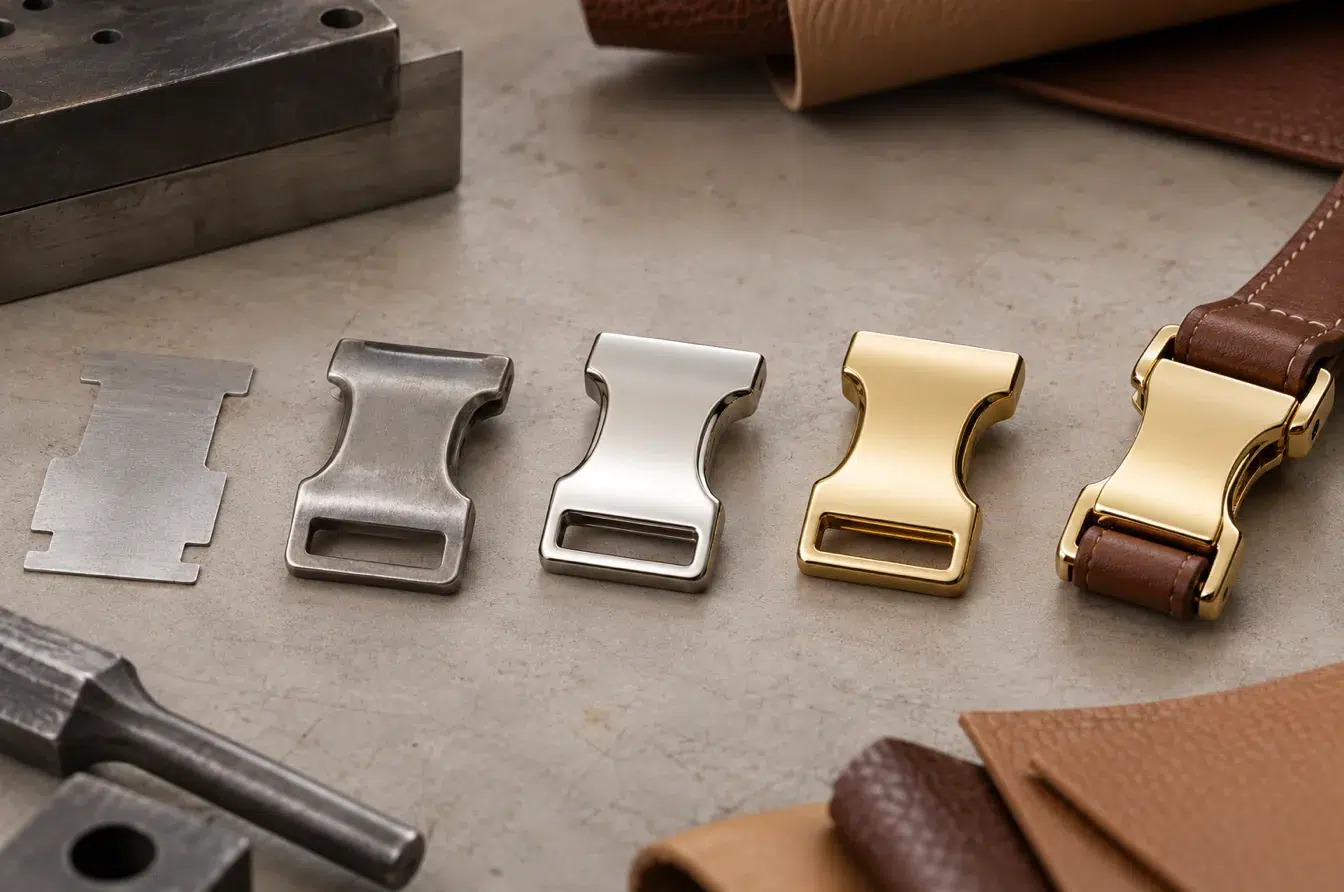
The process map should follow the approved part, not the company brochure. It should show who creates or owns the tooling, who forms the metal, where polishing and coating take place, who assembles moving elements, and who checks the finished order. Several sites can be involved. The key is an accountable handoff, with the latest drawing and approved finish reference used throughout.
An outside operation is not automatically a weakness. A specialist finisher may be appropriate for a required surface treatment. The risk appears when the parties cannot explain who controls the specification, authorizes changes, retains approval samples, or investigates a failure. Broad claims such as “all in-house” should be replaced with a process route for the specific design.
| Record | Question it should answer |
|---|---|
| Contracting entity | Who accepts the purchase order and commercial responsibility? |
| Tooling and forming site | Where is the component shape actually produced? |
| Finishing and assembly sites | Who controls appearance and moving-part fit? |
| Inspection record | Which site releases the finished lot? |
| Origin declaration | What origin is declared for the supplied component? |
Keep Origin Claims Precise
Marketing phrases should not be used as evidence of origin. The supplier should state the intended production sites for the order and provide the applicable commercial and shipping documents. Any origin claim used in the brand’s own product information must be checked against the actual process and the destination market’s requirements. The article does not assume that a particular finishing step determines origin in every market.
Which Costs and Timelines Should Be Compared Across Countries?
The lowest unit price can conceal different tooling, sample, finish, and shipping scopes. Timelines can also refer to different stages of work.
Comparable quotations separate development, tooling, sampling, production, testing, packaging, and transport. Each supplier should price the same drawing revision, material and finish requirements, variant quantities, acceptance criteria, and delivery scope. Countrywide price or lead-time rankings cannot be derived from unrelated supplier quotes.
Quote the Same Product and Purchasing Route
“Custom” can mean an existing item, an existing item with a new logo or finish, a modified design, or a fully original part. These routes do not require the same tooling or approvals. A quotation comparison should state which route each offer covers before unit prices are placed side by side.
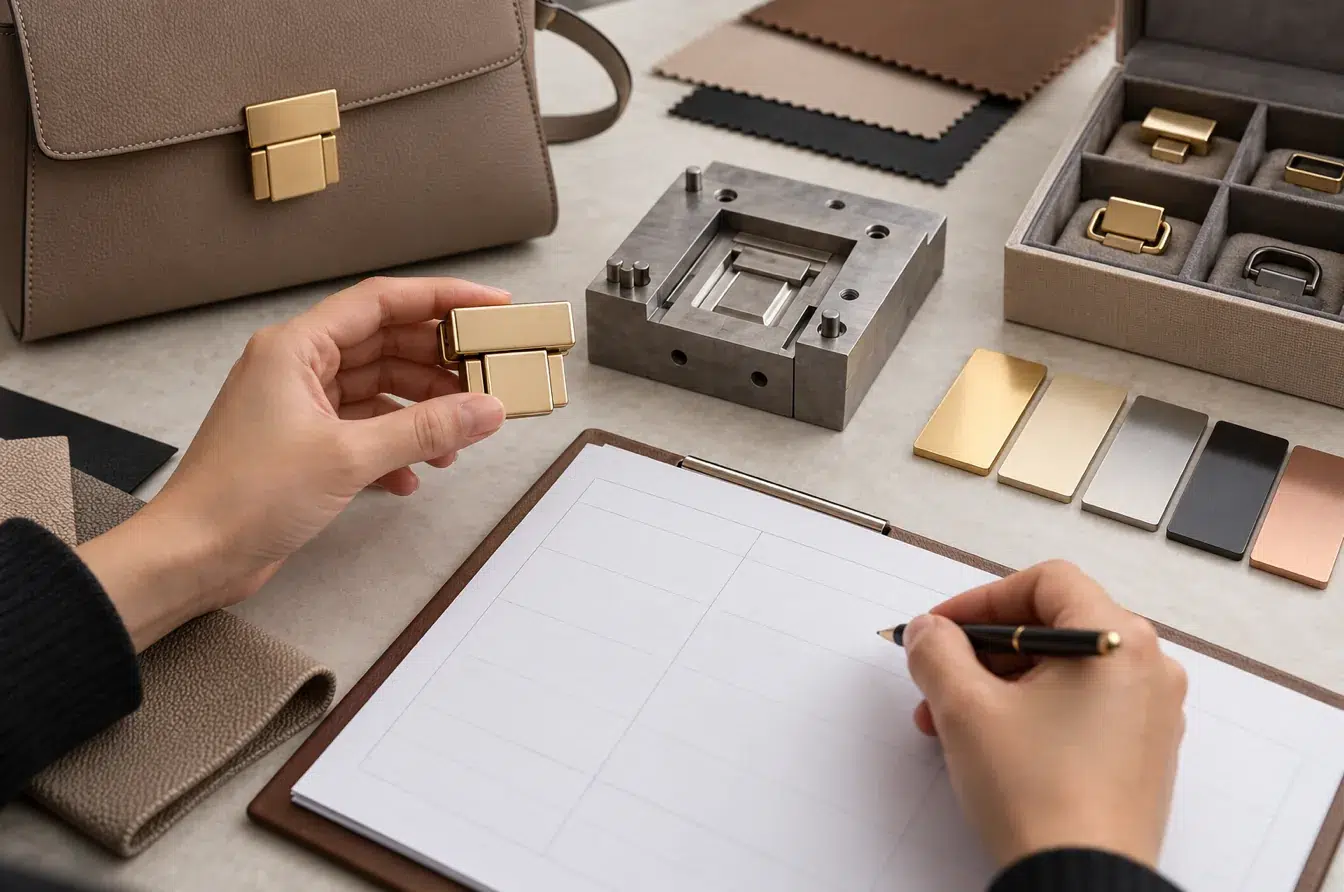
The cost of a custom component includes more than the recurring price per piece. Tooling, development samples, finish references, tests, inspection, packaging, and freight can be quoted separately or bundled differently. A lower piece price may correspond to a larger order or a different material. The comparison becomes meaningful only after these assumptions are written down.
The same discipline applies to quantities. A supplier may calculate its minimum by design, size, finish, or production run. The initial order and forecast should be separated. Forecast volume is planning information, not a firm order commitment. If several finishes are required, the quotation should state how quantities are divided among them.
| Quotation line | Comparison question |
|---|---|
| Development and tooling | What work and tool ownership are included? |
| Samples and revisions | Which stages and iterations are covered? |
| Unit price | Which material, finish, and quantity basis apply? |
| Tests and inspection | Which checks are included and who performs them? |
| Packaging and transport | What is protected, shipped, and delivered to which point? |
Compare Stage-by-Stage Timing
A published production lead time is not necessarily the time from first drawing to delivered goods. Plastic models, metal samples, and finish approvals can precede bulk production. A supplier may therefore quote different periods for standard production and full development. Neither period should be treated as a national benchmark.
Ask for timing by stage: drawing review, tool preparation, prototype, metal sample, finish approval, production, inspection, and transport. Record dependencies such as approval of a revised drawing or physical finish sample. This provides a schedule that can be managed, rather than a single number that hides development work.
How Can Supplier Capabilities Be Verified Before Bulk Production?
A polished website and attractive sample tray help find candidates. Production approval needs evidence tied to the exact part and its intended use.
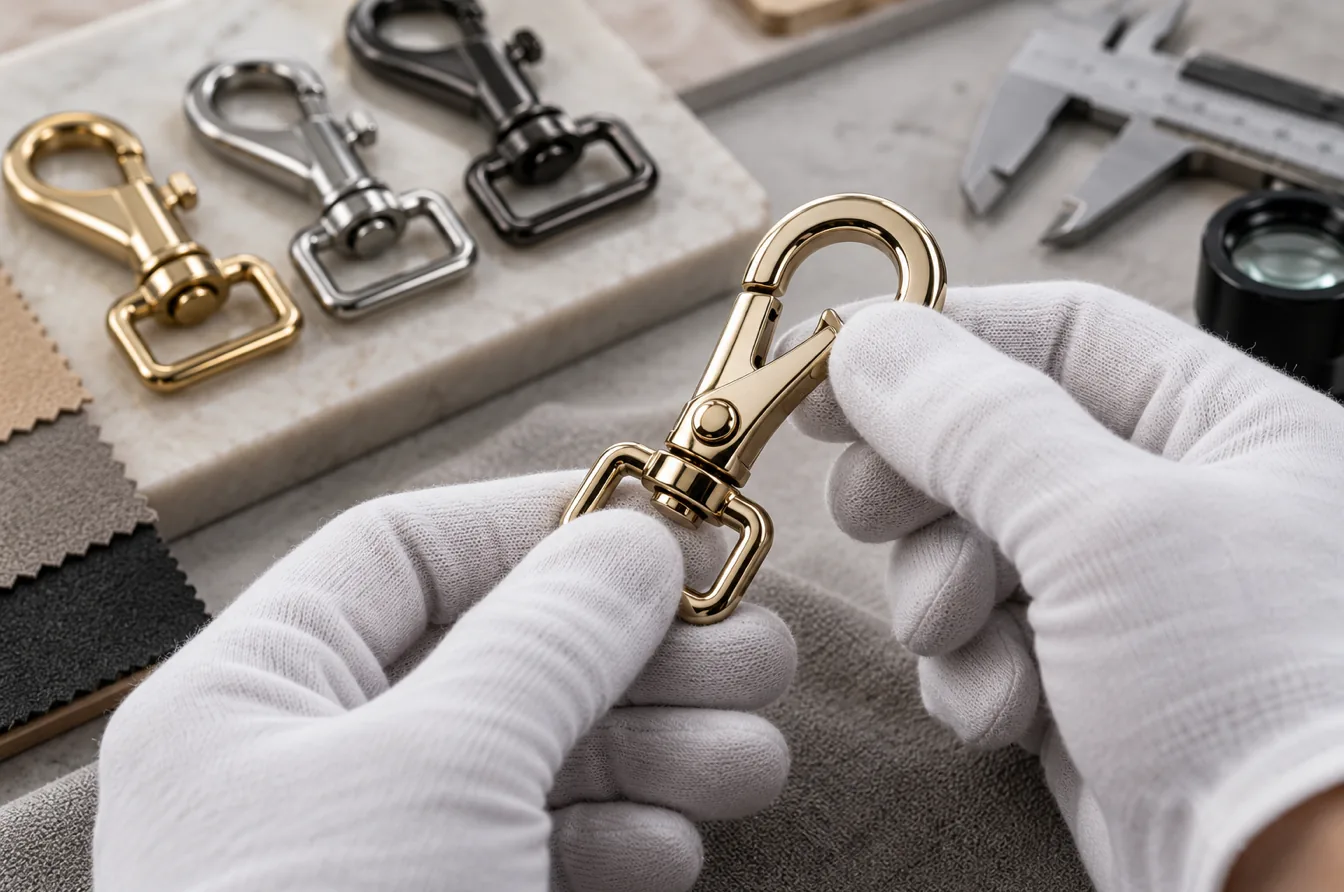
Verify a custom hardware supplier through a technical drawing review, relevant process examples, named production responsibilities, physical samples, and agreed acceptance checks. Approve the finished metal and installed function before bulk production. Keep a controlled reference sample and record any later changes.
Test the Proposed Production Route
The first supplier discussion should expose unresolved details. A bag clasp may need review of movement, clearances, mounting, plating access, and assembly. A garment snap may depend on fabric thickness, attachment tooling, and retention. A logo plate may need its edge treatment and mounting method confirmed. A supplier with relevant experience should be able to connect the drawing to these practical questions.
Physical samples answer different questions at different stages. A model can check scale and form. A metal sample can show the actual weight, finish, edges, operation, and attachment. The final approved sample should establish what production will be compared against. A rendered image is not an adequate substitute for a part that must move, fasten, or survive handling.
Testing should follow the application. Zippers may need strength and operation checks, while a visible metal accessory may need corrosion or restricted-substance checks where applicable. The test plan must be selected for the actual component, materials, use conditions, and destination requirements rather than copied across all hardware categories.
| Evidence before production | Decision it supports |
|---|---|
| Marked-up drawing and process route | Manufacturability and unresolved design changes |
| Comparable part or process sample | Relevant factory experience |
| Finished metal approval sample | Appearance, fit, operation, and attachment |
| Application-specific test plan | Required functional or chemical checks |
| Inspection and change-control record | Bulk and repeat-order consistency |
Confirm Repeatability, Not Just a First Sample
The approved part must remain recognizable in bulk and on reorder. Drawings should have revision numbers, finish references should be retained, and the inspection plan should identify critical dimensions and visible surfaces. Material or process substitutions need a documented approval route before production changes.
A controlled first order can test the complete chain: communication, tooling, sample approval, forming, finishing, inspection, packing, and delivery. The result provides stronger evidence for a long-term source than a country reputation. When a second supplier is developed, the same specification and approval standard should be used so that differences in the finished hardware can be traced to production rather than an inconsistent brief.
Conclusion
Choose countries through proven suppliers and component requirements. Compare the same design, verify every production step, and approve a physical part before committing to repeat production.