- Loading...
Solid brass vs stainless steel hardware is a small choice with a big effect on leather goods. It shapes weight, touch, durability, and brand value.
Solid brass gives leather goods warmth, repairable strength, and aging character, while stainless steel gives extreme corrosion resistance and stable industrial performance. The best choice depends on load, environment, finish, brand language, and long-term value.
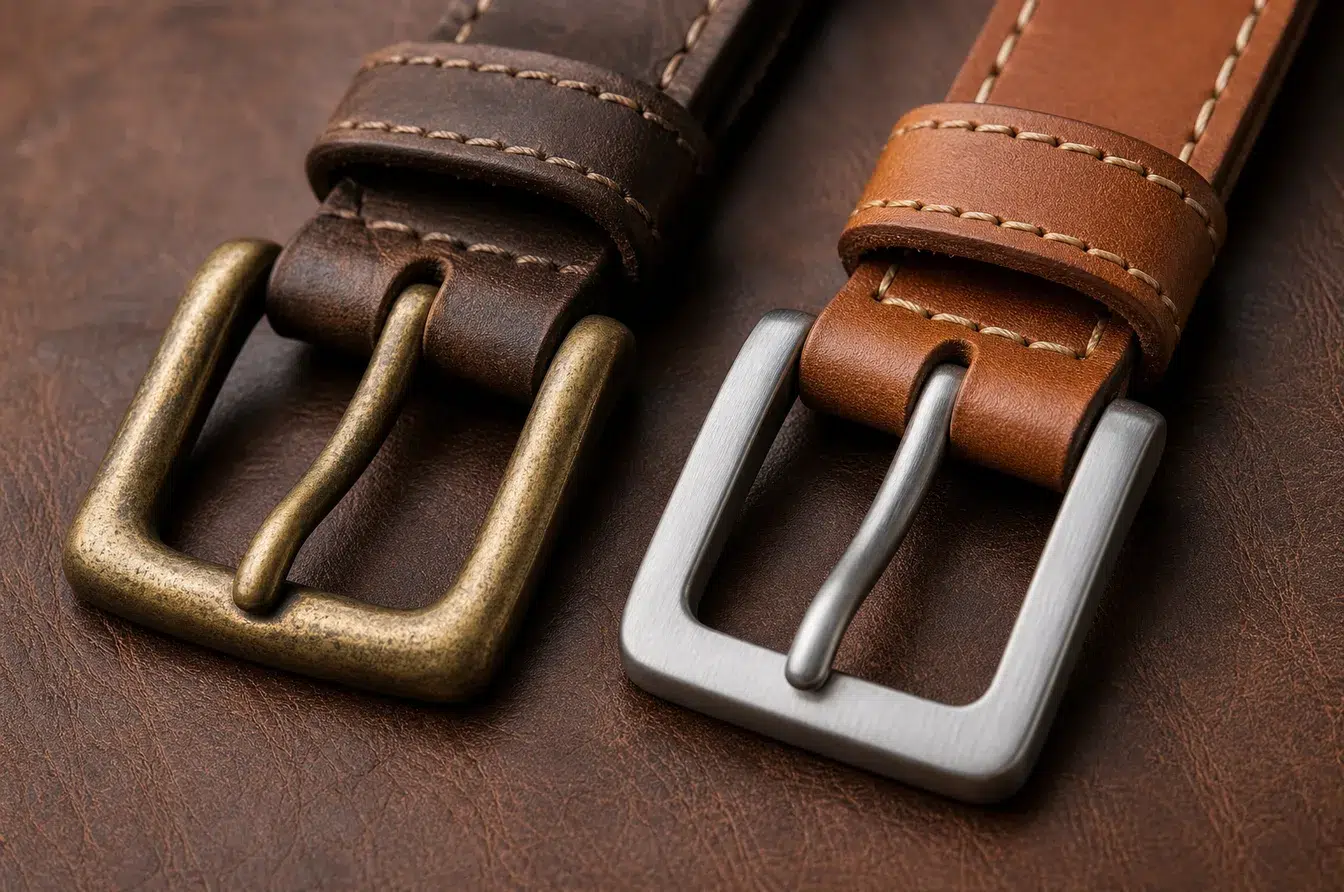
When I evaluate hardware for a leather product, I never treat it as a simple accessory. A buckle, swivel snap, Chicago screw, D-ring, or bag lock is part skeleton and part jewelry. It must hold force, survive friction, accept finishing, and still feel right in the hand. This is why high-end leather workers often pay more for solid brass. They are not only buying a yellow metal. They are buying density, toughness, surface depth, and a material that can age together with leather.
Why Does Solid Brass Still Feel More Luxurious Than Stainless Steel?
Designers often compare metals by price first, but the hand feel tells a deeper story.
Solid brass feels premium because it combines weight, warmth, machinability, and visual depth. Stainless steel feels cleaner and harder, but it does not carry the same craft signal in most leather goods.
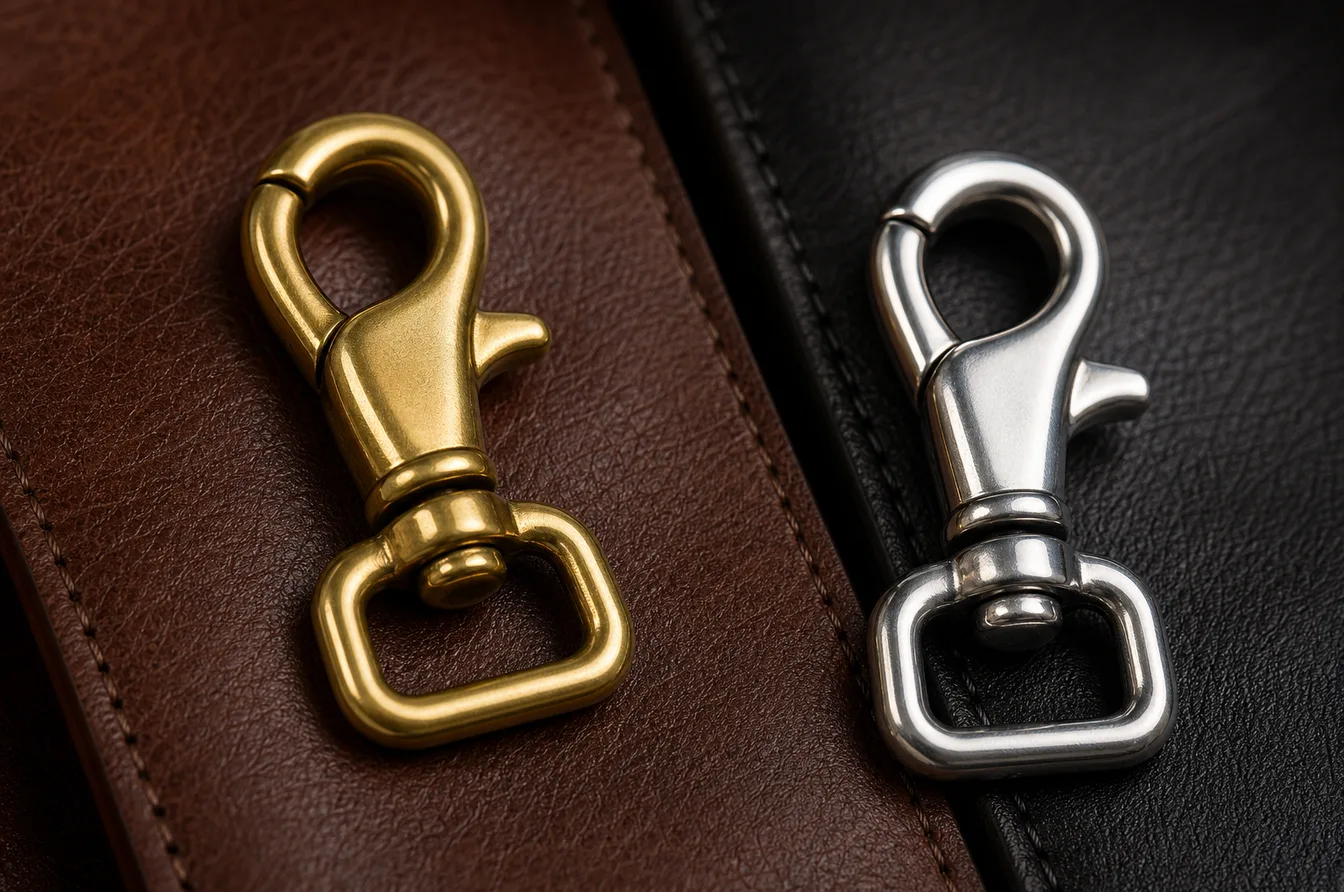
Weight, Warmth, and the First Touch
Solid brass is an alloy of copper and zinc. In practical hardware development, this matters because copper gives the metal warmth, density, and good formability, while zinc helps tune strength and hardness. A belt buckle or snap hook made from solid brass usually feels substantial without feeling cold or clinical. When the surface is polished, brushed, antiqued, or plated, the base metal still supports a rich finish.
Stainless steel gives a different message. It is crisp, hard, and clean. It works well when the product needs a technical or industrial personality. But for classic leather belts, handbags, pet leashes, and equestrian-inspired accessories, the sensory match between vegetable-tanned leather and solid brass is hard to replace.
| Design Factor | Solid Brass | Stainless Steel |
|---|---|---|
| First touch | Warm and dense | Cool and hard |
| Luxury signal | Traditional craft and weight | Technical precision |
| Aging behavior | Develops patina | Stays visually stable |
| Finish flexibility | Strong for antique, brushed, plated, and polished looks | More limited in color variety |
Hardware as Skeleton and Jewelry
The best leather hardware must do two jobs at once. It must act as a skeleton by taking load, tension, twisting, and repeated opening. It must also act as jewelry because it sits on the surface and defines the product’s value perception. I see this clearly on leather bags. If the lock, ring, and strap adjuster feel light or hollow, the leather immediately feels less premium, even if the hide is excellent.
This is the reason I separate solid brass from brass-plated parts. Solid brass keeps its identity through wear. Brass plating only gives a surface impression. Once the thin coating is scratched, the lower-value core begins to show. The product then loses trust at the exact place the user touches most.
What Does Alloy Composition Really Change?
A metal name is never enough. The alloy system decides how the part bends, wears, cracks, and finishes.
Brass balances hardness and ductility through copper-zinc ratio, while stainless steel relies on iron, carbon, chromium, and other elements for corrosion resistance and high structural strength.
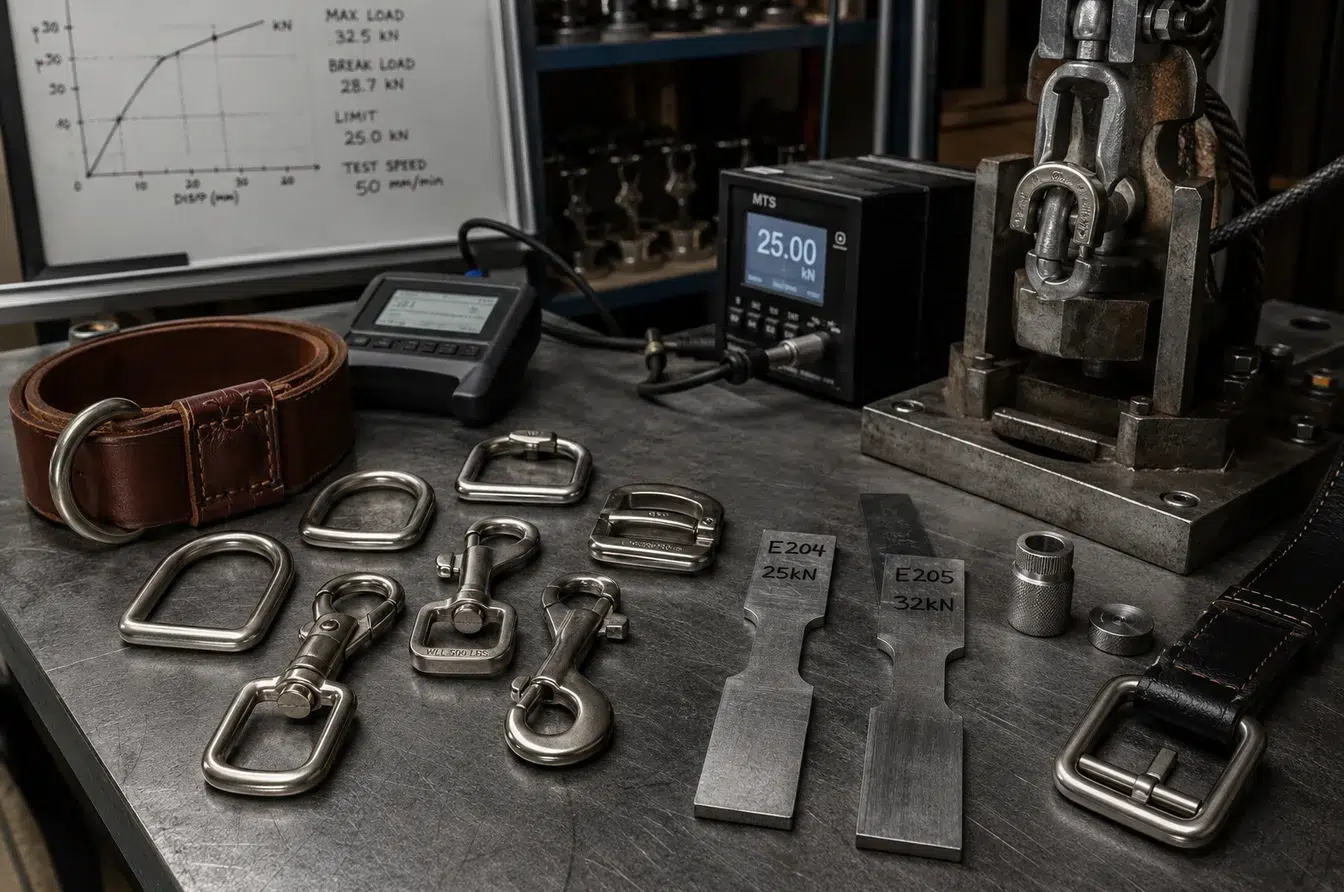
The Flexible Strength of Brass
In leather hardware, solid brass is useful because it is strong without being brittle. The exact copper and zinc balance changes hardness, ductility, color, and machining behavior. More copper usually supports a warmer tone and better ductility. More zinc can increase hardness and change the working feel. For small hardware, this balance is important because the part often sees shock rather than only static load.
Think about a swivel snap on a dog leash, a trigger hook on a handbag strap, or a buckle tongue under belt tension. These parts do not only sit still. They rotate, hit other metal, and take sudden pulls. A well-made brass part can absorb this movement with a degree of toughness. That is why I prefer solid brass over low-cost zinc alloy for many premium leather applications. Zinc alloy can cast clean shapes, but it can also feel lighter and fail more suddenly under abuse.
| Property | Solid Brass | Common Zinc Alloy | Practical Meaning |
|---|---|---|---|
| Toughness | Good balance of strength and ductility | Often lower in impact resistance | Brass is safer for repeated pulling |
| Repair feel | Can be polished and refinished | Often surface-dependent | Brass supports longer product life |
| Weight | Dense and premium | Usually lighter | Weight helps perceived value |
| Failure risk | More likely to deform before breaking | Can crack or snap under shock | Brass gives warning through deformation |
The Cold Fortress of Stainless Steel
Stainless steel is built around a different logic. Chromium helps form a thin passive oxide layer on the surface. This film is the reason stainless steel performs so well in marine, medical, food, and chemical environments. When the design problem is corrosion, hygiene, or harsh exposure, stainless steel becomes very difficult to beat.
Its iron-carbon base and alloying system also give it high structural strength. For heavy mechanical parts, tools, and industrial equipment, this is a major advantage. But leather goods rarely ask the metal to reach the physical limit of stainless steel. In most belts, bags, collars, and small leather accessories, the decision is more balanced. The user feels the finish, aging, color, and brand language before they ever tests the ultimate strength of the metal.
How Does Production Shape the Final Hardware Feel?
The same alloy can feel cheap or refined depending on casting, polishing, plating, and inspection.
Traditional casting and careful finishing give solid brass its tactile depth, while stainless steel often stays within a narrower visual language because it resists color transformation.
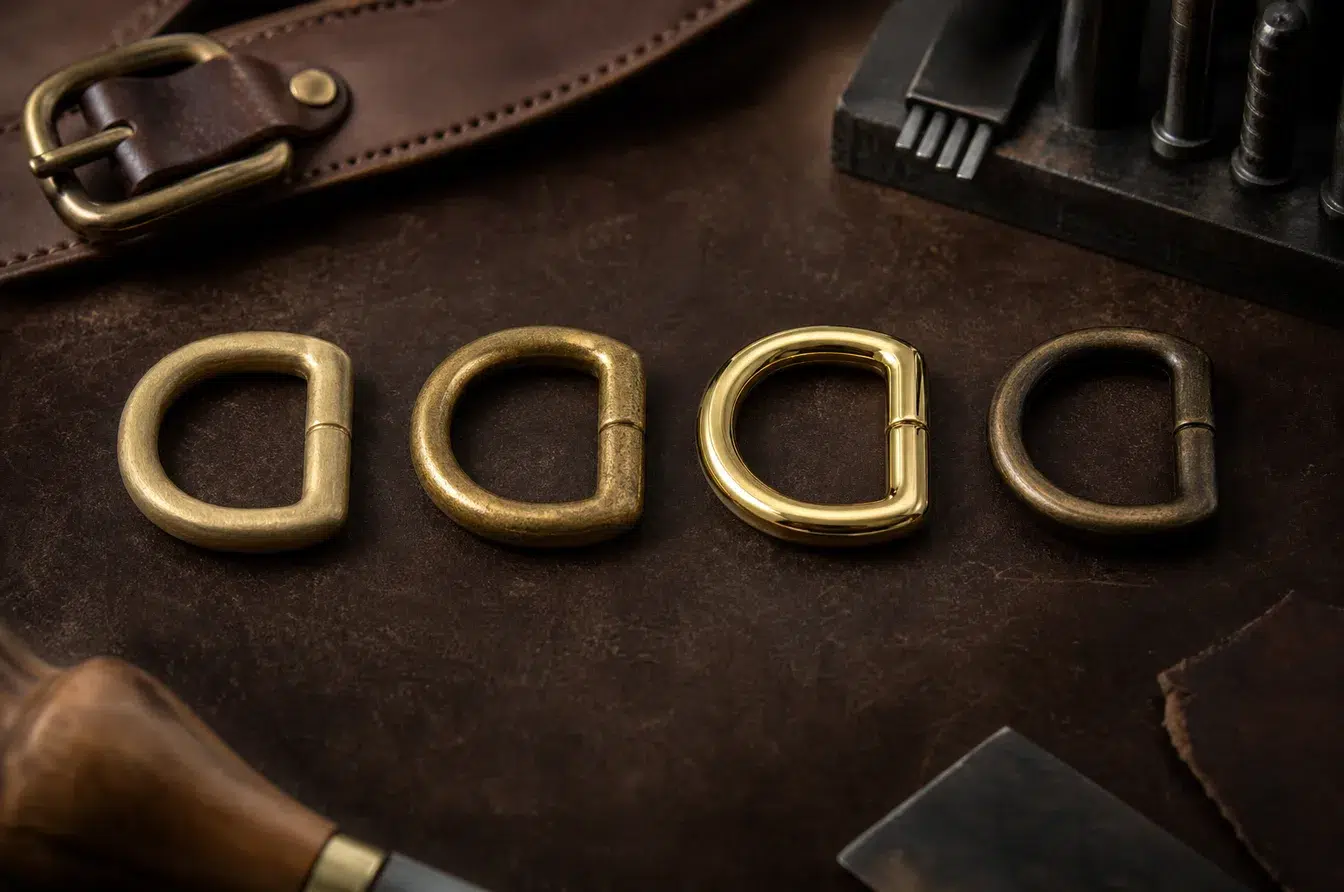
From Sand Casting to Solid Hardware
For many classic leather hardware forms, sand casting remains attractive because it creates substantial parts with a handmade depth. Suppliers known in the leather craft market have helped popularize this language of solid brass hardware: buckles, D-rings, swivel snaps, trigger snaps, Chicago screws, strap loops, and bag locks with real weight and visible craft character. The surface may later be polished or plated, but the underlying part still feels solid.
Sand casting is not only a romantic story. It affects how designers read the part. A cast brass buckle can have a slight softness at the edges. It may feel less cold and more architectural than a stamped light-gauge part. When the tooling, casting, tumbling, polishing, and plating are controlled well, this process supports hardware that feels expensive before any logo is added.
| Process Stage | Design Impact | Quality Risk to Control |
|---|---|---|
| Casting | Creates mass and three-dimensional form | Porosity, shrink marks, rough edges |
| Tumbling | Softens edges and improves touch | Over-rounding fine details |
| Polishing | Builds shine and surface clarity | Uneven reflection or wave marks |
| Finishing | Adds antique, natural, nickel, silver, or matte tone | Color mismatch between batches |
Why Brass Accepts More Fashion Languages
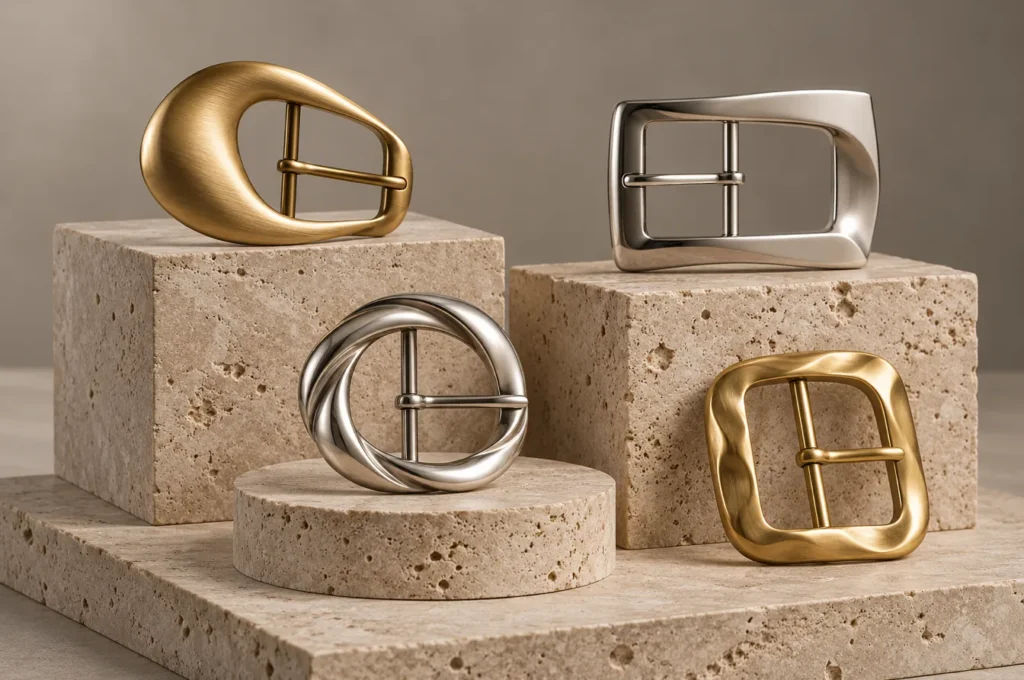
One reason I like solid brass for leather development is its finishing range. Natural brass can stay golden and honest. Antique brass can sit beautifully with brown, black, olive, and burgundy leather. Brushed brass gives a modern architectural tone. Bright nickel, silver, gunmetal, and other plated looks can also be built on a brass base with strong visual depth.
Stainless steel is excellent when the design wants a clean silver-gray tone. It can be brushed, polished, or bead-blasted. But its identity remains more fixed. It is harder to make stainless steel feel antique, warm, or emotionally aged without moving away from the natural logic of the material. For fashion hardware, that narrower range can limit storytelling.
How Can I Spot Brass Plating Before It Becomes a Failure?
The most expensive hardware problem is not always breakage. Sometimes it is a surface that betrays the brand.
Brass plating can look convincing when new, but scratches, edge wear, rust, and light weight often reveal a cheaper zinc alloy or steel core underneath.
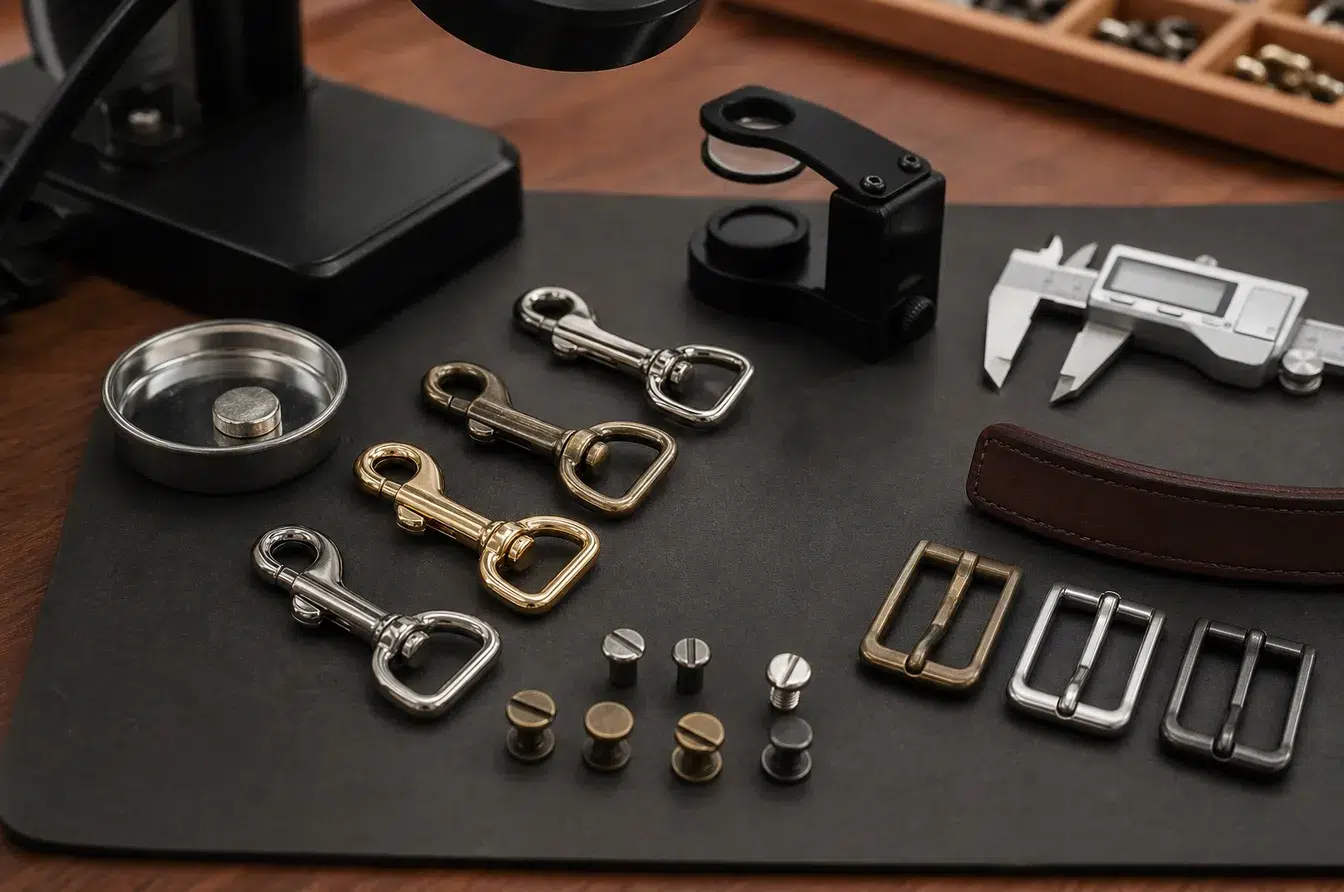
The Truth Behind Brass-Plated Hardware
Brass-plated hardware is not automatically wrong. It can work for low-cost fashion, short product cycles, or decorative parts with little load. The problem begins when it is sold or selected as if it were solid brass. A thin brass-colored layer cannot provide the same long-term behavior as a solid brass body.
The core is often zinc alloy, steel, or another lower-cost metal. If the part is a buckle frame, a swivel hook, or a screw that receives regular friction, the plating will wear first at corners, contact points, and moving joints. Once the layer breaks, the product may show gray metal, dull patches, or red-brown rust if the core is steel. On a premium leather product, that visual failure is serious because the user reads it as poor quality.
| Test Method | What I Look For | Practical Warning |
|---|---|---|
| Magnet test | Strong attraction may suggest steel core | Not proof alone, but useful |
| Scratch test | Yellow metal throughout or different core color | Use on hidden area only |
| Weight test | Solid brass feels denser | Compare same-size parts |
| Edge wear check | Corners reveal base metal first | Inspect moving contact points |
Factory-Level Inspection Habits
When I review a sample set, I do not only look at the front face. I check the inner corners, screw threads, spring gates, pin holes, and hinge areas. These locations expose the truth faster than a polished surface. For a snap hook, I open and close the gate many times and inspect the rubbing line. For a belt buckle, I check the tongue contact point. For Chicago screws, I look at the thread finish and the slot edge because tools can scratch plating during assembly.
If a supplier says the part is solid brass, I also ask for material confirmation and keep a control sample. In production, one approved sample is never enough. Batch-to-batch color, plating thickness, and base material substitution can change the result. A simple incoming inspection checklist prevents many after-sales problems.
When Should I Choose Brass or Stainless Steel?
The right material is not the strongest one on paper. It is the one that fits the product’s life.
Choose solid brass for premium leather goods, emotional aging, and rich finishing. Choose stainless steel for salt, chemicals, hygiene, and very high corrosion demands.
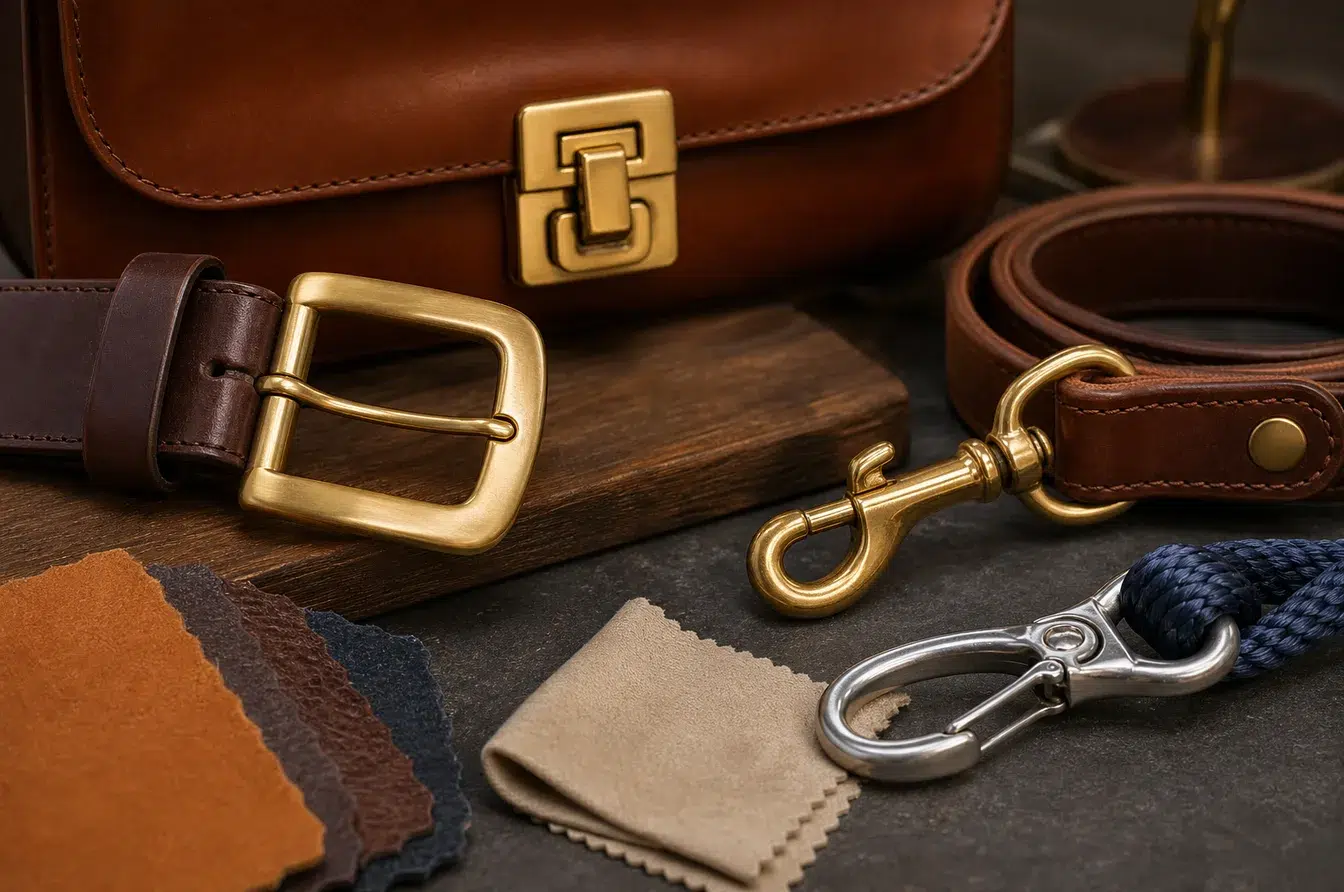
Solid Brass in Its Natural Home
Solid brass is my first choice for many high-end leather goods: belt buckles, handbag locks, D-rings, strap adjusters, pet leash swivel hooks, collar buckles, key holders, and decorative screw systems. These parts need strength, but they also need a luxury signal. Brass gives that signal through mass, warmth, finish, and aging.
The aging point is important. Leather changes with the user. It darkens, softens, creases, and becomes personal. Solid brass can join that story through patina. Natural brass may deepen, dull, or develop subtle oxidation marks. Some users polish it back to brightness. Others let it record time. I think this is one of the strongest arguments for brass in luxury design. It behaves like a living companion to leather.
| Product Part | Recommended Material | Reason |
|---|---|---|
| Belt buckle | Solid brass | Premium weight, patina, strong finish options |
| Handbag lock | Solid brass | Touch point with high perceived value |
| Pet leash swivel hook | Solid brass or stainless steel | Brass for luxury, stainless for coastal use |
| Chicago screw | Solid brass | Good repairability and visual consistency |
| Slide adjuster | Solid brass | Stable appearance on straps |
Stainless Steel in Its Real Battlefield
Stainless steel earns its place when the environment is severe. If the product will be used near salt water, in wet outdoor conditions, in chemical exposure, or in hygiene-sensitive settings, stainless steel can be the correct choice. It is also logical for hardware that must look unchanged for a long time. Some brands want no patina, no darkening, and no visible aging. For that promise, stainless steel is more honest.
I also use stainless steel when the design language is technical. Black nylon, performance leather, marine gear, medical straps, and industrial carry systems can all benefit from the colder and more precise character of stainless steel. The key is to choose it because it fits the brief, not because it sounds stronger in a simple comparison table.
| Scenario | Better Choice | Why |
|---|---|---|
| Classic luxury leather belt | Solid brass | Warmth, density, and aging |
| Coastal dog leash | Stainless steel | Salt resistance |
| Heritage handbag | Solid brass | Antique finishing and patina |
| Medical or sanitary strap | Stainless steel | Hygiene and corrosion performance |
| Fashion color range | Solid brass | Broader finishing language |
Cost, ROI, and Product Trust
Solid brass usually costs more than zinc alloy and often costs more than basic plated options. But I do not judge it only by unit price. I look at the return on investment across the product’s life. Better hardware can justify a higher retail price, reduce complaints about fading or breakage, and support the brand’s promise of longevity.
For premium brands, the hardware is one of the easiest parts for customers to touch and judge. A bag lock that clicks cleanly, a buckle that feels heavy, or a snap hook that rotates smoothly can make the whole product feel more valuable. If the hardware fails, the leather may still be good, but the product becomes unusable. That is why hardware quality often protects the value of the leather itself.
| Decision Area | Low-Cost Hardware Risk | Solid Brass Advantage |
|---|---|---|
| Retail perception | Can feel light or temporary | Feels substantial and premium |
| After-sales | Higher risk of plating wear | Better long-term surface honesty |
| Repair | Often not worth repairing | Can be polished, replaced, or refinished |
| Brand story | Short-cycle fashion signal | Long-life craft signal |
Sustainability is not only about leather sourcing or recycled packaging. It is also about whether a product stays useful. A leather bag should not be discarded because a lock peeled, a hook cracked, or a screw rusted. Better hardware reduces replacement frequency and supports repair culture.
This is where the brass versus stainless steel debate becomes more than a technical choice. Solid brass represents a material that can age and be maintained. Stainless steel represents a material that resists environmental attack and stays stable. Both can support responsible design when used correctly. The weak choice is not brass or stainless steel. The weak choice is hardware selected only by the lowest quote, without thinking about load, finish, touch, repair, and the user’s real environment.
Conclusion
Solid brass breathes with leather; stainless steel stands like a fortress. Lasting design begins when I choose the metal for the life it must live.