- Loading...
Beautiful hardware fails quickly when the surface is only decorative, so I look at PVD as both color and engineering.
PVD plating uses high vacuum, controlled heat, and metal vapor to create thin, hard coatings that improve color, wear resistance, and corrosion performance on modern hardware.
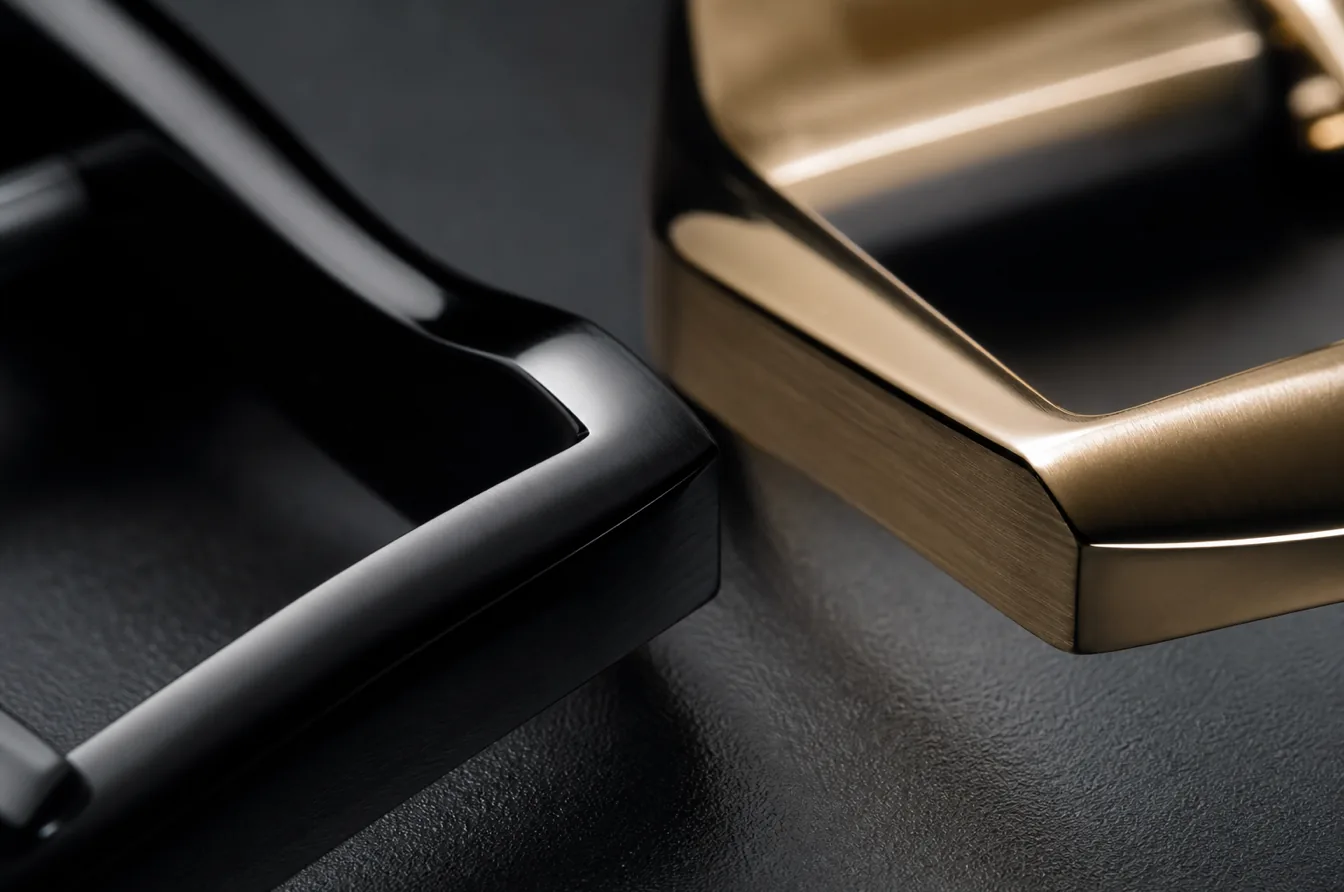
In fashion hardware, the surface is often the first thing a customer touches and the first thing that shows wear. A buckle, watch case, zipper pull, bag lock, or golf club detail may be small, but its finish carries the promise of quality. This is why PVD, or physical vapor deposition, has become a serious option for high-end metal parts. It works in a high-vacuum chamber, usually at controlled medium to high temperatures around 150 to 500 C, and it builds the coating by moving atoms instead of dipping parts into a chemical bath. For designers and sourcing teams, that difference matters. It changes the way we judge color, hardness, adhesion, environmental impact, and long-term value.
How does PVD turn metal vapor into a hard coating?
PVD can look mysterious from outside the chamber, but the basic logic is clear when we follow the atoms.
PVD forms a coating by vaporizing metal, ionizing particles, and attracting them to a negatively biased workpiece, where they condense into a controlled film.
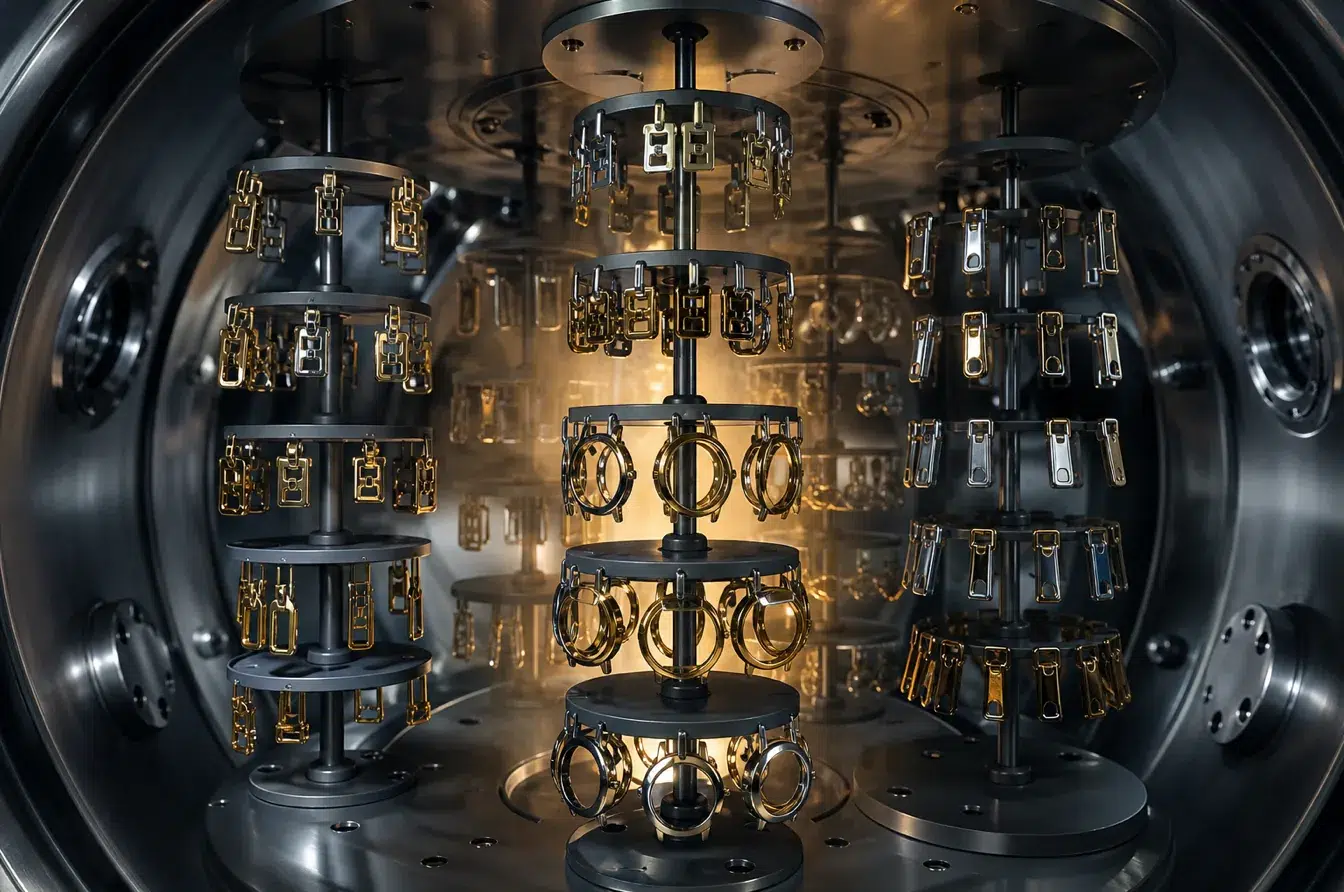
The atom-level deposition process
When I explain PVD to a designer, I usually start with the vacuum chamber. The part is cleaned, loaded onto a fixture, and placed under high vacuum. This vacuum is not just for cleanliness. It reduces unwanted gas and gives the vaporized particles a clearer path to the hardware surface. Then a target material such as titanium, zirconium, chromium, or other coating metal is vaporized by arc evaporation, sputtering, or another PVD method. The vapor contains energetic particles, and many of them become positively charged ions.
The workpiece is given a negative bias voltage. Because positive ions are attracted to negative surfaces, the ionized metal vapor moves toward the part with force. This attraction improves film density and helps the coating bond tightly to the substrate. At the surface, atoms land, move into stable positions, and build a thin layer one atomic step at a time. The coating may only be a few microns thick, but it can be much harder than the base metal. This is why a PVD finish can change both the color and the working life of hardware without making the part bulky or changing the design dimensions too much.
| Process point | What it controls | Why designers should care |
|---|---|---|
| High vacuum | Clean path for vapor | Fewer surface defects |
| Negative bias | Ion attraction | Better film density and adhesion |
| Controlled heat | Surface mobility | Stable coating and color |
| Target material | Coating chemistry | Hardness and final tone |
Why rotation matters for complex hardware
Many hardware parts are not flat. A watch case has undercuts, a belt buckle has curved corners, and a bag lock may include grooves, holes, and raised logo areas. If these parts sit still in a chamber, some areas receive more vapor than others, and the finish can become uneven. This is why multi-axis rotation is an important part of PVD production. Parts rotate around the fixture, and the fixture may also rotate around the chamber. This synchronized movement exposes different faces of the part to the coating source.
In factory review, I pay close attention to edges, recessed areas, and hidden corners. These are the places where poor fixture design shows itself. A beautiful front face is not enough if the side wall looks thin or the inner radius has a different color. Multi-axis rotation helps reduce that risk, but it still needs good loading density, correct part spacing, and stable chamber parameters. For luxury hardware, I prefer to discuss these details before mass production because once the tool, fixture, and color standard are locked, any weakness will repeat across the order.
Why is PVD different from traditional electroplating?
Traditional electroplating still has value, but PVD changes the discussion from simple surface decoration to engineered surface performance.
Compared with conventional electroplating, PVD usually offers stronger wear resistance, high hardness, better adhesion, and a cleaner process with no toxic wastewater from plating baths.
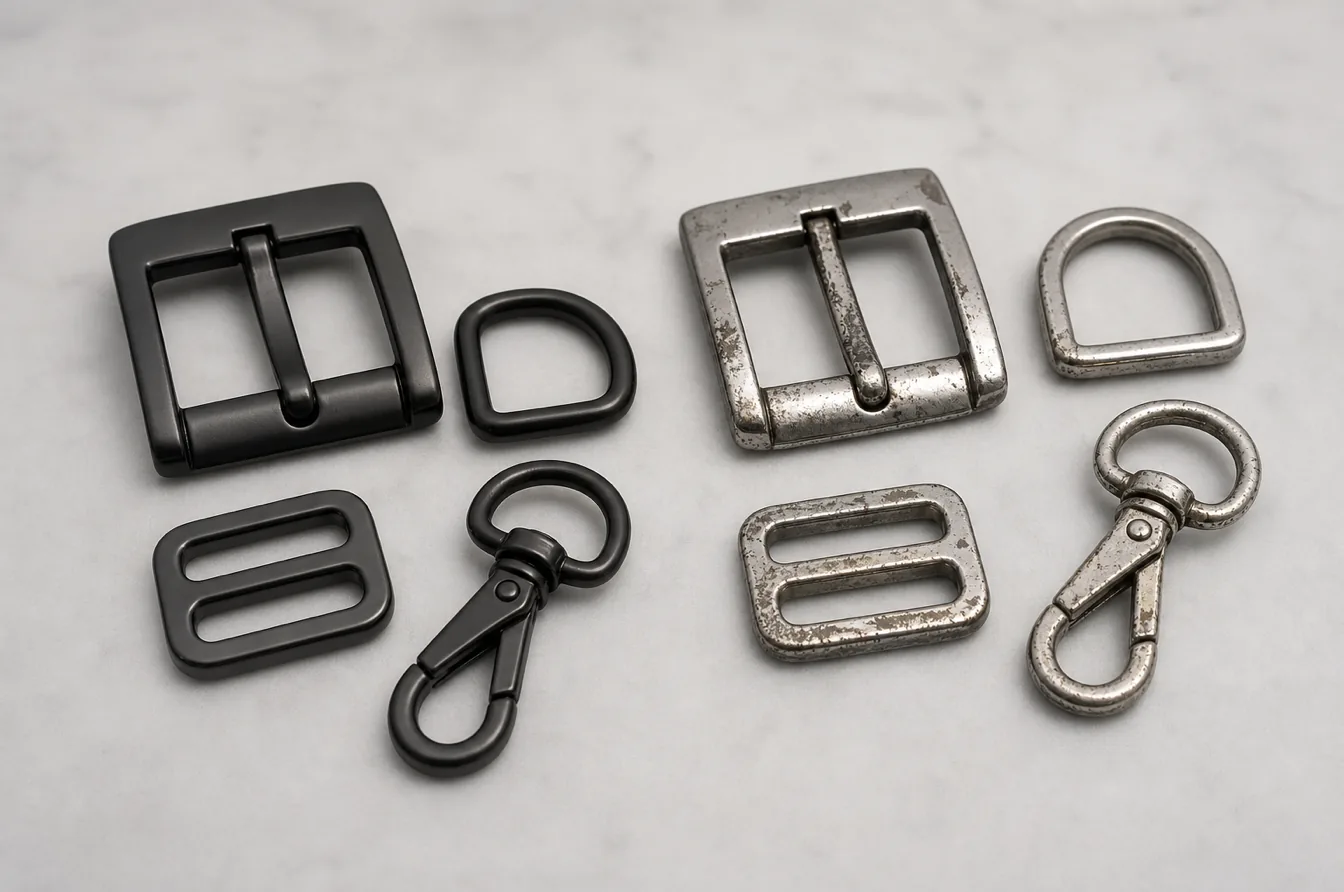
Durability, hardness, and corrosion life
The biggest practical difference is wear behavior. A traditional electroplated layer can give attractive color and brightness, but it often depends heavily on the quality of chemical pretreatment, layer sequence, and top protection. In daily use, keys, rings, leather edges, fingernails, dust, and sweat all test the surface. PVD coatings are widely chosen because their ceramic-like compounds can reach much higher hardness than many decorative plated surfaces. Titanium nitride, chromium nitride, zirconium nitride, and carbon-based coatings are common examples.
This does not mean PVD is indestructible. I still treat it as a finish with limits. Sharp impact, poor base polishing, weak cleaning, or wrong substrate selection can reduce performance. But when the process is controlled well, PVD gives a stronger answer to scratching and corrosion than many conventional decorative finishes. In salt spray discussions, I also separate the coating from the full system. A stainless steel substrate with suitable PVD may behave differently from solid brass with another pretreatment route. The final result depends on base metal, surface preparation, layer structure, and sealing strategy.
| Finish route | Typical strength | Typical risk | Best use case |
|---|---|---|---|
| Traditional electroplating | Broad colors and lower cost | Wastewater, peel risk, wear variation | Standard fashion hardware |
| PVD on stainless steel | Strong wear and corrosion performance | Higher cost and color control demands | Watches, buckles, premium accessories |
| PVD on solid brass | Warm base tone and luxury feel | Needs careful pretreatment | Leather goods and decorative hardware |
| Hybrid systems | Balanced look and protection | More process control needed | High-value branded parts |
Adhesion and environmental value
Adhesion is where PVD often earns trust. In a good PVD process, the coating is not simply sitting on top like a fragile decorative skin. Energetic ions strike the surface and form a very tight interface. The film grows with high density, and in many systems the bond has a molecular-level character. This is one reason PVD layers are less likely to peel when the substrate is clean, stable, and correctly prepared.
The environmental discussion is also important. Traditional electroplating uses chemical baths and can create wastewater that needs strict treatment. PVD is a dry vacuum process, so it does not produce the same kind of toxic plating wastewater. It still uses energy, targets, gases, and cleaning steps, so I do not describe it as impact-free. But compared with wet plating, it gives brands a stronger story for cleaner manufacturing and process control. For European brands and sourcing teams, this is not only a marketing point. It can reduce compliance pressure, improve supplier confidence, and support longer product life, which is often the most honest form of sustainability.
How do chemistry and base metal shape the final color?
PVD color is not paint, so I always judge it as a relationship between chemistry, surface texture, and base material.
Different borides, silicides, carbides, and nitrides allow PVD to create gold, black, blue, red, and other controlled tones with specific hardness and visual depth.
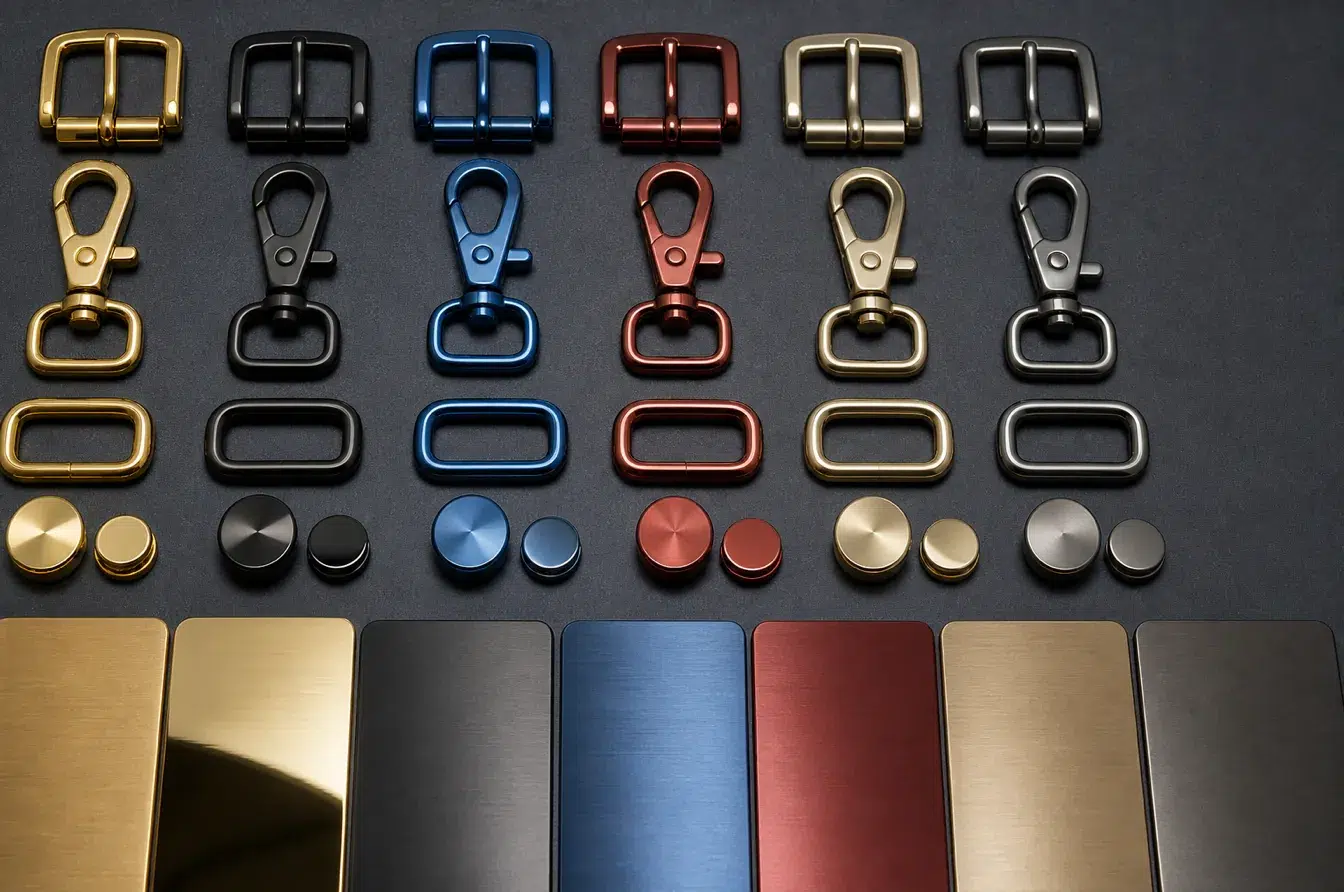
The coating recipe behind color and hardness
PVD color comes from the coating compound and its optical behavior. Metal targets combine with reactive gases or process conditions to form nitrides, carbides, oxides, borides, or other compounds. By changing the ratio and process window, factories can shift color and performance. Titanium nitride is known for gold tones. Chromium nitride can produce silver-gray and dark shades. Carbon-based systems can create deep black. Other recipes can move toward blue, red, bronze, champagne, rose gold, or smoky gunmetal.
For designers, this is useful but also risky. A PVD color is not a free-form paint color. It has a process logic. If a brand asks for a special red or blue, I first check whether the color target is realistic for the coating system and whether the required hardness still fits the product use. Strong artistic colors may need more testing because small changes in thickness, substrate, polishing, and viewing angle can change the final appearance. I like PVD blue when it has a clean metallic glow, because it gives hardware a modern technical feel. PVD red can be powerful, but it needs careful control so it looks premium instead of decorative in a cheap way.
| Compound family | Common design value | Possible visual direction |
|---|---|---|
| Nitrides | High hardness and stable tones | Gold, gray, black, champagne |
| Carbides | Wear resistance and dark depth | Black, graphite, smoky metal |
| Borides | Hardness and special surface behavior | Dark technical tones |
| Silicides | Heat and oxidation stability | Subtle metallic effects |
Brass, stainless steel, and surface texture
The same PVD coating can look different on solid brass and stainless steel. Solid brass brings warmth and a premium weight that works very well for leather goods, belt buckles, and decorative closures. When the surface is polished correctly, PVD on brass can look rich and deep, especially in gold, rose gold, bronze, and black. But brass also needs careful pretreatment because the base metal can influence corrosion performance and adhesion if cleaning, barrier layers, or surface preparation are weak.
Stainless steel feels cooler and more technical. It is strong for watches, wearable hardware, golf components, and parts that face sweat or outdoor exposure. A mirror-polished stainless steel base under PVD can create a very sharp luxury reflection. A brushed base gives linear texture and a more industrial feeling. A matte base absorbs light and makes black or gunmetal finishes look calm and precise. I always ask for approval samples in the final texture, not only in the final color, because brushing direction, polishing level, and micro roughness can change the reading of the PVD surface more than many people expect.
Where does PVD create the most market value?
PVD costs more, so I use it where the surface must protect brand value, not only decorate the part.
PVD adds the most value in premium hardware where touch, friction, sweat, and long-term appearance directly affect the customer’s quality judgment.
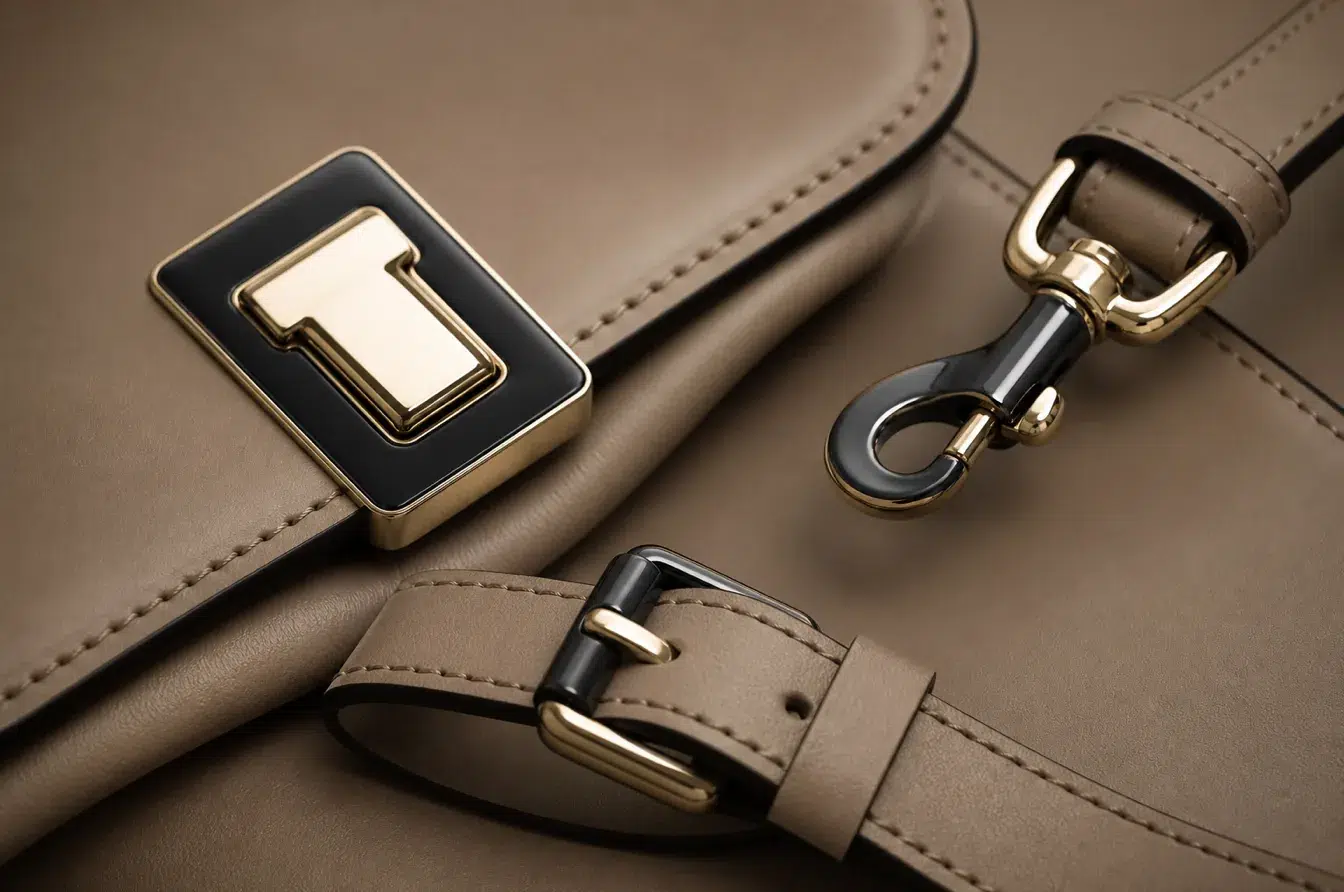
High-end applications that need surface confidence
In high-end watches, customers look at the case, crown, clasp, and bracelet under close light. Any weak coating quickly damages trust. PVD is attractive here because it can offer deep black, hard gold, gunmetal, and technical gray finishes with strong wear resistance. In luxury leather goods, locks, snap hooks, zipper pulls, and buckles are touched again and again. The finish must survive friction from hands, clothing, leather edges, and storage conditions. PVD helps a brand keep the product looking new for longer.
Golf hardware is another interesting area. A golf club or accessory detail needs corrosion resistance, scratch performance, and a technical premium look. PVD can support that feeling without relying only on bright chrome. In fashion accessories, I also see PVD used when brands want a signature color that is harder to copy through basic plating. A stable black, champagne, or blue finish can become part of brand language. But I would not recommend PVD only because it sounds high-end. The application must justify the process.
| Product category | Surface stress | PVD value |
|---|---|---|
| High-end watches | Sweat, abrasion, close inspection | Hard color and premium consistency |
| Leather goods hardware | Hand touch and friction | Longer lasting visual quality |
| Golf components | Outdoor use and impact contact | Corrosion resistance and technical appearance |
| Luxury accessories | Brand differentiation | Special colors and stronger finish story |
Cost, sampling, and long-term value
PVD has a higher process cost because it needs vacuum equipment, precise chamber control, special targets, fixture planning, and more careful sampling. The cost is not only the coating fee. It also includes the time needed to match color, test adhesion, confirm wear, and control batch consistency. For small accessories with low retail value, this may be hard to justify. For premium products, it can be a good investment because the finish helps protect the perceived value of the whole item.
My practical approach is to calculate finish cost against product life and return risk. If a cheaper finish saves a small amount per piece but causes visible scratching, customer complaints, or replacement costs, the saving is false. PVD can extend the period during which the product still looks like the brand intended. That matters for products with long use cycles, high margins, or strong visual identity. I also recommend checking supplier stability. A good PVD partner should be able to discuss chamber size, fixture design, color tolerance, adhesion testing, salt spray expectations, and maintenance of repeatable quality.
How should designers maintain and specify PVD hardware?
Even strong coatings need correct care, and good specification starts before the product reaches the customer.
PVD hardware should be specified with clear substrate, texture, color, test, and care requirements, then maintained with gentle cleaning and low-abrasion handling.
Cleaning and care for long-term gloss
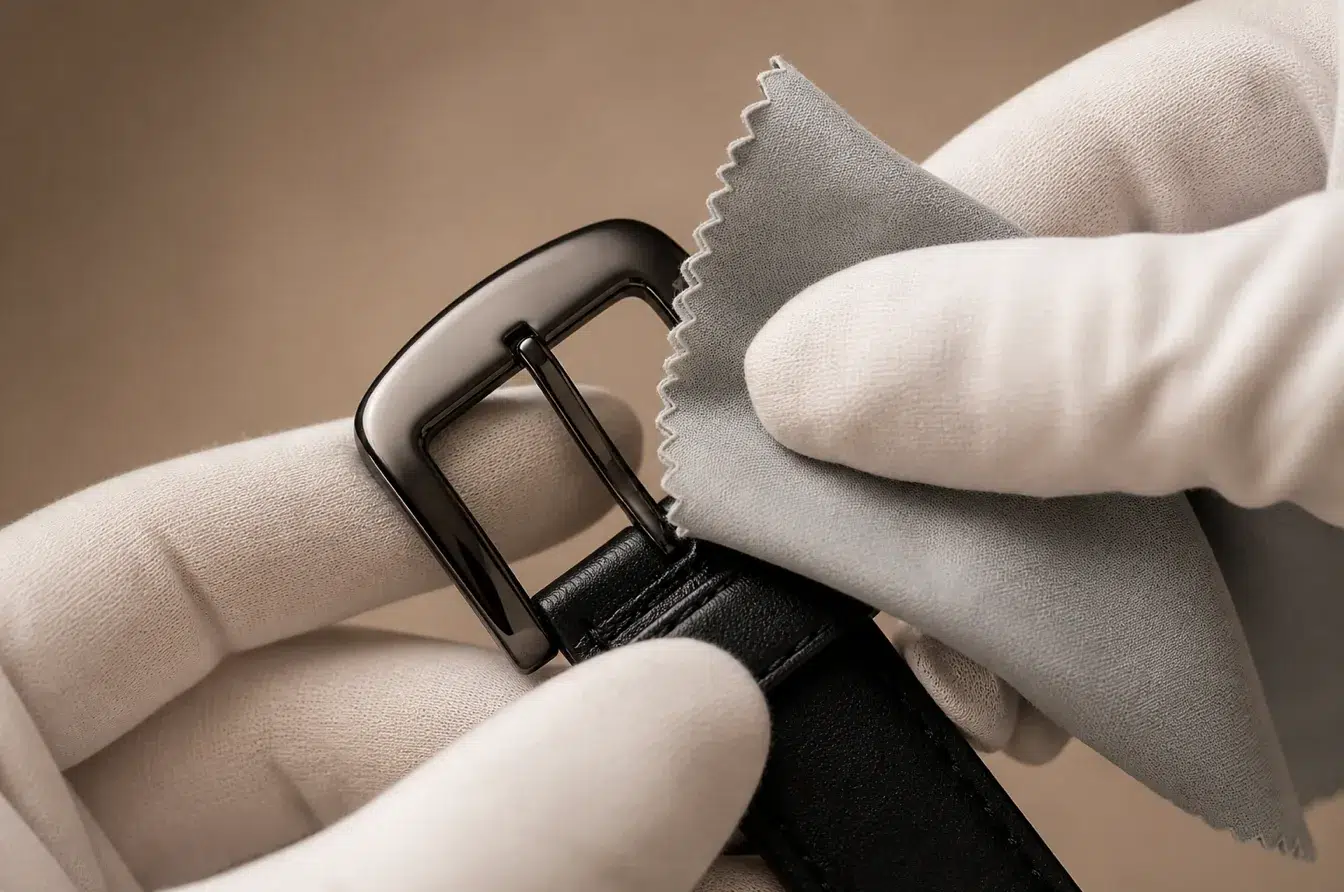
PVD is durable, but I do not treat it like a surface that needs no care. For consumers and after-sales teams, the cleaning rule is simple: use a soft cloth, mild soap if needed, and clean water. Dry the part after cleaning, especially when it has corners or joints where moisture can stay. Avoid abrasive pads, polishing compounds, strong acid cleaners, strong alkaline cleaners, and unknown chemical wipes. These may not destroy the PVD layer immediately, but they can mark the surface, attack nearby materials, or weaken the total finish system.
Storage also matters. Hardware on bags, belts, watch straps, or accessories can rub against other metal parts during shipping or display. I like to specify protective wrapping for high-polish PVD parts because mirror surfaces show micro scratches more easily than brushed or matte surfaces. For dark PVD, fingerprints and oil marks may be more visible, so brands should prepare realistic cleaning guidance. Good care does not need to be complicated. It only needs to protect the coating from unnecessary abrasion and chemical exposure.
| Care action | Recommended approach | Avoid |
|---|---|---|
| Daily cleaning | Soft dry microfiber cloth | Rough fabric or abrasive pads |
| Deeper cleaning | Mild soap and water | Strong acid or alkaline cleaners |
| Storage | Separate from hard metal contact | Loose rubbing in bulk packaging |
| Display handling | Gloves for mirror finishes | Fingerprints left for long periods |
Specification points for future applications
PVD will keep expanding into consumer electronics, smart wearables, and technical fashion hardware because these products need thin, hard, attractive surfaces. Smart rings, watch frames, phone buttons, wearable clasps, and sensor-friendly accessories all ask for finishes that are beautiful but also stable in daily contact with skin, sweat, and movement. This is where PVD has a strong future. It offers color, hardness, and cleaner manufacturing logic in one process family.
For design teams, the important step is to specify PVD in a way that a supplier can actually produce. I include the base material, surface texture, target color sample, gloss level, acceptable color tolerance, adhesion test, abrasion test, corrosion test, and packaging method. If the part is brass, I ask how the supplier prepares the surface and controls corrosion risk. If the part is stainless steel, I check whether the polishing or brushing standard is locked before coating. PVD is a beautiful technology, but it rewards discipline. When the specification is clear, it can turn hardware from a small functional detail into a durable design signature.
Conclusion
PVD is where modern hardware finish becomes engineering, design language, and responsible manufacturing in the same surface.