- Loading...
A garment can look finished, but one weak button can make the whole product feel cheap. I have seen this small detail change buyer trust fast.
Apparel buttons matter because they affect garment style, structure, comfort, durability, and brand value. A good button supports the fabric, matches the market position, and survives real production, washing, and daily wear.
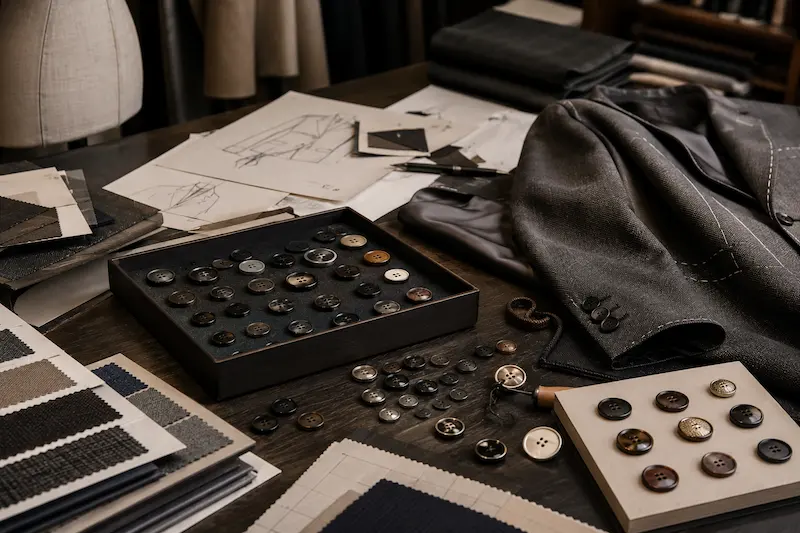
I used to think buttons were only small accessories. Then I started working closer to product teams, sample rooms, and factories. I saw one clear truth. A button is not only a decoration. It is also a small engineering part. It sits at the place where fabric, movement, touch, and brand image meet. When the button is right, the garment feels complete. When the button is wrong, the customer may not explain the problem, but they can feel it. This is why I now look at buttons through three lenses: design, material, and production reliability.
How Can a Small Button Define the Quality of a Garment?
A button is small, but it is often one of the first details a buyer touches1. That touch can confirm quality or raise doubt.
A button defines garment quality through weight, surface feel, color match, sewing stability, and fit with the fabric. It works like a small quality signal that buyers notice even before they study the full garment.
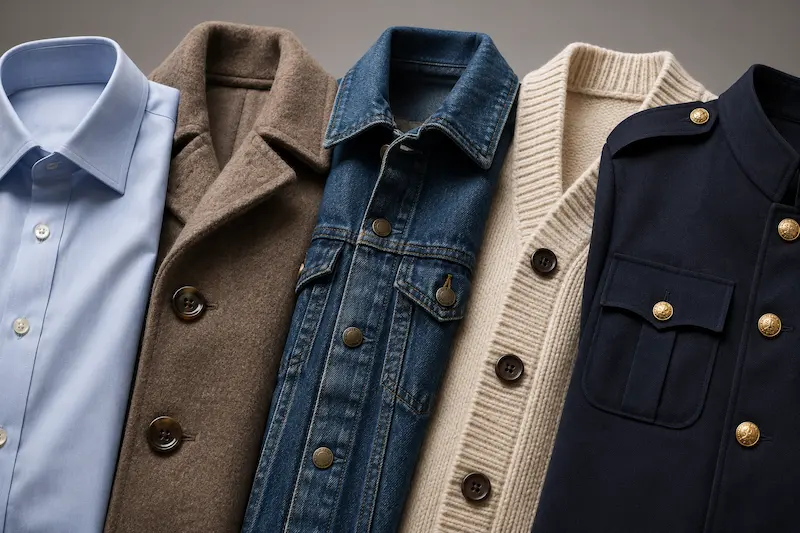
I often see brands spend time on fabric, cutting, and labels, but they make the button decision too late2. This creates risk. The button may look good on a flat sample card, but it may not work on the final garment. A shirt button, a coat button, and a denim button do not carry the same job. A light shirt button should feel clean and easy. A coat button should give enough space for thick fabric3. A denim button should hold strong under stress4. I also see buttons work as visual centers. A horn button can make a wool coat feel classic. A shell button can make a shirt feel refined. A matte resin button can make a casual jacket feel modern. The right button does not shout. It quietly supports the whole garment.
| Garment Type | Common Button Choice | Main Reason | Risk If Chosen Wrong |
|---|---|---|---|
| Dress shirt | Shell, polyester, resin | Clean look and light weight | Cheap touch or poor washing result |
| Coat | Horn, corozo, metal, shank button | Space for thick fabric and stronger look | Fabric pulls or button sits too flat |
| Denim | Jeans button and rivet | Strong mechanical fixing | Button may loosen under stress |
| Knitwear | Wood, corozo, resin | Soft look and light pressure | Heavy button may deform fabric |
| Uniform | Metal, resin, branded button | Brand identity and repeat order consistency | Color and logo may vary between batches |
In my work, I treat buttons as part of the garment system. I check the fabric weight, the garment use, the customer price point, and the brand image. This simple habit can prevent many problems before sampling starts.
From Shirts to Outerwear, How Do Different Button Types Serve Different Garment Needs?
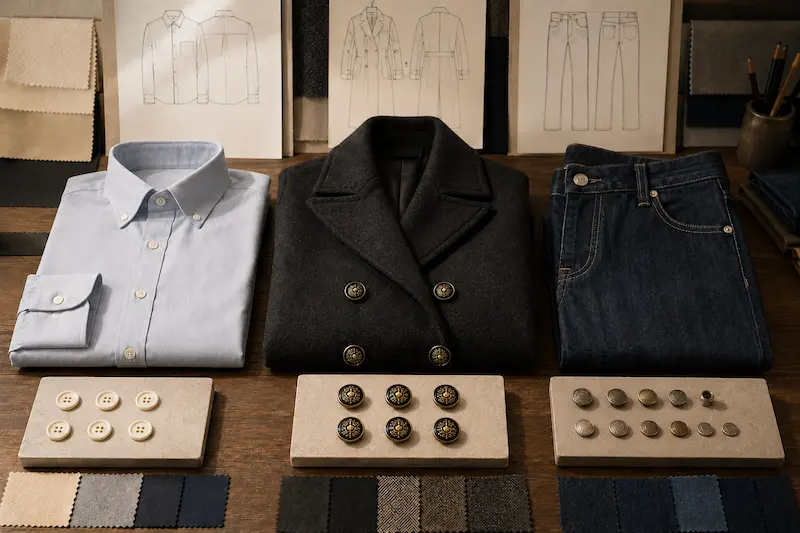
A shirt, a coat, and a pair of jeans all need closure, but each garment needs a different button logic.
Different button types serve different garment needs because each structure handles fabric thickness, pulling force, comfort, and installation in a different way5. The best choice depends on how the garment moves and how the user wears it.
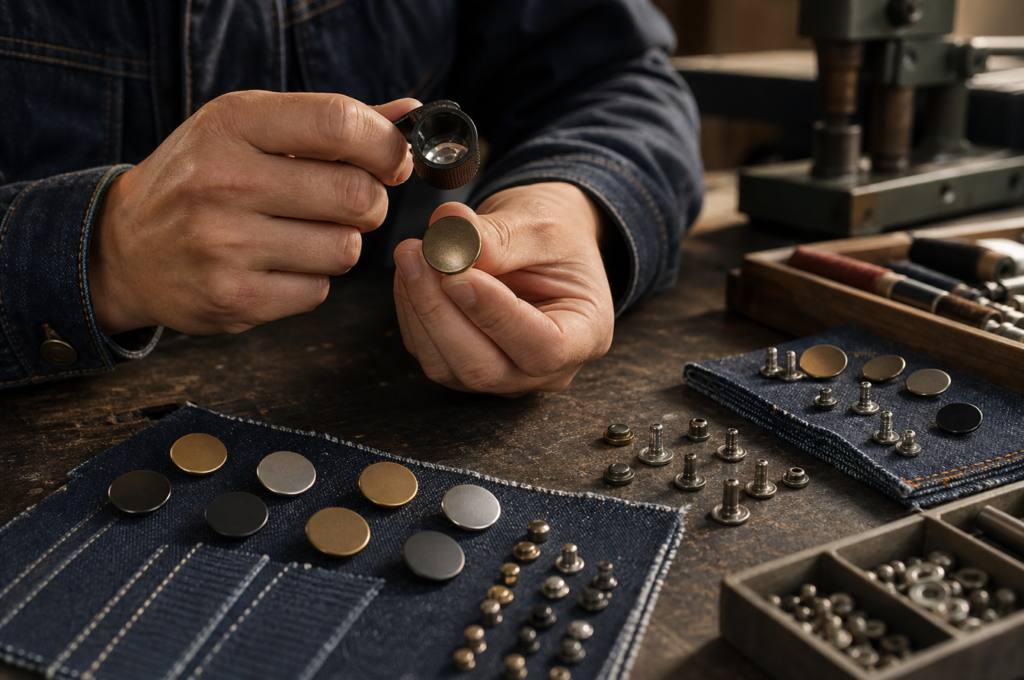
I like to start with structure before style. A flat sew-through button works well for many shirts and light garments. It is simple, stable, and easy to replace. A shank button works better when the fabric is thicker. The shank creates space between the button face and the fabric.6 This matters for coats, jackets, and textured fabrics. If a flat button is forced onto thick fabric, the button may pull, tilt, or make the front closure look tight. Snap buttons work in another way. They use a male and female part to create a pressing force.7 This makes them useful for kidswear, sportswear, workwear, and outdoor jackets. Jeans buttons and rivets are different again. They are usually installed by impact. They lock into the fabric and help denim handle strong wear.8
| Button Type | Best Use | Key Structure | Production Note |
|---|---|---|---|
| Flat sew-through button | Shirts, blouses, light jackets | Holes through the button face | Sewing tension must be even |
| Shank button | Coats, suits, heavy jackets | Back loop or metal shank | Needs enough fabric space |
| Snap button | Kidswear, sportswear, jackets | Two-part or four-part snap system | Opening force must be tested |
| Jeans button | Denim jeans and jackets | Tack and button cap | Installation pressure must be controlled |
| Rivet | Denim pocket stress points | Cap and nail structure | Fabric thickness must match nail length |
I usually ask one practical question first: what stress will this button face in real use? If the garment will be pulled often, the button must be tested for fixing strength. If the garment will be washed often, the material and finish must be checked. If the garment uses thick fabric, the button height and back structure matter. This is why button selection should not be treated as the last step. It should be part of the design decision.
How Should I Choose the Right Button Material for Beauty, Cost, Durability, and Market Positioning?
Material choice decides how the button looks, feels, ages, and fits the price level of the garment.
The right button material should match the garment fabric, retail price, care method, and brand message. Natural materials bring texture and identity, while synthetic and metal options give more control, color range, and production consistency.9
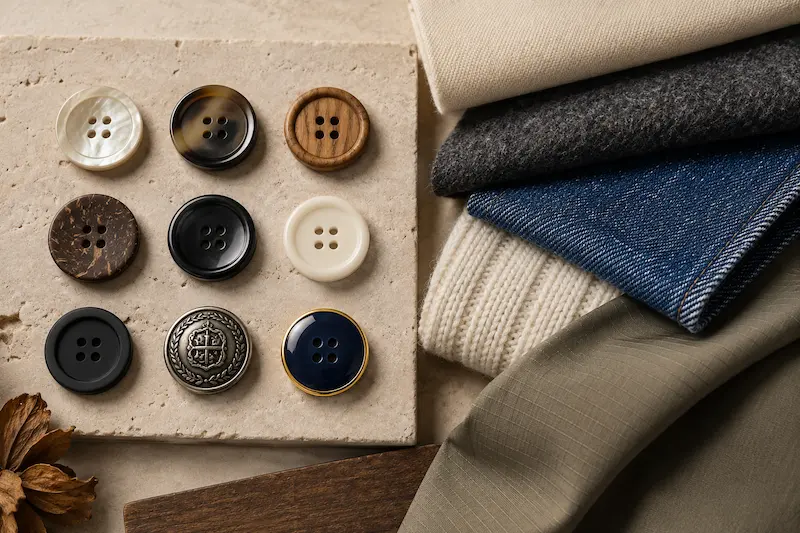
I often divide button materials into three groups. The first group is natural material. Shell buttons are common in refined shirts. White mother-of-pearl gives a clean and bright look.10 Dark shell can look more dramatic and premium. Horn buttons are strong in classic coats and tailoring because each piece has natural lines. Wood and coconut buttons are useful for casual, resort, and eco-style garments. The second group is synthetic material. Resin and polyester buttons are widely used because they offer color control, shape freedom, and stable pricing.11 Resin can create rich depth, imitation horn, imitation shell, and special color effects. Polyester is also common for mass production. Rubber buttons are softer, so they are often considered for sportswear and kidswear when touch and flexibility matter. The third group is metal and enamel. Metal buttons can create a strong brand look. Enamel adds color and a jewelry-like surface.
| Material | Visual Feeling | Strength | Cost Level | Good For |
|---|---|---|---|---|
| Shell | Natural shine, premium | Medium to good | Medium to high | Shirts, luxury blouses |
| Horn | Natural texture, classic | Good | High | Coats, suits, premium outerwear |
| Wood / Coconut | Warm, casual, natural | Medium | Low to medium | Resort wear, casual wear |
| Resin | Flexible look, rich colors | Good | Medium | Fashion garments, outerwear |
| Polyester | Clean and consistent | Good | Low to medium | Shirts, uniforms, volume orders |
| Rubber | Soft and flexible | Medium | Medium | Sportswear, kidswear |
| Metal | Strong, branded, premium | Good to high | Medium to high | Uniforms, jackets, luxury details |
| Enamel | Colorful, decorative | Depends on base | High | Premium fashion, statement buttons |
I also pay attention to care requirements. A beautiful button is not enough if it fails after washing, ironing, or dry cleaning. Heat resistance, color fastness, and surface stability should be checked before bulk production.12 For a low-price garment, a stable polyester or resin button may be the best choice. For a premium coat, horn, corozo, or custom metal may support a higher price. The best button is not always the most expensive one. It is the one that matches the product promise.
Which Finishes Help Buttons Sell Better Through Color, Texture, Plating, Engraving, and Branding?
A finish can turn a basic button into a brand detail. It can also create problems if it is not planned well.
Button finishes help products sell when they support the garment story, stay consistent in bulk, and remain stable after use. Color, texture, plating, engraving, and logo details should be tested before production.
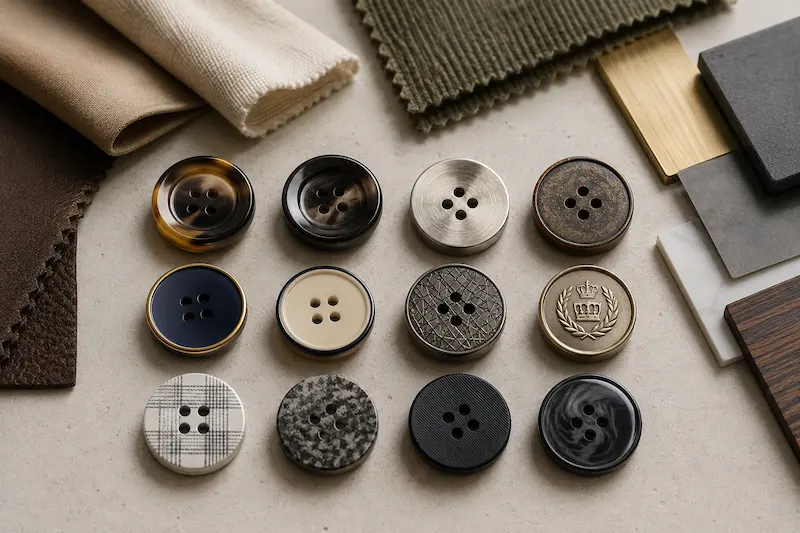
I see finishing as the bridge between design and market value. A simple resin button can look very different after polishing, matte treatment, laser logo work, or color layering. A metal button can change from casual to luxury through plating tone, brushing, antique finishing, or enamel filling. A logo can be engraved, debossed, printed, or molded into the surface. Each method has a limit. Laser engraving works well on many metal and some coated surfaces.13 Screen printing can work for color logos, but it may need stronger testing for rubbing and washing.14 Molded logos are stable, but they usually need a mold, and this means development cost and lead time.15
| Finish Method | Common Use | Advantage | Key Risk |
|---|---|---|---|
| Polishing | Shell, resin, horn, metal | Smooth and premium touch | Scratches may show more clearly |
| Matte finish | Resin, metal, plastic | Modern and soft look | Dirt or oil may be more visible |
| Antique plating | Metal buttons | Vintage character | Color must be controlled batch by batch |
| Enamel filling | Metal buttons | Strong color and high value | Surface may chip if poorly made |
| Laser engraving | Metal, coated buttons | Clean logo detail | Contrast may be weak on some surfaces |
| Molded logo | Resin, plastic, metal | Stable brand identity | Mold cost and MOQ may increase |
| Printing | Resin, plastic, shell | Low tooling barrier | Wear resistance must be tested |
I also look at color from a production view. A color may look perfect in one sample, but the bulk batch must stay close. This is very important for brands that reorder. I usually suggest keeping a confirmed sample as the production reference. I also suggest checking the button under different light. Warm light, cool light, and daylight can make the same color look different.16 For branding, I prefer clean and restrained details. A small logo on the button can increase recognition, but too much decoration can make the garment look busy. The finish should help the garment sell, not fight with it.
What Is the Engineering Side of Buttons in Real Production?
A button may look simple, but real production tests its size, structure, fixing strength, and washing result.
The engineering side of buttons includes size standard, hole design, shank height, snap force, installation pressure, pull strength, washing stability, and logo accuracy. These details decide whether the button works in bulk production.
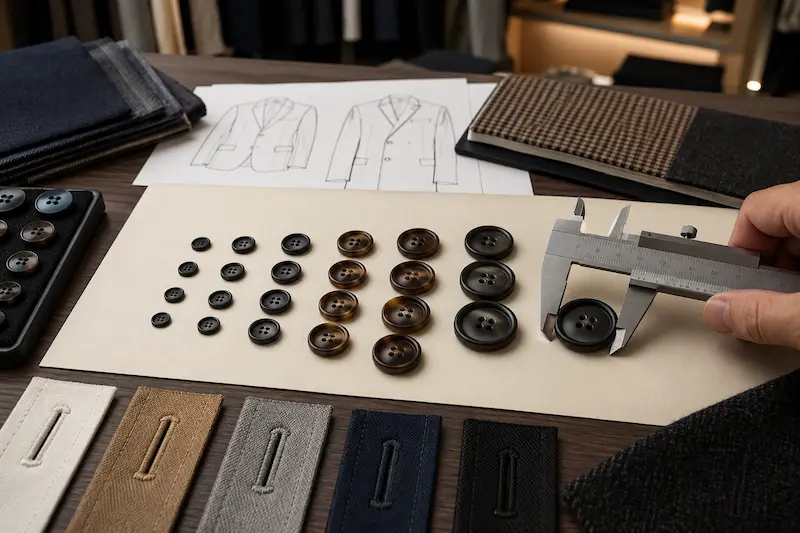
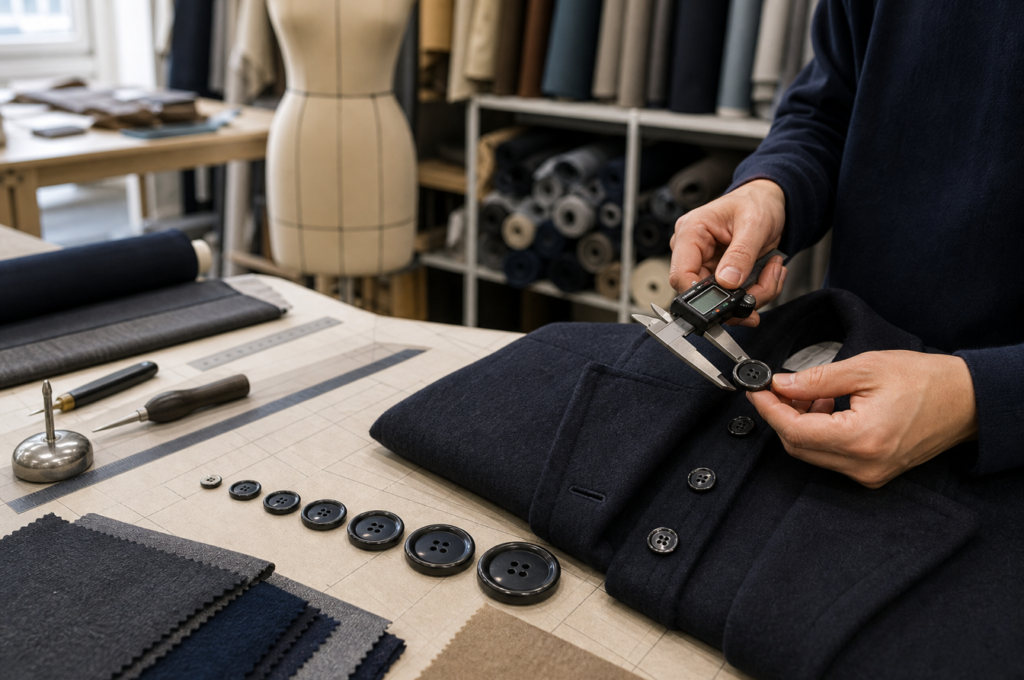
I always pay attention to button size because one small unit can change the whole balance. The traditional button size unit is Ligne, written as L. One Ligne is about 0.635 mm.17 A 16L button is about 10.16 mm. Shirt buttons often use smaller sizes, such as 14L or 16L. Coat buttons may use larger sizes, such as 28L, 32L, or even bigger. Size should match both design and sewing method. The buttonhole must also match.18 If the button is too large for the hole, the user feels friction. If it is too small, the garment may open too easily.
| Ligne Size | Approx. Diameter | Common Use |
|---|---|---|
| 14L | 8.9 mm | Fine shirts, cuffs |
| 16L | 10.2 mm | Standard shirts |
| 18L | 11.4 mm | Shirts, light blouses |
| 24L | 15.2 mm | Jackets, cardigans |
| 28L | 17.8 mm | Outerwear |
| 32L | 20.3 mm | Coats |
| 40L | 25.4 mm | Heavy coats, statement buttons |
I also check fixing methods. A four-hole shirt button needs proper thread tension. A shank button needs enough back space. A snap button needs a stable opening and closing force.19 If the force is too strong, the user may pull the fabric too hard. If the force is too weak, the snap may open during wear. Denim buttons and rivets need correct installation pressure. Poor pressure can damage fabric or make the button loose. For quality testing, I look at pull strength, washing behavior, color fastness20, surface scratches, and logo clarity. I also check the parting line on plastic or resin buttons. A rough parting line can make the button look lower grade. These details may sound small, but they decide whether a sample can become a real order.
How Can I Select the Right Button for My Design Before Sampling?
A smart button choice starts before sampling. It starts with fabric, price point, use case, and production risk.
To select the right button, I first match the button with fabric weight, garment function, target price, washing method, and brand style. Then I confirm size, structure, finish, and testing needs before sample production.
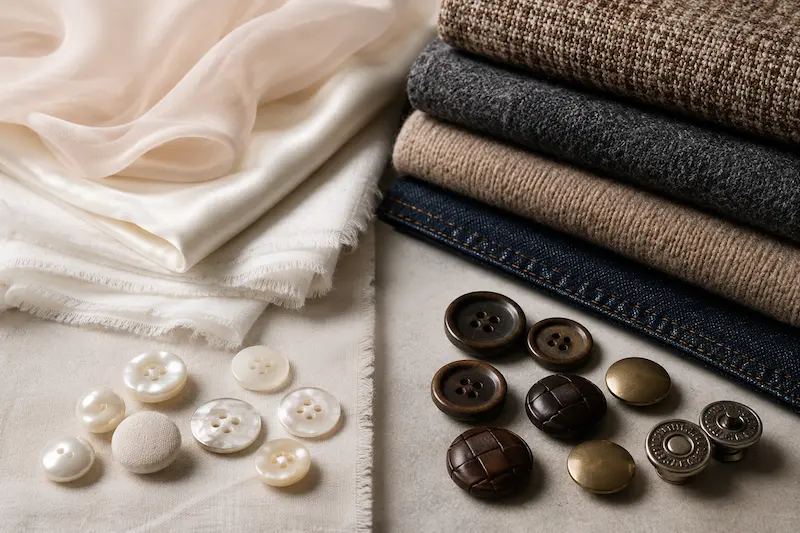
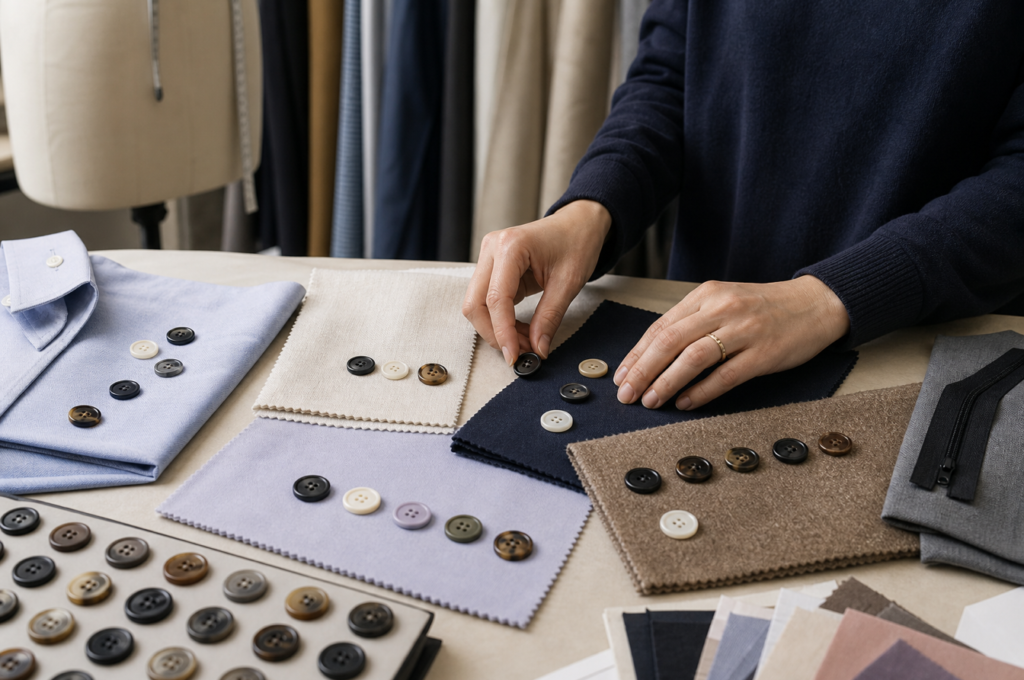
I use a simple process when I help choose a button. First, I ask what fabric the garment uses. Light silk, chiffon, and thin cotton need lighter buttons.21 Pearl, shell, fabric-covered, or small resin buttons may work well. Heavy tweed, wool, cashmere, or denim needs stronger choices.22 Horn, corozo, leather-covered, metal, or jeans buttons may be more suitable. Second, I ask how the garment will be used. A fashion blouse and a work jacket do not face the same stress. Third, I check the market position. A low-cost uniform needs stability and repeatability. A premium coat needs texture and emotional value. Fourth, I check care instructions. Washing, dry cleaning, ironing, and steaming can all affect buttons.23
| Design Question | What I Check | Why It Matters |
|---|---|---|
| What is the fabric weight? | Light, medium, or heavy fabric | Prevents pulling and distortion |
| What is the garment use? | Daily, sports, work, luxury, kidswear | Matches strength and comfort |
| What is the retail level? | Entry, mid, premium | Matches material and finish cost |
| What care method is needed? | Wash, dry clean, iron, steam | Prevents color and surface failure |
| Is branding needed? | Logo, color, custom mold | Controls identity and MOQ |
| Is bulk repeat needed? | Color standard and reference sample | Reduces reorder risk |
I also suggest doing basic tests before bulk production. A pull test can show whether the button or snap fixing is safe.24 A washing test can show whether the surface changes. A rubbing test can show whether printing or plating is stable. A visual check can show whether the color and surface meet the brand standard. I have learned that most button problems are not caused by one big mistake. They are caused by many small details that were not checked early. A clear selection process saves time, cost, and stress.
Where Are Apparel Buttons Going Next With Sustainability and Smart Hardware?
Button development is moving toward cleaner materials, better traceability, and more brand interaction.
Future apparel buttons will focus more on recycled materials, bio-based resin, lower-impact finishing, digital traceability, and smart functions such as NFC for authentication and customer engagement.
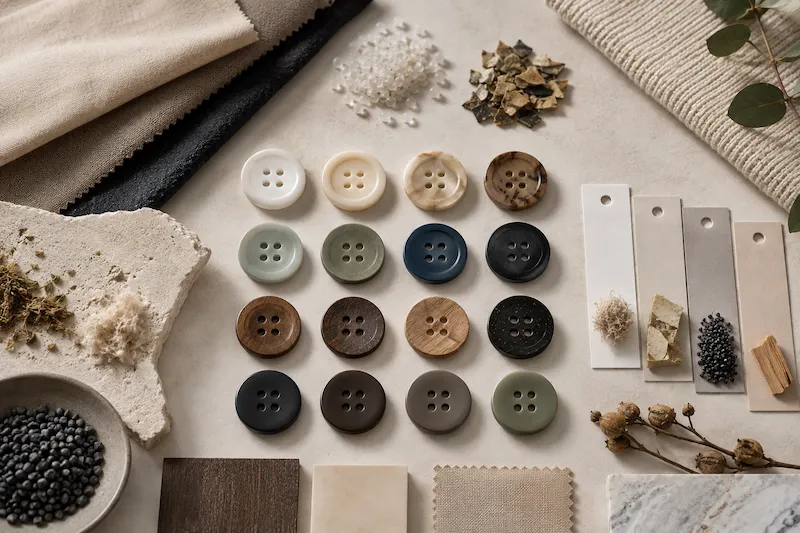
I see sustainability becoming more practical in button sourcing. Some brands now ask for recycled polyester, recycled plastic, bio-based resin, natural materials, and lower-impact finishes. This is not only about marketing. It is also about meeting future sourcing rules and customer expectations25. A recycled button still needs to pass quality tests.26 It must keep color, shape, strength, and washing stability. This is why I do not see sustainability as a simple label. I see it as a production system that needs material proof, stable suppliers, and clear testing.
Smart buttons are also becoming more interesting. NFC buttons can support product authentication, care information, brand stories, and customer interaction.27 This may be useful for premium garments, limited collections, uniforms, and products that need traceability. I do not think every garment needs a smart button. The cost and use case must make sense. Still, the direction is clear. Buttons are moving from simple closure parts to small identity carriers.
| Trend | Possible Benefit | Practical Concern |
|---|---|---|
| Recycled plastic buttons | Supports sustainability claims | Material source must be clear |
| Bio-based resin buttons | Reduces reliance on traditional plastic28 | Stability and cost must be tested |
| Natural material buttons | Strong texture and lower synthetic feel | Color and grain variation must be accepted |
| Lower-impact finishing | Better environmental story | Finish durability must stay stable |
| NFC buttons | Authentication and digital interaction | Cost and privacy concerns must be reviewed |
| Custom branded buttons | Stronger product identity | Mold cost, MOQ, and lead time must be planned |
I believe the future button will still need to do the basic job first. It must close, hold, and survive wear. Then it can add beauty, branding, sustainability, or digital value. This order matters. A smart button that falls off is still a bad button. A sustainable button that fails washing is still a failed part. Good development starts with function, then adds meaning.
Conclusion
I treat every button as a small product. When design, material, finish, and engineering work together, the whole garment feels more valuable.
-
"[PDF] PERCEIVED QUALITY OF APPAREL", https://dr.lib.iastate.edu/bitstreams/ddac01c6-c0f5-47a5-ac74-817e4d83d455/download. Research on consumer touch and haptic product perception shows that tactile interaction can shape product evaluation and perceived quality, supporting the relevance of touch-sensitive details in apparel assessment. Evidence role: general_support; source type: paper. Supports: A button is often one of the first tactile details a buyer notices when judging a garment.. Scope note: The evidence is likely to address consumer touch behavior broadly rather than buttons specifically. ↩
-
"Design Principles for Clothing and Textiles | USU", https://extension.usu.edu/research/principles-of-design. Apparel construction and textile selection guidance commonly treats fasteners as design components that must be matched to fabric weight, garment function, and care requirements, providing contextual support for making button choices during product development rather than after sampling. Evidence role: expert_consensus; source type: education. Supports: Delaying the button decision can create garment-development risk because buttons must be matched to the final fabric and use case.. Scope note: Such sources may give general garment-construction guidance rather than empirical data on late button selection risks. ↩
-
"Machine Buttonholes Made Easy | New Mexico State University", https://pubs.nmsu.edu/_c/C231/index.html. Sewing and apparel-construction references explain that shank buttons create a gap between the button and garment surface, allowing thicker fabrics or multiple layers to sit under the button without distortion. Evidence role: mechanism; source type: education. Supports: A coat button should provide enough clearance for thick fabric layers.. Scope note: The support explains the construction mechanism; it does not prove that every coat requires a shank button. ↩
-
"Jeans – Wikipedia", https://en.wikipedia.org/wiki/Jeans. Historical and technical accounts of jeans construction describe metal rivets and mechanically attached buttons as reinforcements used at high-stress points, supporting the claim that denim closures require stronger fastening than ordinary sewn shirt buttons. Evidence role: mechanism; source type: encyclopedia. Supports: A denim button should remain secure under mechanical stress.. Scope note: The evidence may discuss denim rivets and workwear construction generally rather than testing a specific button product. ↩
-
"Fasteners Made Easy – BE BOLD. Shape the Future.", https://pubs.nmsu.edu/_c/C232/index.html. Clothing-construction and textile references describe fasteners as functional components selected according to garment material, stress, use, and method of attachment; this supports the general design logic rather than proving any single button choice is universally optimal. Evidence role: general_support; source type: education. Supports: Different button types serve different garment needs because their structures respond differently to fabric thickness, pulling force, comfort, and installation requirements.. Scope note: Contextual support only; garment-specific performance still depends on fabric, construction, and testing conditions. ↩
-
"Machine Buttonholes Made Easy | New Mexico State University", https://pubs.nmsu.edu/_c/C231/index.html. Standard sewing and clothing-construction references define a shank button as a button with a loop or projection on the back that raises the button from the fabric surface, providing room for the buttonhole layer; this directly supports the described function. Evidence role: definition; source type: education. Supports: A shank button creates space between the button face and the fabric.. ↩
-
"Snap fastener – Wikipedia", https://en.wikipedia.org/wiki/Snap_fastener. Technical descriptions of snap fasteners identify them as interlocking male and female components that engage under pressure; this supports the mechanism described, although terminology varies among two-part and four-part snap systems. Evidence role: mechanism; source type: encyclopedia. Supports: Snap buttons use male and female components that fasten through applied pressure.. Scope note: Some sources describe snap assemblies by cap, socket, stud, and post rather than simply male and female parts. ↩
-
"Jeans – Wikipedia", https://en.wikipedia.org/wiki/Jeans. References on riveted denim and jeans construction explain that metal rivets and tack buttons mechanically fasten through layers of fabric and are used at high-stress points to reinforce denim garments; this supports the durability claim in general terms. Evidence role: mechanism; source type: encyclopedia. Supports: Jeans buttons and rivets mechanically lock into denim and help garments withstand high wear or stress.. Scope note: The source may support rivets and jeans buttons separately; actual durability depends on denim weight, hardware material, and installation quality. ↩
-
"Dress for Life and Death: The Archaeology of Common Nineteenth …", https://www.academia.edu/15779079/Dress_for_Life_and_Death_The_Archaeology_of_Common_Nineteenth_Century_Buttons. Textile and apparel materials references distinguish natural button materials such as shell, horn, wood, and corozo by their inherent surface variation, while molded plastics and metals are generally described as offering repeatable shapes, finishes, and colors in industrial production. Evidence role: general_support; source type: education. Supports: Natural button materials tend to offer visual variation and identity, while synthetic and metal materials can provide more controlled color, shape, and production consistency.. Scope note: This supports the material distinction in general terms; it does not prove that every natural or synthetic button will perform this way in every garment line. ↩
-
"New nondestructive optical technique reveals the structure of mother …", https://www.physics.wisc.edu/2021/03/29/new-nondestructive-optical-technique-reveals-the-structure-of-mother-of-pearl/. References on nacre, commonly called mother-of-pearl, describe its iridescent, lustrous appearance and its historical use in decorative objects including buttons, which supports the association with a bright visual effect. Evidence role: mechanism; source type: encyclopedia. Supports: White mother-of-pearl buttons have a bright, lustrous appearance.. Scope note: The source can support the optical basis of brightness and luster, but the description of a “clean” look remains a design judgment. ↩
-
"Button Type – Polres Polyester Paint and Chemical Industry Co. Ltd.", https://www.polrespolyester.com.tr/en/dugme-tipi/. Polymer and textile manufacturing sources describe polyester and other resin buttons as moldable, pigmentable components suitable for large-scale apparel production, supporting claims about design flexibility and production repeatability. Evidence role: mechanism; source type: education. Supports: Resin and polyester buttons are common apparel components because molded polymers allow controlled color, shape variation, and repeatable production.. Scope note: Such sources may support moldability, coloring, and common use more directly than “stable pricing,” which can vary with resin markets and supplier conditions. ↩
-
"Clothes Captioning: Complying with the Care Labeling Rule", https://www.ftc.gov/business-guidance/resources/clothes-captioning-complying-care-labeling-rule. Textile testing standards and care-labeling guidance require assessment of colorfastness, laundering, dry-cleaning, pressing, and related durability factors, supporting the need to test garment components such as buttons before production approval. Evidence role: expert_consensus; source type: institution. Supports: Button performance factors such as heat resistance, colorfastness, and surface stability should be tested before bulk garment production.. Scope note: Standards usually specify test methods and performance evaluation rather than prescribing one universal approval threshold for all button materials. ↩
-
"Laser engraving – Wikipedia", https://en.wikipedia.org/wiki/Laser_engraving. A technical source on laser engraving/marking supports that lasers can mark metals and coated or treated surfaces by removing material or changing surface appearance; this supports the general feasibility of the method rather than guaranteeing good contrast on every button substrate. Evidence role: mechanism; source type: encyclopedia. Supports: Laser engraving can be used effectively on many metal and coated button surfaces.. Scope note: Support is general to laser marking materials and may not address specific button coatings or production settings. ↩
-
"Digital Grading the Color Fastness to Rubbing of Fabrics Based on …", https://pmc.ncbi.nlm.nih.gov/articles/PMC10672307/. Textile testing standards and institutional guidance on colorfastness describe wash and rubbing/crocking tests for evaluating whether printed or dyed surfaces transfer color or degrade during use; this provides contextual support for testing printed button logos, though the standards are usually written for textiles rather than buttons specifically. Evidence role: general_support; source type: institution. Supports: Printed color logos should be tested for resistance to rubbing and washing.. Scope note: The evidence is likely to be based on textile colorfastness methods and may need adaptation for hard button surfaces. ↩
-
"Understanding Lead Times in Injection Molding for Production …", https://www.aprios.com/insights/lead-times-in-injection-molding-essential-insights-for-engineers. Manufacturing references on molding note that molded parts generally require tooling or molds, and that tooling contributes to upfront cost and production lead time; this supports the production-cost aspect of molded logos but does not quantify costs for a specific button design. Evidence role: mechanism; source type: education. Supports: Molded logos usually require mold tooling, which adds development cost and lead time.. Scope note: Support is general to molding processes and may not provide button-specific tooling cost or MOQ data. ↩
-
"The Eye of the Beholder: How Lighting Affects Our Color Perception", https://www.nist.gov/blogs/taking-measure/eye-beholder-how-lighting-affects-our-color-perception. Color-science sources on illuminants and metamerism explain that an object’s perceived color can change under different light sources such as daylight, warm light, and cool light; this supports the need to review button color under multiple lighting conditions. Evidence role: mechanism; source type: research. Supports: The same button color can appear different under different lighting conditions.. Scope note: The source may explain the optical principle generally rather than focusing on garment buttons. ↩
-
"Traditional button sizes measured in ligne – Facebook", https://www.facebook.com/groups/punkbadges/posts/10156905492193886/. A neutral reference on button sizing states that the ligne is a traditional button-diameter unit equal to 1/40 inch, approximately 0.635 mm, supporting the conversion used here. Evidence role: definition; source type: encyclopedia. Supports: One Ligne is about 0.635 mm.. ↩
-
"Machine Buttonholes Made Easy | New Mexico State University", https://pubs.nmsu.edu/_c/C231/index.html. Apparel construction references describe button-and-buttonhole fit as a functional requirement: the buttonhole must be sized in relation to button diameter and thickness so the closure fastens securely without excessive resistance. Evidence role: mechanism; source type: education. Supports: The buttonhole must match the button size so the closure functions properly.. Scope note: Such sources generally provide construction guidance rather than experimental proof for every fabric and button type. ↩
-
"The Importance of Testing for Zippers, Buttons, and Fasteners", https://contractlaboratory.com/the-final-stitch-the-importance-of-testing-for-zippers-buttons-and-fasteners/. Mechanical-testing literature and snap-fastener test methods evaluate the force required to engage and disengage snap fasteners, supporting the claim that opening and closing force is a measurable functional property. Evidence role: mechanism; source type: institution. Supports: Snap buttons require controlled opening and closing force for reliable use.. Scope note: A test-method source establishes that the force is measured for quality control, but it may not define a universal acceptable force for all garments. ↩
-
"Understanding the Importance of Button Snap Pull Testing in …", https://www.gester-instruments.com/blog/understanding-the-importance-of-button-snap-pull-testing-in-garment-manufacturing_b60. Textile quality standards and test methods commonly assess attachment strength, laundering behavior, and color fastness, supporting these as recognized quality-control criteria for garment components. Evidence role: expert_consensus; source type: institution. Supports: Pull strength, washing behavior, and color fastness are relevant quality tests for buttons in garment production.. Scope note: Standards support the relevance of these tests generally; the exact pass/fail thresholds depend on garment category, market, and buyer specification. ↩
-
"[PDF] FCS 1240 Apparel Construction I Class Supplies", https://files.wmich.edu/s3fs-public/attachments/u415/2016/FCS1240-supply-list-rev.pdf. An apparel construction or textile-design source explains that fastener size and weight should be compatible with fabric weight to avoid sagging, distortion, or strain at the attachment point. Evidence role: expert_consensus; source type: education. Supports: Lightweight fabrics generally require lighter or smaller buttons than heavier fabrics.. Scope note: This would support the design principle generally, but it may not prescribe exact button materials for every named fabric. ↩
-
"[PDF] BUTTONS & BUTTONHOLES BUTTONS – University of Kentucky", https://fcs.mgcafe.uky.edu/sites/fcs.mgcafe.uky.edu/files/ct-mmb-189.pdf. A textile or apparel engineering source describes how heavier fabrics and higher-stress garments require closures with greater attachment strength and durability than lightweight garments. Evidence role: mechanism; source type: education. Supports: Heavy fabrics such as tweed, wool, cashmere, or denim generally require stronger button or closure choices.. Scope note: The source may establish the relationship between fabric weight, stress, and closure strength without endorsing each specific material listed in the article. ↩
-
"Care Labeling of Textile Wearing Apparel & Certain Piece Goods", https://www.ftc.gov/legal-library/browse/rules/care-labeling-textile-wearing-apparel-certain-piece-goods-text. Care-labeling and textile-testing guidance notes that laundering, dry cleaning, heat, and steam can affect garment components, including trims and fasteners, through color change, deformation, corrosion, or surface damage. Evidence role: general_support; source type: government. Supports: Garment care methods can affect buttons and other trims.. Scope note: Such guidance usually addresses garment components broadly; it may not isolate every button material or finish discussed in the article. ↩
-
"[PDF] Textiles/Apparel – Consumer Product Safety Commission", https://www.cpsc.gov/s3fs-public/Session%204%20Textiles%20En.pdf. Consumer product safety and textile-testing standards use tension or pull-force tests to evaluate whether buttons, snaps, and similar attachments detach under specified loads, which is relevant to safety and attachment security. Evidence role: mechanism; source type: government. Supports: Pull testing can evaluate the safety and security of button or snap attachment.. Scope note: A pull test indicates resistance under defined test conditions; it does not by itself prove safety under all real-use scenarios. ↩
-
"OECD Due Diligence Guidance for Responsible Supply Chains in …", https://www.oecd.org/en/publications/2018/03/oecd-due-diligence-guidance-for-responsible-supply-chains-in-the-garment-and-footwear-sector_g1g89b0b.html. European Commission textile-policy materials identify circularity, recycled content, traceability, and product-information requirements as emerging priorities for apparel supply chains; this supports the regulatory context for button sourcing, although it does not address buttons specifically. Evidence role: historical_context; source type: government. Supports: Sustainable button sourcing is partly driven by future sourcing rules and customer expectations.. Scope note: The source supports the broader apparel and textile regulatory direction rather than button components alone. ↩
-
"(PDF) Trims Testing Protocol – Academia.edu", https://www.academia.edu/24737608/Trims_Testing_Protocol. Textile and trim testing standards specify performance checks such as colorfastness, laundering durability, dimensional stability, and mechanical strength; this supports the need to validate recycled buttons through testing, though the standards define test methods rather than performance outcomes for any individual product. Evidence role: expert_consensus; source type: institution. Supports: Recycled apparel buttons need to meet quality and durability tests before use.. Scope note: Standards establish relevant testing criteria but do not prove that a specific recycled button will pass or fail. ↩
-
"Fully-Textile, Wearable Chipless Tags for Identification and Tracking …", https://pmc.ncbi.nlm.nih.gov/articles/PMC7013661/. Research on NFC and RFID-enabled product identification describes how embedded tags can link physical goods to digital information for authentication, traceability, and user-facing content; this supports the proposed functions for NFC buttons, with the caveat that adoption depends on garment design, cost, and data-governance choices. Evidence role: mechanism; source type: paper. Supports: NFC buttons can enable authentication, care information, brand content, and customer interaction.. Scope note: The evidence supports the technical capability of NFC/RFID systems generally and may not be specific to button hardware in every case. ↩
-
"Are Biobased Plastics Green Alternatives?—A Critical Review", https://pmc.ncbi.nlm.nih.gov/articles/PMC8345407/. Biobased polymer literature explains that polymers derived partly or wholly from renewable biomass can substitute for fossil-derived plastics in selected applications; this supports the statement that bio-based resin may reduce reliance on traditional plastics, although environmental benefits depend on feedstock, formulation, durability, and life-cycle impacts. Evidence role: definition; source type: paper. Supports: Bio-based resin buttons can reduce reliance on traditional fossil-derived plastic materials.. Scope note: The source supports substitution potential, not a guaranteed lower impact for every bio-based resin button. ↩