- Loading...
A beautiful swimwear trim can fail quickly when material, finish, structure, and real exposure are treated as separate decisions.
Choose 316L stainless steel as the safer starting point for load-bearing swimwear hardware exposed repeatedly to saltwater or chlorinated water. Choose a specified brass alloy for decorative pieces when warm color, engraving, or forming flexibility matters, but validate its complete protective finish.
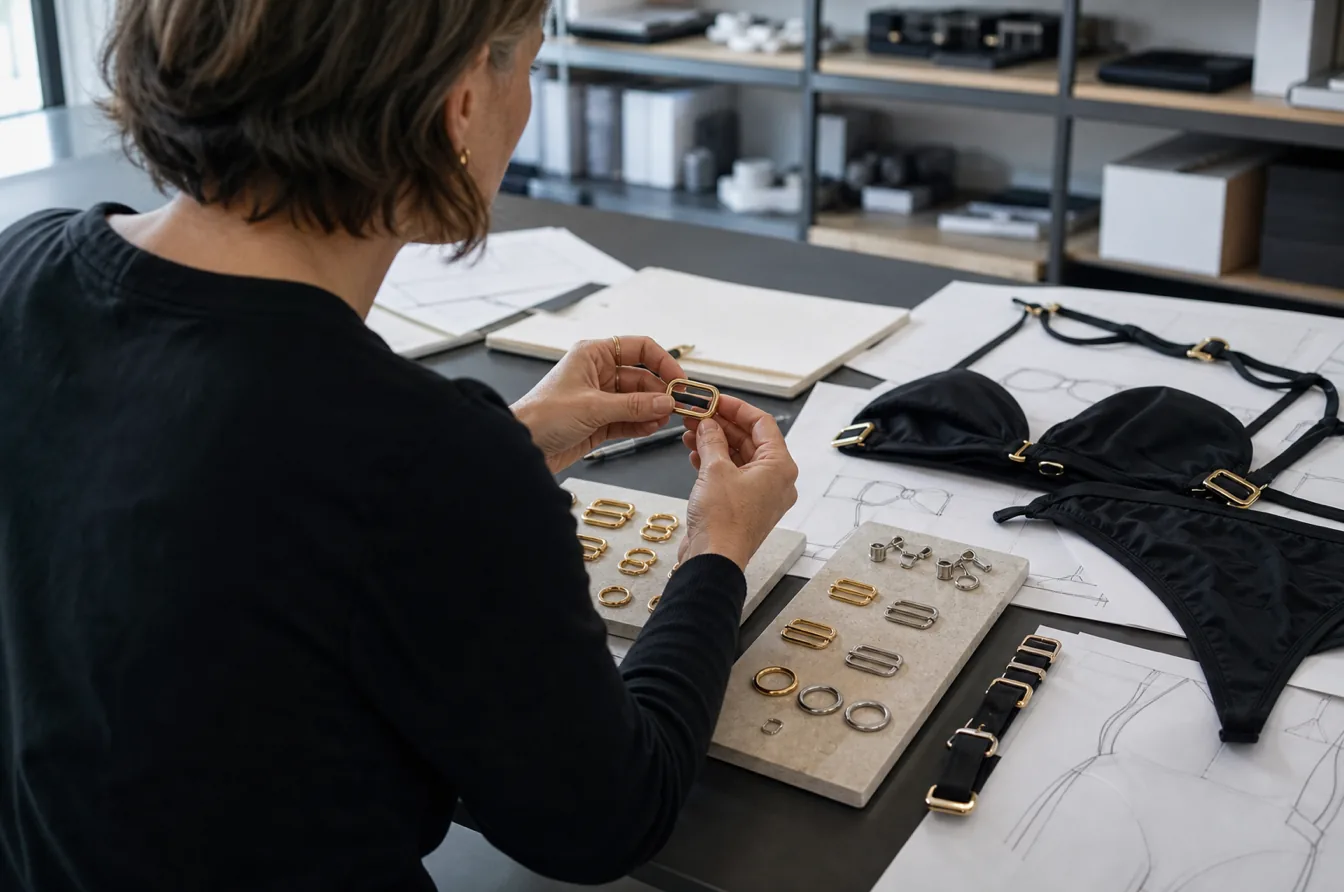
In development, I start by separating functional parts from decorative parts. That simple step usually makes the material decision clearer than comparing two metal samples on appearance or unit price alone.
How Do Brass and 316L Stainless Steel Compare in Corrosion Resistance, Weight, and Appearance?
Brass and 316L can both look premium at approval, yet they age differently once moisture, salts, movement, and finish wear enter the product.
316L generally provides the stronger corrosion margin in chloride exposure. Brass offers a naturally warm color and easier decorative processing, but its alloy and finish need tighter control. Weight depends on density, geometry, and manufacturing route—not on the material name alone.
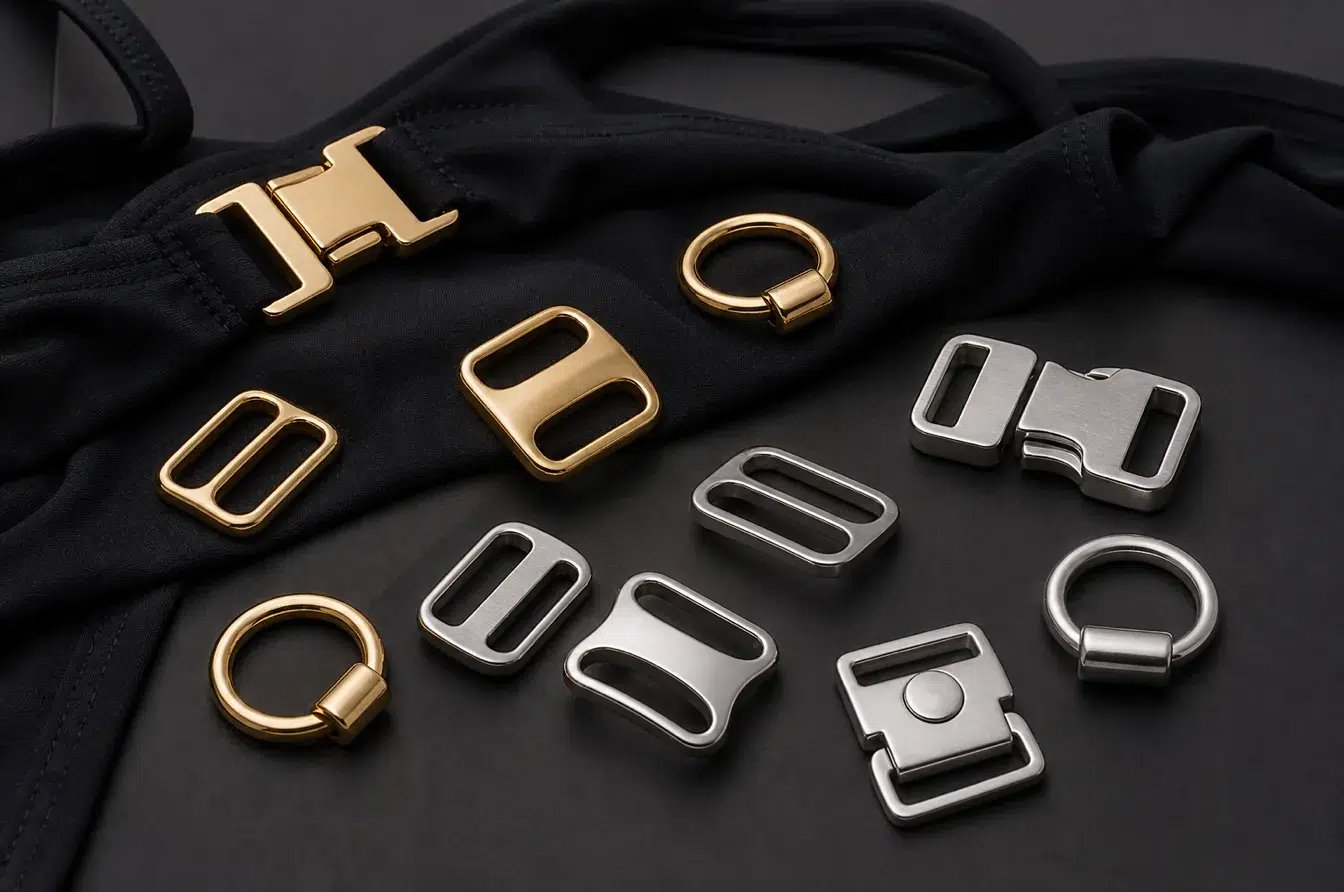
Corrosion Resistance Comes from Different Mechanisms
316L is an austenitic stainless steel containing chromium, nickel, and molybdenum. Chromium supports the passive film that protects the surface, while molybdenum improves resistance to localized pitting and crevice corrosion in chloride-containing conditions. The Aperam 316L technical data lists typical values of 16.8% chromium, 10.1% nickel, and 2.1% molybdenum. This chemistry is why 316L is usually a more defensible base metal for closures, hooks, rings, and sliders that repeatedly meet seawater, pool water, perspiration, and humid storage.
That advantage is a margin, not an immunity claim. Chloride concentration can rise as water evaporates, and deposits can become trapped in hinge barrels, engraved recesses, overlaps, and contact points. Poor polishing, iron contamination from shared tools, incomplete cleaning after fabrication, and tight crevices can all weaken the performance of a correct 316L alloy. A component may therefore show localized staining or pitting even when the material certificate is genuine.
“Brass” describes a large family of copper-zinc alloys rather than one dependable swimwear specification. Zinc level, secondary elements, temper, manufacturing route, and environment can change performance. The Copper Development Association explains that dezincification can affect higher-zinc brasses in certain stagnant, acidic aqueous conditions, leaving a porous copper-rich layer. Swimwear does not reproduce a plumbing system exactly, but wet joints, retained salts, low-quality alloy selection, and long damp storage make a vague “solid brass” description commercially unsafe. The RFQ should identify an exact alloy and a tested finish system.
Weight, Appearance, and Finished Cost Need Separate Comparisons
Brass is not automatically the lighter option. For example, the Copper Development Association lists a density of 0.308 lb/in³ for C26000 cartridge brass, which is approximately 8.5 g/cm³, while Aperam lists about 7.9 g/cm³ for 316L stainless steel. If two parts have identical volume, the brass version may therefore be heavier. Finished weight can reverse when one material allows a thinner section, a hollow construction, a different forming method, or a smaller load-bearing profile.
Appearance creates a clearer distinction. Bare or polished brass supplies a naturally warm yellow-gold tone and works well for resort, vintage, jewelry-inspired, or engraved statement pieces. Its surface can also darken or develop patina. That change may suit an intentional aged design, but it is usually a defect when a collection promises stable bright gold. A plated or lacquered brass part can keep its approved color longer, although edges, moving zones, and skin-contact faces remain vulnerable to wear.
Uncoated 316L has a cooler silver-gray appearance. It can be mirror polished, satin finished, brushed, blasted, or electropolished. Gold, rose gold, black, and other fashion colors normally require PVD or another compatible coating system. The base metal may remain corrosion-resistant, but visible color durability then depends on surface preparation, coating adhesion, thickness distribution, abrasion, and the geometry below the coating.
The cost comparison should include more than raw metal. Brass may be easier to machine, stamp, engrave, and polish, which can reduce tooling difficulty or cycle time for detailed pieces. Its final quotation may rise after underplating, decorative plating, clear protection, inspection, and rejection risk are added. 316L often costs more to purchase and process, especially for complex machining, but a silver 316L finish can reduce reliance on decorative barrier coatings. The right comparison is finished cost per approved part plus the expected cost of wear, corrosion, returns, and rework.
| Decision factor | Brass | 316L stainless steel | Practical meaning |
|---|---|---|---|
| Chloride resistance | Alloy- and finish-dependent; vulnerable if protection fails | Generally stronger because of molybdenum | 316L is the safer functional starting point |
| Density | Often slightly higher for common brasses | Often slightly lower by equal volume | Compare actual CAD mass and sample weight |
| Natural color | Warm yellow-gold | Cool silver-gray | Colored 316L normally needs an added coating |
| Decorative processing | Strong machining, forming, and engraving flexibility | More demanding to machine and finish | Brass can suit detailed logos and statement trims |
| Finished cost | May need several protective layers | Higher processing cost but less coating dependence in silver | Compare the full material-and-finish system |
How Do Saltwater, Chlorine, Sweat, Sunscreen, and Heat Affect Each Material?
“Swimwear exposure” is not one condition, so a material that survives occasional beach use may fail in a hot spa or repeated resort service.
Assess chemical type, concentration, temperature, contact time, wet-dry cycling, rinsing, and water retention together. 316L handles many chloride conditions better, while brass performance depends more heavily on alloy selection and an intact finish.
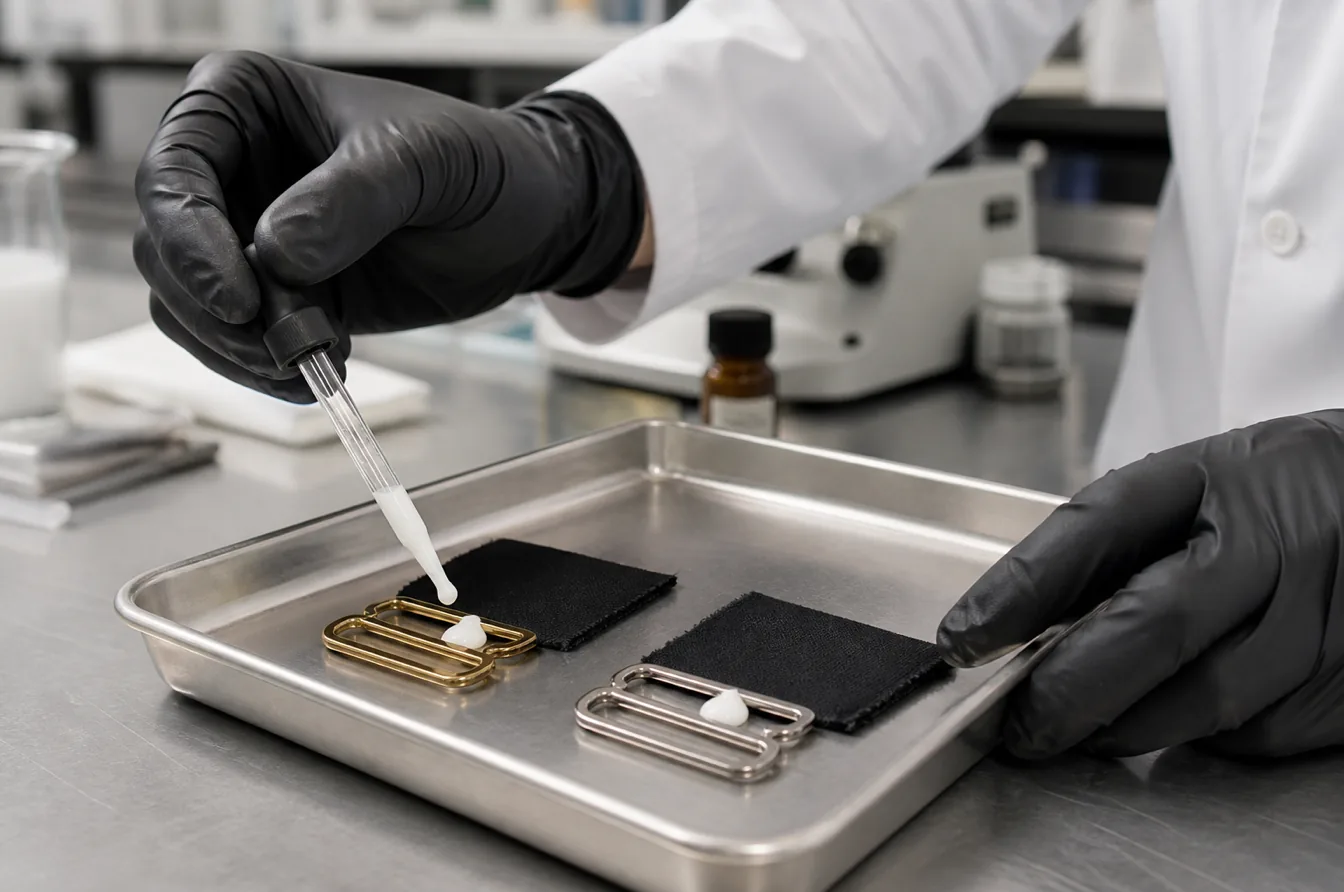
Build an Exposure Profile Before Selecting the Metal
Seawater leaves chloride-rich deposits as it dries. Pool water adds disinfectants and controlled water chemistry, but local conditions can change during dosing, poor circulation, or maintenance. Sweat introduces salts, moisture, and skin residues. Sunscreen and body oils can soften, stain, dull, or lift organic topcoats even when the base metal itself remains acceptable. Heat accelerates many reactions and can make a hot spa more aggressive than a cool, well-managed hotel pool.
The International Molybdenum Association’s pool and spa guidance emphasizes that sanitation method, chemical concentration, water temperature, and application all affect stainless grade selection. This supports a useful development rule: do not approve hardware only for “water resistance.” Define whether the product is intended for occasional swimming, daily training, saltwater beach use, tropical resort wear, spa use, or long periods folded while damp.
316L is normally the safer choice as exposure frequency and chloride retention increase. Even so, severe chemistry, high temperatures, surface deposits, or trapped solution can challenge it. Fresh-water rinsing and complete drying remain sensible care instructions, but care advice should not be used to excuse an under-specified component.
Brass needs closer attention to its protective system. Raw brass may tarnish after contact with water, perspiration, and cosmetics. A coating can delay that change, but once abrasion exposes the substrate at an edge or moving contact point, discoloration can begin locally and transfer to pale fabric. The test sequence should therefore repeat exposure, rinsing, drying, and movement rather than immerse a pristine sample once and declare it suitable.
Geometry and Mixed Metals Can Create Hidden Exposure
Two loose metal coupons rarely represent a finished clasp. Real hardware contains narrow joints, springs, pins, solder, welds, recessed logos, attachment plates, and fabric interfaces. These areas can retain water after the visible front face looks dry. Evaporation concentrates dissolved salts, and the next use rewets the deposit. Repeated wet-dry cycling can be more revealing than a short continuous immersion because it tests both exposure and concentration.
Dissimilar-metal contact adds another risk. A brass charm attached to a stainless ring, a stainless pin inside a brass body, or a plated steel spring inside a closure can create a galvanic couple when an electrolyte bridges the metals. The risk depends on the metal combination, relative exposed areas, finish condition, and how long moisture remains. IMOA’s successful swimming-pool design guidance recommends avoiding direct contact between different metals and minimizing corrosion-prone crevices. The same design principle is valuable at swimwear scale.
Sunscreen and body-care products need representative testing because formulations differ. A hard PVD color layer may behave differently from a lacquered brass surface, but neither should be assumed compatible with every oil, solvent, pigment, or UV-filter system. The test should record the actual product or agreed surrogate, applied amount, temperature, contact time, pressure, rinse method, and inspection interval.
The adjacent textile also matters. Corrosion products, polishing residues, coating fragments, and cosmetic mixtures can move into light fabric. A successful result therefore requires acceptable metal appearance, no staining or color transfer, no roughness on skin-facing areas, and normal operation after the complete cycle.
| Exposure | Main risk to brass | Main risk to 316L | What to reproduce in testing |
|---|---|---|---|
| Seawater | Tarnish, coating breakdown, and possible selective corrosion | Pitting or crevice attack where salts concentrate | Immersion or contact, fresh-water rinse, drying, and repeat cycles |
| Chlorinated pool water | Finish discoloration, barrier damage, and substrate exposure | Localized corrosion in aggressive or trapped conditions | Target chemistry, temperature, circulation assumption, and wet-dry cycle |
| Perspiration | Tarnish, transfer, and coating wear against skin | Deposits, staining, and nickel-release concerns | Damp skin-side contact with movement and representative fabric |
| Sunscreen and body oil | Softening, dulling, tack, staining, or adhesion loss | Coating interaction when a colored finish is used | Market-relevant products followed by rinse, dry, and abrasion |
| Hot spa or tropical storage | Faster chemical action and longer damp time | Reduced corrosion margin under heat and concentration | Elevated temperature, humidity, trapped moisture, and delayed drying |
Which Material Works Better for Load-Bearing Closures, Rings, Sliders, and Decorative Trims?
Material selection cannot rescue a weak section, open joint, sharp edge, or poor attachment, but it can provide the right safety margin for each function.
Use 316L as the default for tension-carrying and frequently moving components. Use specified brass for low-load decorative trims when its color and detail advantages justify a validated protective finish.

Start with the Load Path, Not the Product Name
Closures, hooks, rings, and sliders form part of the garment’s load path. They carry strap tension, receive repeated adjustment, rub against fabric or other metal, and may be pulled at angles that a simple tensile coupon never sees. For these parts, 316L is usually the stronger development starting point because it combines useful mechanical durability with a larger chloride-corrosion margin. It is especially defensible for narrow sections, moving interfaces, swim-training products, and premium garments expected to survive frequent use.
That recommendation does not mean every 316L component is strong enough. Section thickness, internal radius, opening width, grain or forming direction, weld penetration, casting or machining defects, and attachment geometry determine the completed part’s behavior. A thin 316L ring can spread under load. A poorly welded hook can crack. A sharp slider bar can cut elastic before the metal corrodes. The drawing and the assembly test remain as important as the alloy.
Brass can work for functional components when the grade, temper, section, and finish are designed for the load and exposure. Its formability and machinability can be useful for shaped frames, engraved clasps, and detailed parts. However, soft sections may deform, and moving contact can remove a protective finish. When brass is chosen for a closure, the approval plan should set limits for pull strength, permanent deformation, opening force, closure retention, cycle life, edge condition, and post-exposure operation.
For rings and sliders, check the complete strap path. Wet fabric stretches differently, elastic loses force over time, and a metal edge can concentrate stress. Testing the isolated component misses slippage, fabric cutting, seam failure, and coating transfer. A production-intent assembly with actual fabric, elastic, stitching, reinforcement, and setting method gives the more useful answer.
Reserve Decorative Freedom for Parts That Can Tolerate It
Decorative logo plates, engraved charms, jewelry-like medallions, and statement trims often favor brass. Warm natural color, crisp engraving, small relief details, and efficient machining can support a premium visual result. These pieces may also sit outside the main load path, so slight differences in strength matter less than color, hand feel, and surface definition.
The decorative label should not be assigned too casually. A logo charm can still strike the body, rub against fabric, trap water at its connector, or become a lever on a small attachment. A trim placed at the center front may experience more tension than its visual role suggests. The tech pack should show whether each part is structural, adjusting, closing, attaching, or purely decorative; many components perform more than one function.
Weight and comfort should be checked on the garment, not inferred from a material stereotype. A large brass plate may drag thin swim fabric, rotate during movement, or become uncomfortable against the body. A stainless part may be made thinner, but overly thin edges can become sharp or distort. The correct target is a balanced component that stays flat, moves comfortably, avoids pressure points, and keeps the intended drape when the garment is both dry and wet.
A mixed-material strategy can work well: 316L for functional rings, hooks, sliders, and closures; brass for a separate decorative logo or accent. If the materials touch, use suitable isolation or a design that drains and dries, then test the full assembly for galvanic and crevice risks. Color matching also needs review because gold PVD on stainless and gold plating on brass may age at different rates.
| Component | Preferred starting point | Why | Essential validation |
|---|---|---|---|
| Load-bearing closure or hook | 316L stainless steel | Corrosion margin plus structural durability | Pull, retention, operating cycles, corrosion, and fabric attachment |
| Strap ring | 316L stainless steel | Repeated tension and wet-dry exposure | Opening, deformation, weld or joint integrity, edge quality, and staining |
| Slider or adjuster | 316L stainless steel | Metal-to-fabric friction and repeated movement | Adjustment cycles, slip, abrasion, fabric cutting, and post-exposure operation |
| Engraved logo plate | Specified brass or 316L | Brass supports warm color and detail; 316L supports silver durability | Attachment, edge comfort, color, corrosion, and skin contact |
| Decorative charm | Specified brass when low-load | Visual warmth and machining flexibility | Connector security, coating wear, impact, staining, and trapped-water review |
| Mixed-metal assembly | Application-specific | Each subcomponent may need a different property | Galvanic contact, drainage, color aging, and complete assembly testing |
How Do Plating, Passivation, and Surface Finishing Affect Color Durability and Skin Contact?
A premium first sample proves only initial appearance; finish durability depends on substrate preparation, layer construction, geometry, wear, chemicals, and skin-contact compliance.
Approve the base metal and finish as one named system. Brass normally needs a controlled protective finish for stable color, while 316L may use passivation for surface cleanliness and PVD or another coating for fashion color.
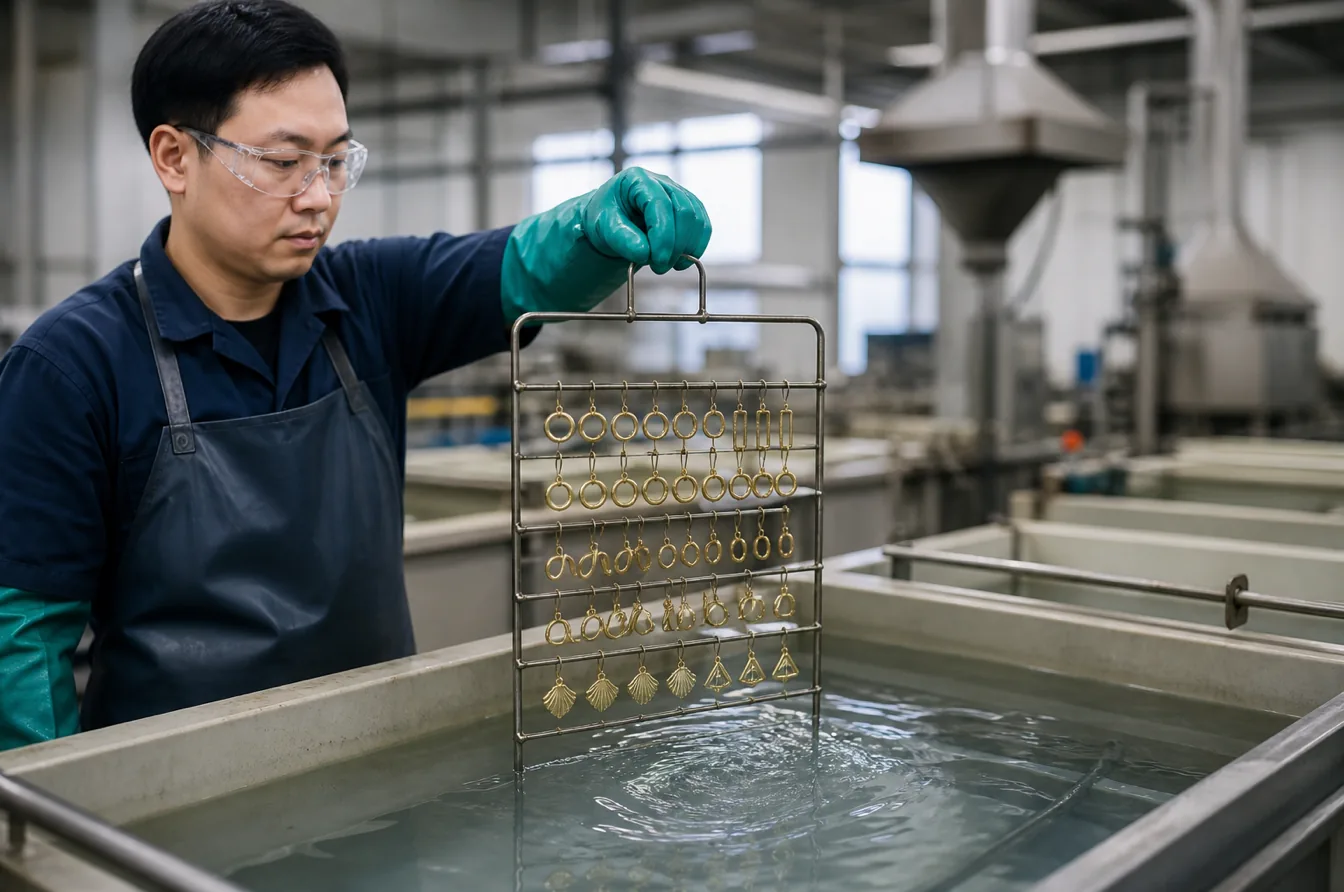
Treat Every Finish as an Engineered Stack
For brass, “gold plated” is not a complete specification. The supplier should define the brass grade, cleaning and polishing route, any copper or nickel barrier layer, decorative metal layer, color layer, clear lacquer or electrophoretic topcoat, and curing conditions. The stack should also identify target thickness or process limits, rack points, masking areas, and the surfaces that are critical for appearance or skin contact.
Edges, holes, deep recesses, hinge barrels, and moving contact zones are common weak points. Electroplated thickness can vary with geometry, while organic coatings can bridge a recess, pull away from a sharp edge, or crack when the part flexes. A decorative layer that looks excellent on a flat master chip may perform poorly on the actual component. Cross-hatch adhesion, abrasion, repeated operation, chemical contact, and microscopy of high-wear areas help expose these weaknesses.
For 316L, passivation and color coating serve different purposes. Passivation is a chemical treatment used to remove free iron and support a clean passive surface; it is not a decorative metal layer and does not turn 316L into a different corrosion grade. Polishing, electropolishing, pickling after heat exposure, proper rinsing, and protection from carbon-steel contamination can all influence corrosion performance.
PVD is a common route for gold, rose-gold, black, and other colors on stainless steel. It can provide a hard, thin surface, but performance still depends on preparation, interlayers, coating chemistry, thickness, adhesion, component geometry, and service wear. A moving slider can create metal-to-metal abrasion that a stationary logo plate never experiences. Each color and component geometry should therefore be approved individually or covered by a justified product-family test plan.
Verify Skin Contact on the Finished, Conditioned Component
Neither “316L” nor “brass” guarantees skin compliance. 316L contains nickel as part of the alloy, and a brass finish may include a nickel-bearing underlayer. A supplier statement such as “hypoallergenic,” “nickel-free color,” or “stainless steel” does not replace release testing when the destination market and contact pattern require it.
For the European Union, REACH Annex XVII Entry 27 limits nickel release to 0.5 μg/cm²/week for parts of relevant articles intended for direct and prolonged skin contact, including listed garment fasteners and metal marks. The current compliance route, product scope, sampling, and result interpretation should be confirmed with a qualified laboratory or compliance specialist for the target market.
The published European standard references also matter. The Commission’s 2023 communication for REACH Entry 27 lists EN 1811:2023 as the reference test method for nickel release and EN 12472:2020 for simulated wear and corrosion of coated articles. This is important for plated or coated brass because an intact new barrier can behave differently after normal-use conditioning. It is also relevant to colored stainless hardware when the coating forms part of the claimed skin-contact performance.
Physical skin safety belongs in the same review. Inspect for burrs, rough corrosion products, peeling layers, sharp edges, pinch points, and pressure concentration after environmental and mechanical cycling. The back of a clasp may be more important than its polished front. Evaluate the component on wet, stretched fabric because its orientation and contact area may change during actual wear.
| Surface route | Main purpose | Main failure risk | Approval evidence |
|---|---|---|---|
| Polished raw brass | Warm natural color and shine | Tarnish, patina, transfer, and uneven aging | Agreed aging expectation plus exposure and staining tests |
| Plated and clear-coated brass | Stable decorative color and substrate isolation | Thin edges, pores, wear-through, lifting, and chemical softening | Documented finish stack, thickness control, adhesion, abrasion, and chemical tests |
| Polished and passivated 316L | Clean silver surface with inherent alloy performance | Fabrication contamination, roughness, deposits, and crevice attack | Alloy verification, surface process control, corrosion test, and visual master |
| PVD-coated 316L | Gold, rose-gold, black, or other fashion color | Adhesion loss, edge wear, scratching, and color mismatch | Coating specification, color master, abrasion, operation, and chemical exposure |
| Any skin-contact finish | Appearance and wearer compatibility | Nickel release, roughness, peeling, and discomfort after wear | Market-specific compliance review and finished-component testing |
What Material Specifications and Tests Should You Confirm Before Bulk Production?
A polished sample and a generic certificate cannot control substitution, mixed alloys, finish variation, or performance loss after assembly.
Lock the exact alloy, finish stack, geometry, exposure profile, acceptance criteria, traceability, and change-control rules. Then verify material identity and test production-intent components for corrosion, wear, function, skin contact, and fabric compatibility.
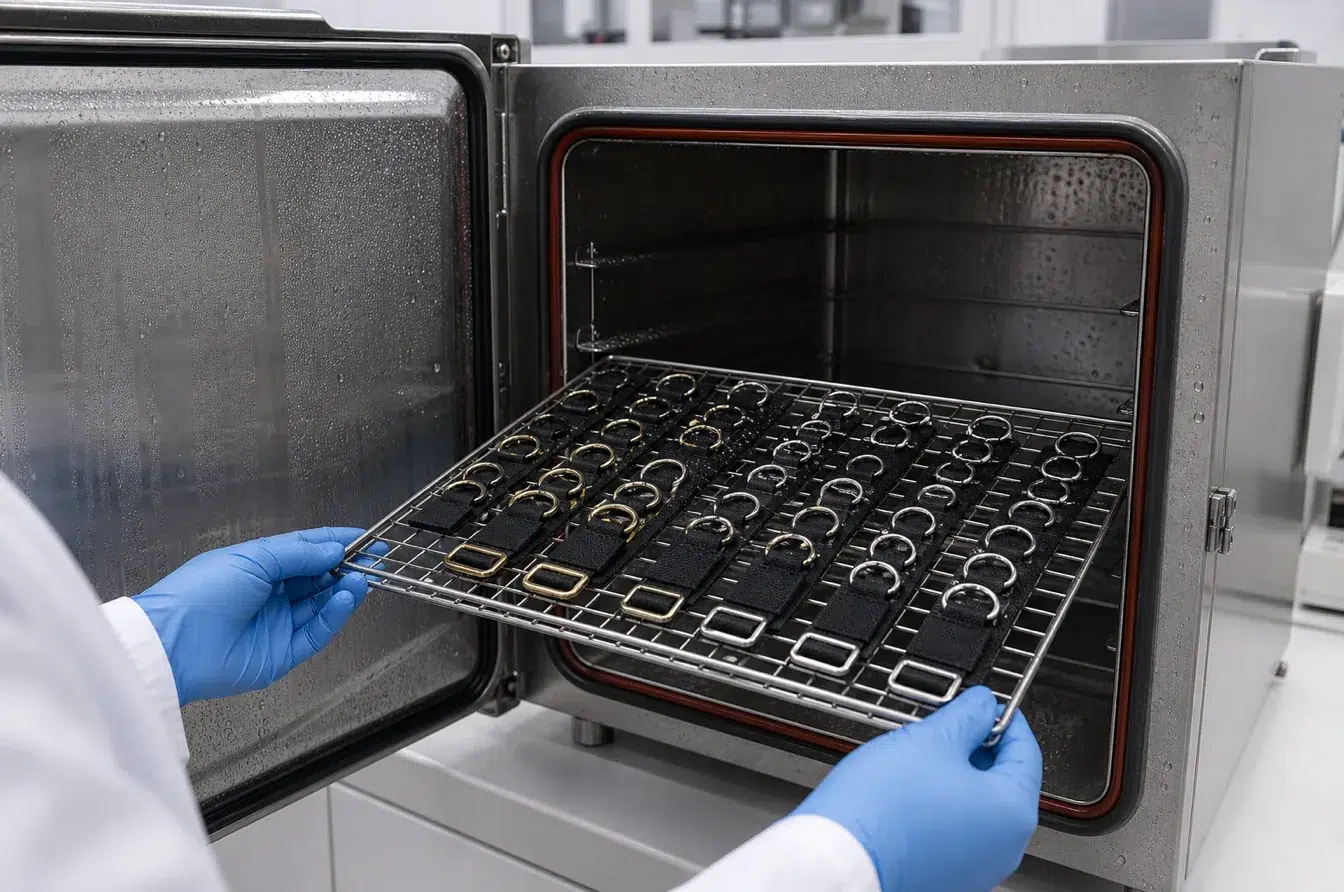
Write an RFQ That a Factory Can Execute and Inspect
The material line should use a recognized grade rather than “stainless steel” or “solid brass.” For 316L, identify the applicable designation and product standard, such as UNS S31603 or EN 1.4404 where suitable for the supplied form. State whether welding is used, because the low-carbon “L” requirement has particular value around heat-affected areas. For brass, specify the exact UNS or EN alloy, temper, lead and restricted-substance limits, and any dezincification-resistance requirement justified by the application.
Material traceability should link the delivered parts to a heat, batch, or lot and to the supplier’s certificate. Handheld XRF is useful for identifying molybdenum and distinguishing the 316 family from 304, but it cannot measure carbon. Thermo Fisher’s PMI technology comparison explains why XRF can identify 316 chemistry yet cannot prove whether the grade is 316L or 316H. When low carbon must be verified, use traceable mill documentation and an appropriate carbon-capable method under a qualified inspection plan.
The drawing should define dimensions, tolerances, section thickness, radii, openings, joints, welds, attachment features, and surfaces that contact skin or fabric. The finish specification should name every layer or treatment, critical thickness or process window, color and gloss master, polishing direction, allowed defects, rack-point location, and masking. Add actual component weight when comfort or garment balance matters.
The RFQ should also state intended use: pool, sea, spa, occasional resort wear, or frequent training; expected contact with sweat and sunscreen; intended care; target markets; and whether the part is load-bearing. Without this information, two technically honest suppliers can quote very different constructions and both claim compliance.
Change control completes the specification. A factory should obtain approval before changing the metal source, alloy, temper, forming method, polishing compound, plating line, underlayer, PVD recipe, topcoat, spring, pin, solder, weld process, or subcontractor. A visually similar change can alter corrosion, nickel release, color, adhesion, or load performance.
Validate Identity and Performance with Different Tests
Material verification answers, “Did the factory use the specified alloy?” Performance testing answers, “Does the finished component survive its intended service?” One cannot replace the other. A correct 316L composition can still fail because of a weak weld, sharp edge, contaminated surface, or water-trapping joint. A correct brass grade can still discolor when its coating is porous or worn through.
Build the validation matrix around failure modes. Use production-intent parts in every approved color and include actual fabric, elastic, stitching, reinforcement, and attachment method. Compare exposed samples with unexposed controls under consistent lighting. Inspect front, back, edges, recesses, joints, contact zones, and adjacent textile after each defined interval.
ISO 9227:2022 can support salt-spray assessment of metallic materials and protective systems, especially for detecting coating discontinuities. However, the standard does not assign a universal exposure duration or interpretation for every product. A quotation that promises a large number of salt-spray hours is incomplete without the method, specimen preparation, acceptance criteria, evaluated surfaces, and reason that the condition represents the product risk.
Swimwear also needs application-specific exposure. The ISO textile methods for sea water, chlorinated pool water, and perspiration can help evaluate color change and staining of the surrounding fabric. They do not replace a metal corrosion test, coating evaluation, or mechanical test. Use them as part of an assembly-level program rather than as proof that the hardware itself is approved.
Mechanical checks should be completed before and after conditioning. Measure pull strength, closure retention, opening force, slider movement, permanent deformation, operating cycles, weld or joint integrity, attachment strength, and fabric damage. Chemical compatibility should include representative sunscreen, body oil, detergent, and care sequences. Skin-contact testing should follow the destination market and the final conditioned surface.
Acceptance criteria should be written before testing. Define permitted color change, gloss change, tarnish, corrosion, pitting, staining, blistering, peeling, cracking, tack, roughness, operating-force change, deformation, and fabric damage. State whether any failed sample causes rejection, how retesting is handled, and who can approve a deviation. A report that only says “pass” is not enough to support bulk production.
| Control stage | Minimum evidence | What it prevents |
|---|---|---|
| Material definition | Recognized alloy, standard, temper or condition, and restricted-substance limits | Vague or substituted base metal |
| Incoming verification | Traceable certificate plus risk-based alloy analysis | Grade mixing and unsupported supplier claims |
| Surface control | Complete finish stack, process limits, color master, and critical areas | Thin edges, inconsistent color, weak adhesion, and hidden process changes |
| Environmental testing | Defined seawater, pool, perspiration, sunscreen, heat, wet-dry, rinse, and drying cycles | Approval under an unrealistic single exposure |
| Mechanical testing | Pull, retention, operation, deformation, abrasion, attachment, and post-conditioning checks | Structural or functional failure despite good appearance |
| Skin and textile evaluation | Nickel-release route where applicable, edge safety, coating condition, and staining | Compliance, comfort, and pale-fabric transfer problems |
| Production control | Lot sampling, inspection records, failure rules, and change notification | Drift between approved samples and bulk goods |
Conclusion
Choose 316L for demanding functional hardware and specified brass for controlled decorative use, then approve the complete component through exposure, wear, skin, fabric, and load testing.