- Loading...
Small lingerie components can lose color, irritate skin, deform, or damage delicate fabric when material selection begins with appearance and price alone.
316L stainless steel is the safest starting point for premium, load-bearing lingerie hardware. Brass suits warm luxury details, while zinc alloy gives the greatest freedom for intricate, cost-efficient shapes. The best specification often assigns different materials to different components.

The useful question is not which metal wins every comparison. It is which combination of base material, geometry, finish, and validation best fits each ring, slider, hook, clasp, charm, or logo plate.
What Performance Requirements Should Lingerie Hardware Meet?
Lingerie hardware works at a difficult interface: it must manage tension and movement while remaining light, smooth, stable, and comfortable against sensitive skin.
A suitable component must balance mechanical strength, low profile, rounded edges, finish durability, skin-contact compliance, fabric compatibility, and repeatable adjustment. These requirements should be defined before the development team compares zinc alloy, brass, or stainless steel.
Translate Garment Use into Hardware Requirements
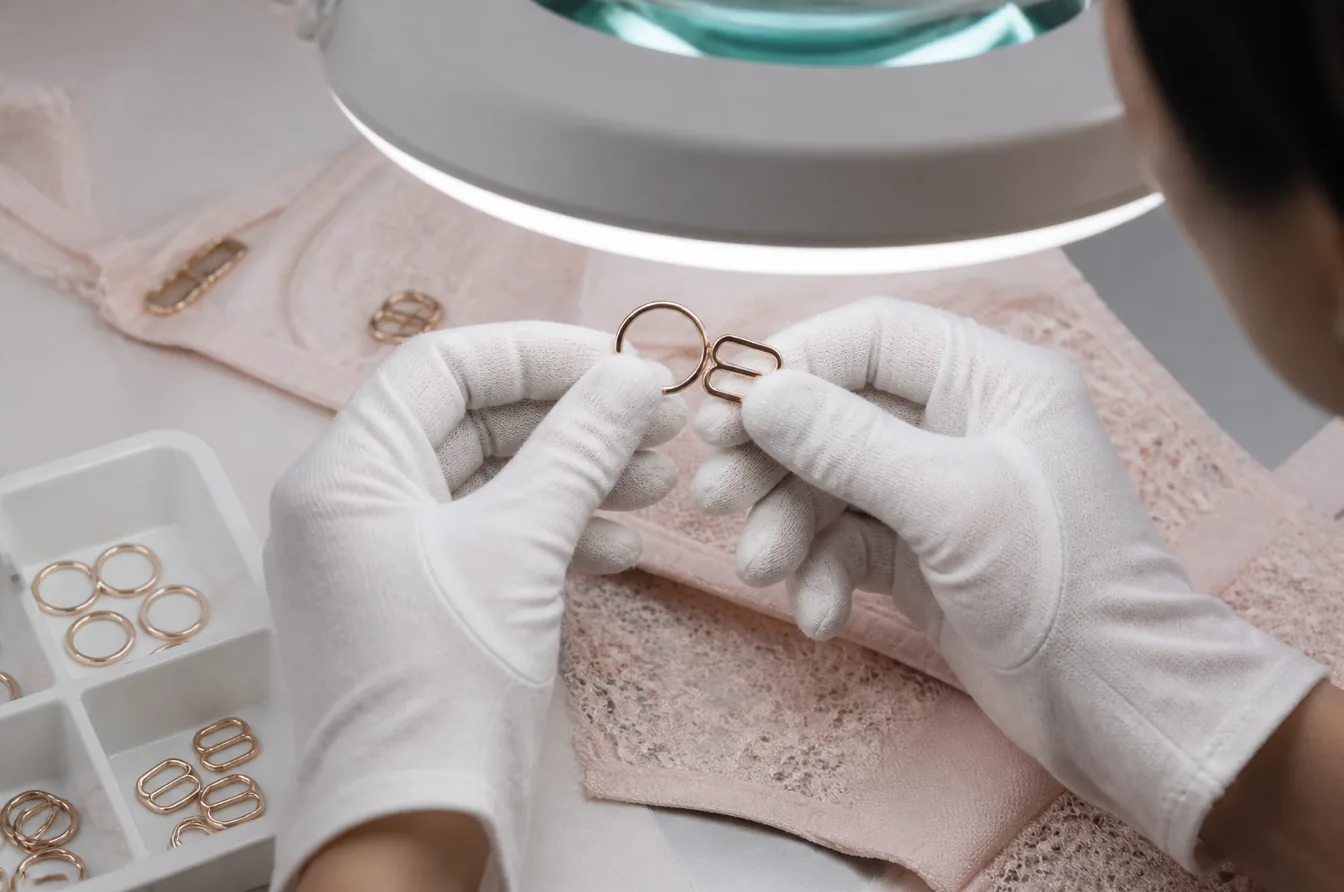
A metal slider on a soft bra strap has a different job from a center-front ornament, even when both parts share the same color. The slider repeatedly moves against elastic and helps control fit. A ring changes the strap direction and carries continuous tension. A hook or clasp must open and close reliably. A decorative bar may carry little structural load but can press directly against the body or pull a lightweight garment out of shape.
Material selection should therefore begin with a short functional classification. Each component can be described as load-bearing, adjusting, closing, connecting, attaching, decorative, or a combination of these roles. This classification identifies the most important failure mode. A load-bearing ring may spread or break. A slider may slip, abrade the strap, or become difficult to move. A plated charm may tarnish or transfer color. A logo plate may remain visually perfect but feel too heavy or create an uncomfortable pressure point.
In our development work, we normally separate functional parts from decorative parts before reviewing metal samples. This prevents the team from choosing one attractive substrate for the entire collection and discovering later that it is too soft for a clasp, too costly for a large ornament, or too difficult to form into a delicate profile.
The garment category also changes the target. Daily bras and shapewear need reliable cycling and stable adjustment. Fashion lingerie may prioritize jewelry-like detail. Sports bras add perspiration and repeated movement. Bridal pieces may be worn less often but still require flawless pale fabrics and stable bright finishes. The use case—not the product name—sets the correct performance level.
Make Comfort Part of the Engineering Specification
Comfort is often discussed only during fitting, but several comfort variables can be controlled on the drawing. Overall mass affects whether a trim stays flat or pulls the fabric. Thickness affects pressure against the body. Edge radius and polish affect whether a part scratches skin or cuts elastic. Internal width influences strap bunching, while opening clearance determines whether a slider adjusts smoothly without creating excessive friction.
Small parts deserve especially careful edge control because lingerie fabrics are thin and skin contact is close. A burr that would be harmless on a handbag can damage lace, snag microfiber, or become painful during extended wear. Parting lines, gate-removal areas, welds, engraving edges, coating buildup, and rack marks should all be placed away from critical contact surfaces or finished to an agreed standard.
Weight should be approved on the garment rather than judged from a loose sample. A component can feel reassuringly substantial in the hand but become distracting when suspended from narrow elastic. Conversely, an aggressively thinned part may feel light but deform during adjustment. The target is not minimum mass at any cost. It is enough section to retain shape, with a profile that follows the garment and avoids concentrated pressure.
The design team should also consider temperature sensation and movement noise. Metal may feel cold at first contact, and loose charms or paired rings can click against each other. These details rarely appear on a material certificate, but they influence how premium the finished garment feels.
| Requirement | Design question | Practical verification |
|---|---|---|
| Strength | Does the part carry strap tension or closure force? | Pull, deformation, and repeated-operation testing |
| Comfort | Can any face, edge, joint, or mark touch skin? | Edge inspection and extended wear trial |
| Low weight | Will the component distort drape or pull narrow elastic? | Actual part mass and garment fitting |
| Fabric safety | Can the part cut, snag, stain, or abrade the textile? | Assembly cycling with production fabric |
| Adjustment | Must the part move deliberately but hold during wear? | Adjustment-force and strap-slippage checks |
| Appearance | Must color remain bright after sweat and washing? | Conditioned finish and color evaluation |
How Do Zinc Alloy, Brass, and Stainless Steel Compare in Weight, Strength, and Corrosion Resistance?
The three materials cannot be ranked responsibly without specifying alloy grade, manufacturing route, geometry, finish, and the environment in which the finished part will work.
316L stainless steel usually provides the strongest all-round margin for functional lingerie hardware. Brass combines formability with a warm premium character, while zinc alloy supports economical complex casting. Finished-part performance still depends on section design and surface treatment.
Compare Finished Components, Not Generic Material Names
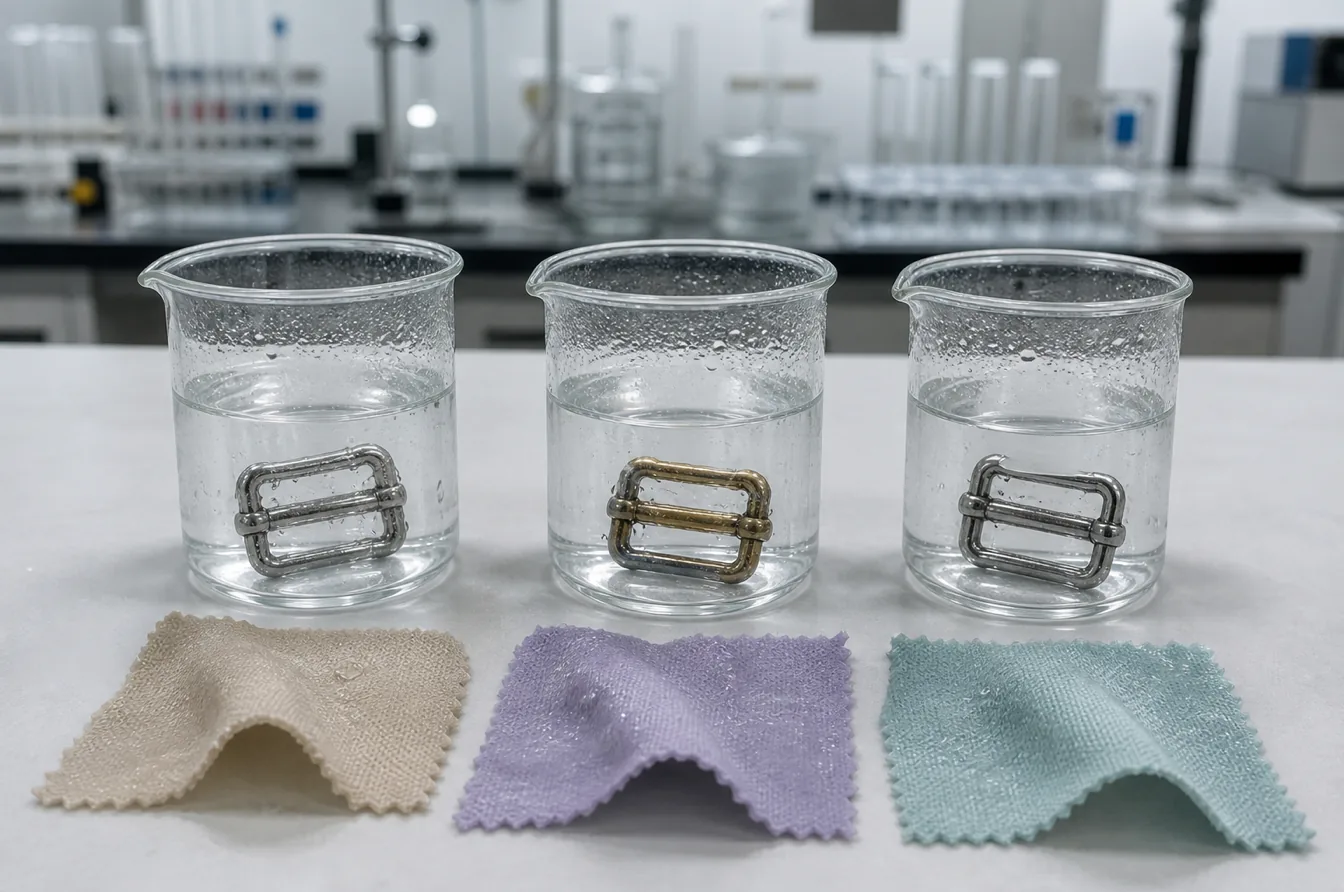
“Zinc alloy,” “brass,” and “stainless steel” each describe a family rather than one fixed performance level. A Zamak die casting, a work-hardened brass strip, and a formed or machined 316L part are produced differently and should not be compared only through generic tensile-strength figures. Temper, porosity, cold work, weld condition, wall thickness, corner radius, and load direction can change the behavior of the actual component.
Zinc alloy is well suited to precision die casting. The International Zinc Association highlights net-shape production, strong finishing capability, and economical casting, while ASME’s overview of zinc casting explains how thin walls and complex geometry can reduce secondary operations. For lingerie, these advantages suit sculptural sliders, logo plates, charms, and decorative clasps. The design must still avoid fragile projections, very thin stressed sections, and hidden porosity in critical areas.
Brass is valuable where forming, stamping, drawing, machining, engraving, or a warm exposed-metal appearance matters. The Copper Development Association’s data for C26000 cartridge brass shows how mechanical properties vary widely with temper, which is why “solid brass” alone is not a production specification. A soft temper may form easily but lack the retention needed for a spring-like part. A harder temper may improve shape retention but require different forming control.
Stainless steel is the strongest default for many narrow functional components because it can combine mechanical durability with corrosion resistance. However, “stainless” is not a grade. The worldstainless material overview distinguishes stainless families and grades, including 304 and molybdenum-bearing 316L. For premium lingerie exposed repeatedly to sweat and washing, 316L often offers the more defensible margin, especially for rings, sliders, hooks, and clasps.
Separate Weight, Strength, and Corrosion Decisions
Weight should be calculated from density and finished volume together. Zinc is relatively dense compared with aluminum, but it can be cast with thin walls and integrated details. Brass and stainless steel can also use efficient stamped, wire-formed, hollow, or machined structures. A heavier material can therefore produce a lighter component if its manufacturing route permits a thinner section, while a low-cost casting can become heavy when the design contains unnecessary bulk.
Strength also needs component-level language. The relevant question may be resistance to opening, bending, impact, fatigue, or permanent deformation—not simply ultimate tensile strength. A closed stainless ring may provide a high structural margin, but a badly welded joint can remain the weak point. A brass slider can perform well when alloy, temper, bar geometry, and strap friction are controlled. A zinc-alloy ornament can be completely suitable when it remains outside the main load path.
Corrosion resistance is equally conditional. Stainless steel forms a protective passive surface, but grade, finish, contamination, crevices, and retained salts still matter. The worldstainless corrosion guide specifically shows that surface roughness and unsealed crevices influence performance. Brass can tarnish or change color, and its behavior depends on alloy and environment. Zinc alloy accepts many protective and decorative finishes, but a damaged or poorly prepared coating can expose the substrate and change appearance.
This is why the broad hierarchy “stainless steel, then brass, then zinc alloy” is useful only as an initial durability assumption. It should never replace evaluation of the exact part. The best commercial decision may use stainless steel for stressed components, brass for premium warm-metal details, and zinc alloy for complex decorative elements.
| Decision factor | Zinc alloy | Brass | 316L stainless steel |
|---|---|---|---|
| Typical strength in lingerie use | Suitable for decorative and moderate-stress cast parts | Good when alloy, temper, and section are controlled | Strong starting point for slender functional parts |
| Weight strategy | Thin-wall casting can control mass | Stamping or wire forming can reduce volume | Thin formed or machined sections can control mass |
| Corrosion behavior | Relies more heavily on finish in demanding use | May tarnish; alloy and protection matter | Strongest general corrosion margin of the three |
| Main production advantage | Complex net-shape casting | Forming, machining, engraving, and warm color | Durable functional profiles and stable silver appearance |
| Main development risk | Porosity, thin projections, and finish breakdown | Vague alloy or temper and uncontrolled tarnish | Unspecified grade, rough finish, or fabrication contamination |
Which Material Works Best for Intricate Shapes, Custom Finishes, and Premium Detailing?
Design freedom depends on the manufacturing route as much as the metal, so the preferred material changes with relief depth, wall section, engraving, color, and volume.
Choose zinc alloy for complex cast relief and economical visual variety, brass for warm luxury and formed or engraved detail, and stainless steel for crisp functional minimalism or durable silver surfaces. Premium quality comes from matching material and process.
Use Zinc Alloy When Geometry Creates the Value
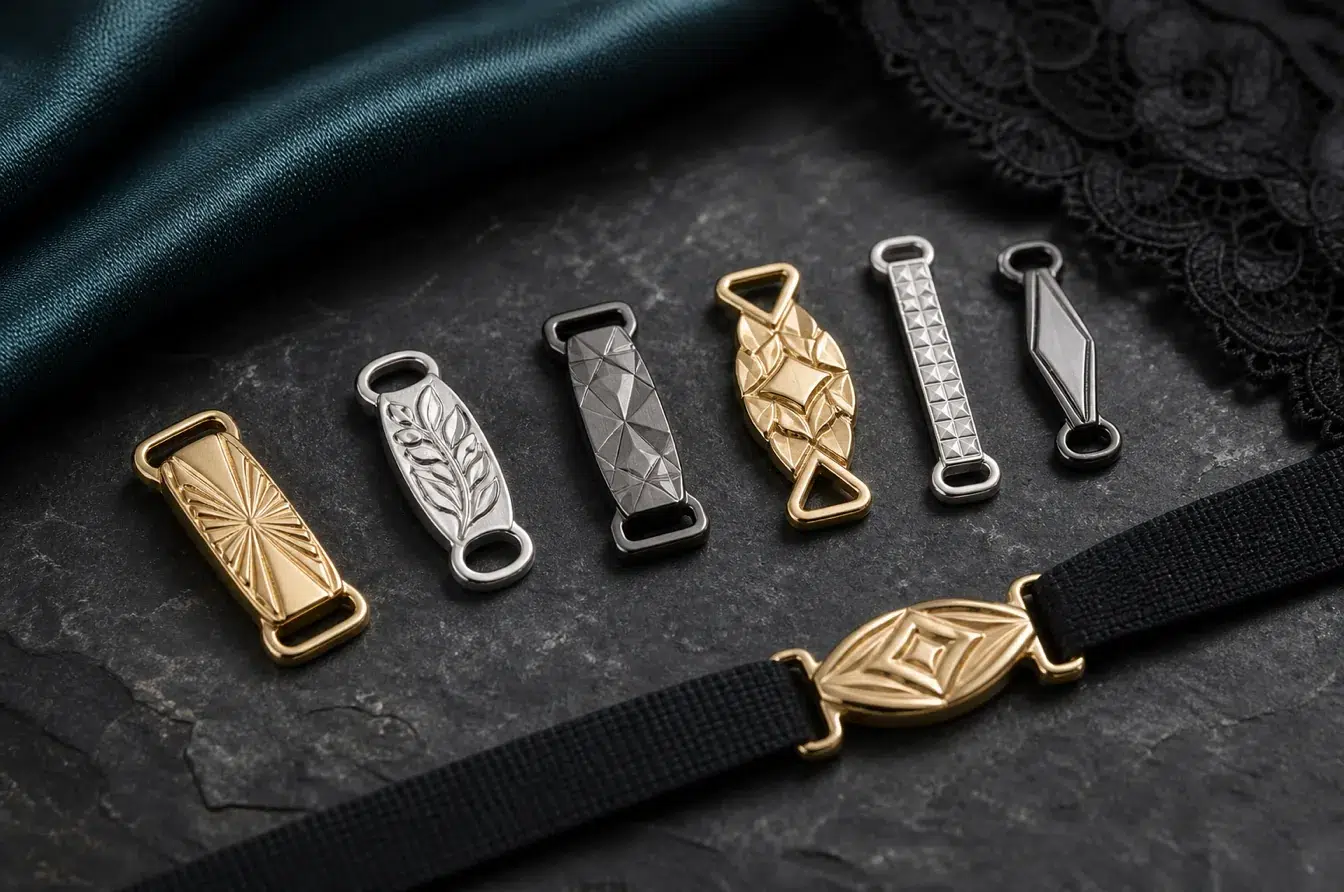
Zinc alloy becomes especially attractive when the component needs a three-dimensional logo, sculptural relief, recessed texture, integrated loop, unusual contour, or multiple features in one casting. Good fluidity and precision die casting can reproduce fine detail and consolidate parts that might otherwise require several stamping, machining, or assembly steps. This makes zinc alloy commercially useful for branded charms, center-front ornaments, custom logo plates, decorative sliders, and fashion-led seasonal collections.
It should not be described only as the “cheap” option. A well-designed zinc casting can provide crisp definition and a substantial hand feel. The material also accepts a broad range of finishing routes. Zinc-industry guidance lists electroplating, painting, passivation, polishing, and other surface options, and its finish-selection guidance makes clear that the required appearance and service class should guide the system.
The design needs casting discipline. Deep blind recesses can trap polishing compound or cleaning solution. Sharp raised logos can create weak projections and poor coating coverage. Thick-to-thin transitions can increase shrinkage or porosity risk. Parting lines and ejector marks can interrupt a premium face. The supplier should review draft, wall transitions, gate location, polishing allowance, rack points, and critical cosmetic zones before tooling is approved.
For high-volume collections, zinc alloy can offer an effective balance between tooling investment and unit cost. For very small trial quantities, however, the mold cost may outweigh the material advantage. Prototype strategy, forecast volume, color count, and expected design life should be discussed together.
Use Brass and Stainless Steel for Different Premium Expressions
Brass communicates warmth naturally. It works well for gold-toned, vintage, jewelry-inspired, engraved, or softly polished details. It can be stamped, formed, drawn, machined, coined, or engraved depending on the selected grade and product form. This flexibility supports thin rings, shaped sliders, decorative bars, and detailed signature pieces without forcing every design into a casting route.
The natural color is also a practical design asset when an exposed-brass appearance is acceptable. Wear may reveal a similar warm substrate rather than a sharply contrasting base. However, unprotected brass can tarnish or develop patina, so a stable bright-gold promise usually needs a controlled finish. The brand must decide whether gradual surface change is part of the aesthetic or a defect.
Stainless steel creates a different premium signal: precise, cool, technical, and durable. Polished, satin, brushed, blasted, or electropolished silver finishes can use the metal’s own surface rather than depending on a decorative barrier layer. That reduces one route to peeling or color breakthrough, although it does not eliminate the need for careful polishing, passivation, cleanliness, and corrosion review.
Colored stainless steel normally needs PVD or another compatible coating. Gold PVD on stainless and gold plating on brass may look similar at first approval but age differently. If both appear in the same garment, the team should compare color under multiple light sources and after wear, sweat, and laundering. Mixed materials can be commercially smart, but only when the visible hardware family remains coherent throughout use.
We recommend approving finish on the actual geometry, not only on a flat color chip. Edge coverage, recess depth, rack position, polishing direction, and moving contact zones can change the result even when the nominal color code is identical.
| Design priority | Best starting point | Why it fits | Main caution |
|---|---|---|---|
| Deep relief or sculptural logo | Zinc alloy | Precision die casting reproduces integrated detail | Control draft, porosity, projections, and coating coverage |
| Warm gold or vintage character | Brass | Natural color and strong decorative process flexibility | Define whether tarnish is acceptable |
| Thin formed ring or slider | Brass or stainless steel | Formed sections can provide low profile and clean edges | Specify alloy, temper, joint, and edge finish |
| Durable natural silver | 316L stainless steel | Premium appearance without a colored decorative coating | Control grade, polish, passivation, and contamination |
| Fashion color on complex geometry | Zinc alloy or coated stainless steel | Both support broad visual options | Qualify each coating on the actual component |
| Seasonal high-volume ornament | Zinc alloy | Tooling can support repeatable low unit cost | Confirm volume before committing to the mold |
How Do Skin Contact, Sweat, and Washing Affect Material and Plating Choices?
Lingerie exposes hardware to a repeating mixture of perspiration, body oils, lotion, detergent, friction, pressure, heat, and storage while still slightly damp.
Skin-contact performance belongs to the finished component, not the base metal alone. The approval plan should evaluate corrosion, color change, coating wear, nickel release, fabric staining, edge comfort, and operation after realistic perspiration and laundering exposure.
Treat Perspiration and Laundering as Combined Exposure
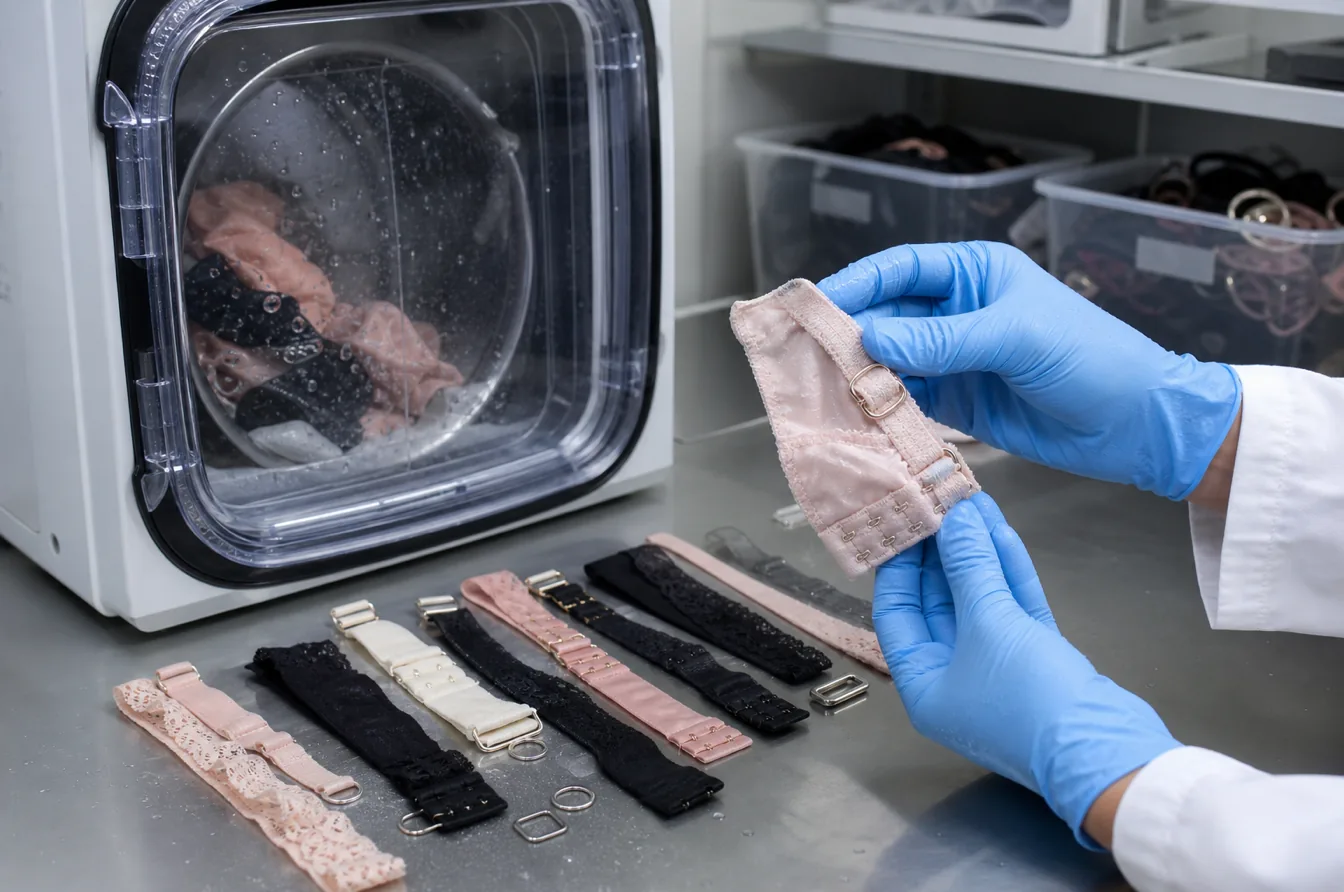
Sweat is not simply water. It adds moisture, salts, acidity, and skin residues while the component rubs against fabric and the body. Lotion, fragrance, deodorant, and body oil can interact with clear coats or colored finishes. After wear, the garment may remain damp in a laundry bag, then meet detergent, heat, water, and mechanical action. A metal coupon dipped once and inspected immediately does not represent this sequence.
Stainless steel generally offers the best starting corrosion margin, particularly in 316L, but retained moisture and deposits can still affect joints, rough surfaces, engraved recesses, and tight crevices. Brass may tarnish or transfer discoloration if its protective finish wears. Zinc alloy can perform well with a suitable finish, but exposed areas at edges or moving interfaces deserve close inspection.
Testing should separate several outcomes. The base metal may remain structurally sound while the decorative color dulls. The coating may stay attached but develop fine scratches. The metal may look acceptable but stain pale fabric. A slider may pass visual inspection while its internal bars become rough enough to abrade elastic. Approval therefore needs both appearance and function criteria.
ISO 105-E04 is a current method for evaluating textile colorfastness to perspiration, and ISO 105-C06 covers domestic and commercial laundering colorfastness under defined detergent and mechanical conditions. These standards do not by themselves prove that a metal component is durable, but they provide useful textile-side frameworks. A hardware program should combine relevant standardized methods with product-specific metal, finish, and assembly checks.
The care label should guide the protocol. Hand-wash lingerie, machine-wash basics, sports bras, and shapewear do not experience the same detergent, temperature, cycle count, or abrasion. The test plan should reproduce the intended care method and include enough repeated cycles to reveal gradual wear.
Verify Skin Compliance after the Finish Has Been Conditioned
“Nickel-free,” “hypoallergenic,” “316L,” or “eco plating” should not be treated as complete compliance evidence. Austenitic stainless steel may contain nickel as an alloying element, and brass or zinc-alloy parts may use nickel-bearing layers within a decorative coating system. What matters for relevant skin-contact requirements is the release from the finished part under the applicable conditions.
For the European Union, REACH Annex XVII Entry 27 covers articles intended for direct and prolonged skin contact and explicitly includes garment items such as tighteners, rivets, zippers, and metal marks. It limits nickel release from the contacting parts and also addresses non-nickel coatings intended to maintain compliance during normal use.
The European Commission identifies EN 1811:2023 as the reference method for nickel release from relevant skin-contact articles and EN 12472:2020 as the accelerated wear and corrosion method for coated items. This distinction is important. A freshly plated sample may release little nickel, but the result after simulated wear is more meaningful when a barrier coating protects a nickel-containing substrate or underlayer.
The correct scope depends on the destination market, contact pattern, product category, and customer requirements. The development team should identify these requirements before requesting tests. Finished components should be tested in the production-intent alloy and finish, and a change in plating supplier, layer construction, coating thickness, polishing route, or substrate should trigger a review of whether revalidation is needed.
| Exposure or concern | Possible failure | What to evaluate |
|---|---|---|
| Perspiration | Tarnish, corrosion, color shift, or roughness | Appearance, function, surface condition, and fabric staining |
| Body oils and cosmetics | Softened clear coat, dulling, tack, or discoloration | Representative contact followed by cleaning and inspection |
| Laundering | Abrasion, peeling, deformation, or transfer | Repeated intended-care cycles on the assembled garment |
| Direct skin contact | Nickel release or irritation risk | Applicable chemical compliance on the finished component |
| Coated skin-contact part | Barrier wear exposes an underlayer or substrate | Nickel release after accelerated wear and corrosion when applicable |
| Damp storage | Crevice attack, deposits, or staining | Wet-dry cycles with delayed drying and joint inspection |
What Material Specifications and Tests Should Be Confirmed Before Bulk Production?
A beautiful sample is not a production specification, and a material name cannot control alloy substitution, finish thickness, edge quality, or bulk consistency.
Before bulk production, lock the exact alloy, manufacturing route, dimensions, tolerances, surface preparation, coating construction, critical surfaces, compliance requirements, and performance tests. Approval should use production-intent hardware installed on the real garment materials.
Write a Specification That Suppliers Can Manufacture and Quote
The drawing should name the exact base material. “Zinc alloy” should become a defined Zamak or other agreed grade. “Brass” should identify the alloy, product form, and temper where these affect forming and strength. “Stainless steel” should identify 316L, 304, or another approved grade rather than allowing the supplier to choose an unspecified stainless material.
Manufacturing route belongs beside the material. A die-cast zinc part, stamped brass slider, wire-formed ring, machined stainless clasp, and metal-injection-molded component have different tooling, tolerances, surface conditions, and failure risks. If the process changes, the original approval may no longer represent production.
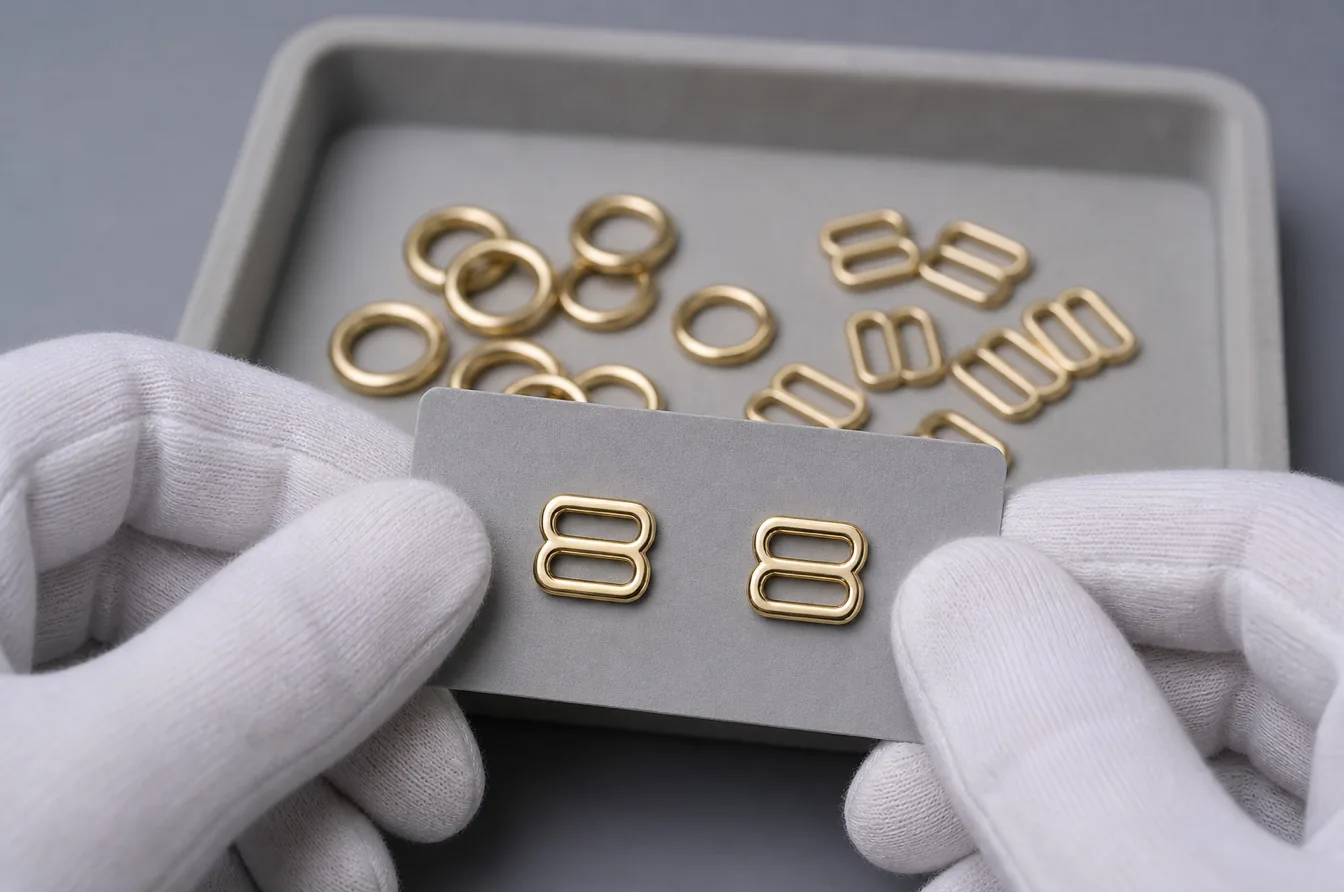
The dimensional specification should include usable internal width, internal height, bar or ring section, overall thickness, opening, joint or weld condition, edge radius, flatness, and critical fit interfaces. For a slider, internal spacing must suit the finished elastic thickness and threading path. For a ring, the drawing should control opening resistance and any weld. For an ornament, it should show attachment points, center of mass, skin-facing surfaces, and maximum permitted weight.
Finish language needs equal precision. “Gold,” “nickel-free,” or “PVD” is incomplete. The specification should define color reference and tolerance, gloss, surface preparation, layer sequence where relevant, thickness or controlled process range, clear coat or sealer, rack-mark location, masked zones, critical appearance faces, and prohibited substances. When suppliers treat this information as confidential, they should still provide enough controlled evidence to ensure repeatability and compliance.
We also recommend separating universal requirements from component-specific requirements. Every part may need acceptable color and restricted-substance compliance, but only a moving slider needs adjustment cycling, and only a structural clasp needs a defined retention force. This keeps the test plan relevant and prevents unnecessary cost.
Approve Production-Intent Assemblies and Control Changes
Testing should move from the loose component to the installed system. First confirm dimensions, material identity, finish appearance, and basic component strength. Then assemble the hardware with production elastic, lace, fabric, stitching, folds, reinforcement, and setting conditions. This reveals strap slippage, cutting, bunching, color transfer, distortion, and attachment failure that the loose part cannot show.
The performance plan can include pull strength, permanent deformation, closure retention, adjustment cycles, strap slippage, abrasion, edge inspection, corrosion exposure, perspiration conditioning, laundering, coating adhesion, color comparison, and relevant chemical compliance. The correct sequence matters. When corrosion or laundering occurs before mechanical cycling, it shows whether exposure changes operation. When cycling occurs before chemical testing, it can expose coating wear that a pristine sample hides.
Samples should come from production-intent tooling and the intended finishing line whenever possible. A hand-polished prototype may have smoother edges and thicker local coating than bulk parts. Early samples remain useful for geometry and appearance decisions, but final approval should represent the process used for the order.
Bulk inspection must then protect the approved standard. The control plan can define sampling level, critical dimensions, color range, surface-defect limits, functional checks, and document review. Retain signed master samples from the approved production route and record the material and finish lot where traceability matters.
Change control is the final safeguard. A new alloy source, revised temper, thinner wall, different mold cavity, altered polishing medium, new plating line, changed coating stack, moved rack point, or new elastic can affect performance. Suppliers should disclose these changes before shipment, and the brand should define which changes require sample approval or repeated testing.
| Specification item | What should be locked | Evidence before bulk approval |
|---|---|---|
| Base material | Exact alloy or grade and relevant temper | Material certificate plus verification when required |
| Manufacturing route | Casting, stamping, wire forming, machining, or other process | Production-intent sample and process confirmation |
| Geometry | Critical dimensions, section, radii, joints, and tolerances | Dimensional report and fit check |
| Surface finish | Preparation, color, gloss, layer system, and critical faces | Approved master sample and finish record |
| Mechanical performance | Load, deformation, retention, cycling, or slippage limits | Component and assembled-product test results |
| Environmental durability | Sweat, laundering, cosmetics, wet-dry cycles, and abrasion | Conditioned samples with agreed acceptance criteria |
| Skin-contact compliance | Destination-market and customer chemical requirements | Finished-part laboratory report where applicable |
| Bulk consistency | Sampling, defect limits, color range, and traceability | Inspection plan and retained production standard |
| Change control | Material, tooling, geometry, finish, and supplier changes | Written disclosure and reapproval rule |
Conclusion
Use 316L for demanding functional parts, brass for warm premium detail, and zinc alloy for complex decorative freedom—then validate every finished component in its garment system.