- Loading...
How Do Custom Buckle Requirements Differ Between Apparel and Pet Products?
A buckle can look correct on a sample and still be dangerously wrong when its real function, load, material, or release behavior is ignored.
I specify apparel buckles around fit, comfort, appearance, and care, while pet buckles require a risk-based definition of retention, release, dynamic load, outdoor exposure, and complete-assembly performance.
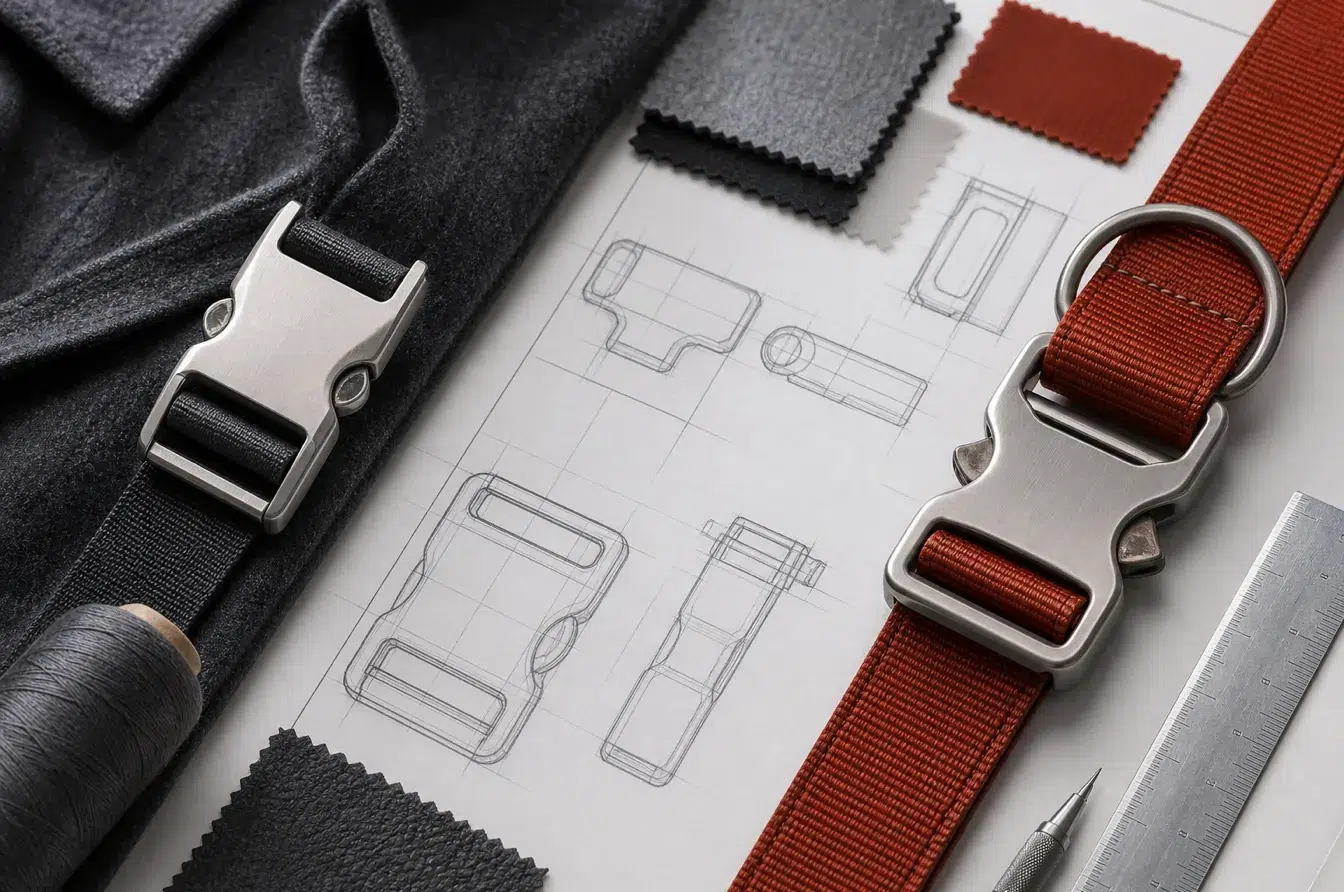
The most important difference is the consequence of failure. An apparel buckle may adjust a waist, complete a silhouette, or carry a logo. A buckle on a collar, harness, or leash may form part of an active restraint system.
This does not mean every apparel buckle is low risk or every pet buckle should be difficult to open. It means I start with the product’s safety function, foreseeable use, and failure modes before I discuss metal color, logo depth, mold cost, or unit price.
What Function Does the Buckle Serve in Apparel and Pet Products?
When a team defines a buckle by appearance alone, suppliers may quote similar-looking parts that solve completely different engineering problems.
Apparel buckles usually provide adjustment, closure, decoration, or brand identity. Pet buckles may provide restraint, controlled release, or adjustment, so the intended safety function must be stated before the mechanism is selected.
Classify the Function Before Selecting the Buckle
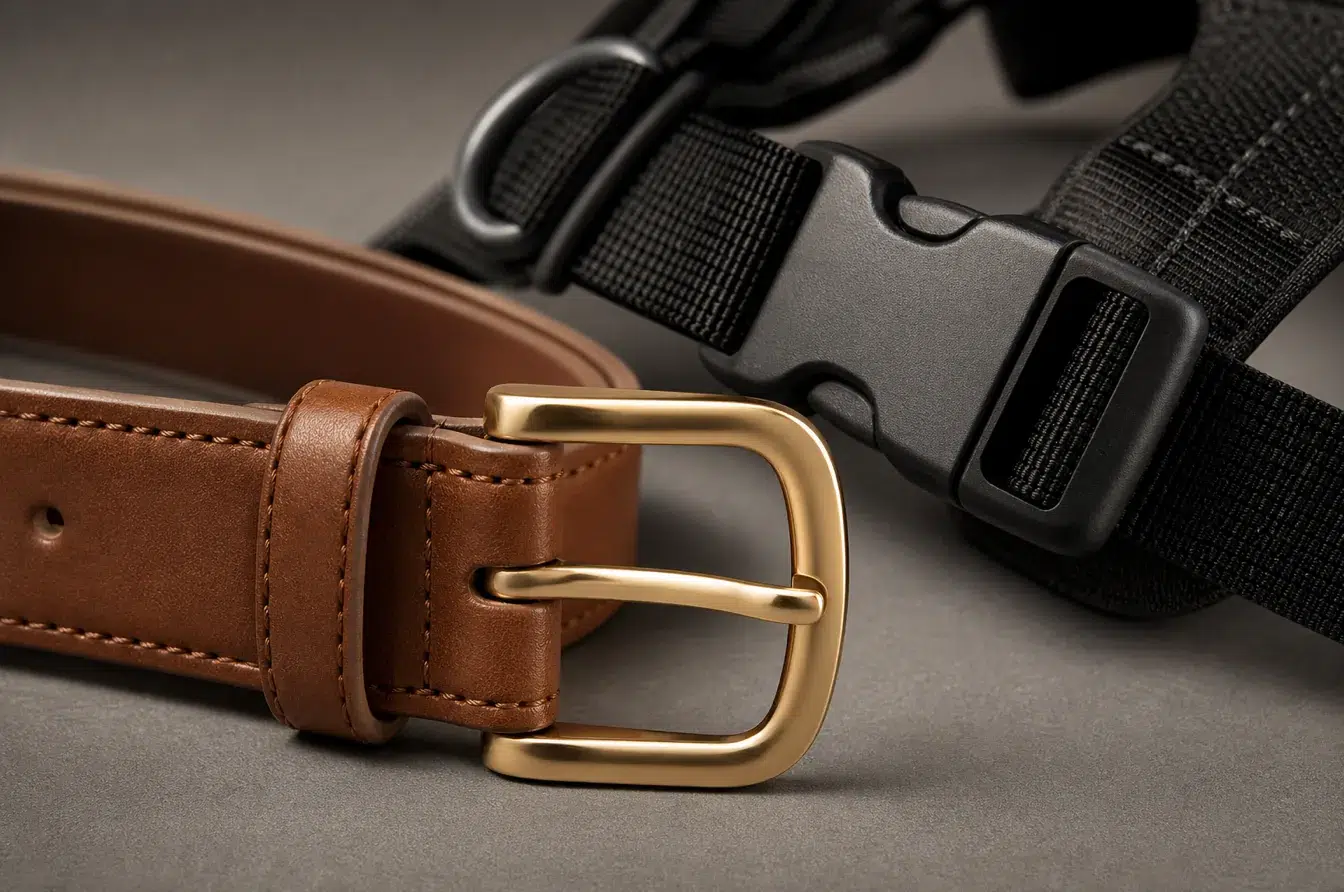
I begin each project by writing one sentence that explains what the buckle must do. For a fashion belt, the answer may be, “Hold the selected waist adjustment during normal wear and release easily by hand.” For a garment trim, the buckle may not carry meaningful load at all. Its real job may be visual balance, brand recognition, or controlled drape.
Pet products need a more precise statement. A side-release buckle on a walking harness may be expected to maintain closure during repeated pulling. A buckle on a leash is part of a connection between the animal and the handler. A breakaway collar has the opposite safety logic: it is intended to separate within a defined condition to reduce entanglement risk. I never treat those functions as interchangeable.
This first sentence controls the rest of the specification. It tells me whether accidental opening, failure to open, loss of adjustment, sharp contact, or visual damage is the dominant risk. It also tells the supplier whether an existing platform is appropriate or whether a new mechanism needs engineering and validation.
| Application | Primary buckle function | Main failure concern | First specification priority |
|---|---|---|---|
| Fashion belt | Adjustment, closure, and visual identity | Unwanted loosening, discomfort, or finish damage | Fit, hand feel, appearance, and normal-wear retention |
| Garment trim | Decoration or light adjustment | Detachment, snagging, or fabric distortion | Low weight, smooth edges, and secure attachment |
| Pet restraint collar or harness | Maintain containment and fit | Accidental release, slippage, or assembly breakage | Retention, load path, and installed-system strength |
| Pet leash | Maintain the handler-to-animal connection | Connection loss or hardware deformation | Dynamic load capacity and secure attachment |
| Breakaway pet collar | Separate under a defined hazard condition | Release too early or failure to release | A controlled and repeatable release window |
Judge Risk by Failure Consequence, Not by Market Label
I do not use “apparel” as a shortcut for “non-safety.” A decorative buckle on an adult runway garment and a closure on children’s outerwear do not have the same risk profile. Workwear, protective clothing, riding equipment, and products used near machinery can also make attachment security, snagging, accessible edges, or unintended release much more important.
A simple risk review asks who uses the product, what the buckle controls, how often it operates, what forces reach it, and what happens if it opens, breaks, or detaches. The answers determine whether the project can follow a visual approval route or needs a formal mechanical and material validation plan.
The same logic prevents overengineering. A heavy safety-style buckle can pull a light garment out of shape, create a pressure point, or make adjustment unpleasant. On pet products, maximum retention is also not always the correct goal. A breakaway collar needs deliberate separation behavior, while a walking harness needs reliable containment. The correct specification follows the safety purpose of the finished product, not a generic belief that stronger is always better.
The classification should be recorded on the drawing and sample approval sheet. This keeps design, sourcing, testing, and the buckle supplier aligned when the project moves from an attractive concept to production.
| Risk question | Lower-consequence example | Higher-consequence example | Development response |
|---|---|---|---|
| What does closure control? | Decorative garment tab | Pet restraint connection | Increase evidence and traceability with consequence |
| What happens after opening? | The silhouette changes | The animal may escape | Validate accidental-release resistance in the assembly |
| Can non-release create harm? | Adjustment is inconvenient | A breakaway function does not operate | Define both retention and intended release behavior |
| Who is exposed? | Adult fashion user | Child, worker, handler, or animal | Add the relevant user and foreseeable-use risk review |
| Does mass affect the product? | Heavy buckle distorts fabric | Oversized buckle creates poor pet fit | Size for function, interface, and comfort together |
How Much Load and Repeated Stress Must Each Buckle Withstand?
Choosing a buckle from strap width alone hides the sudden pulls, changing directions, repeated cycles, and attachment weaknesses that decide real performance.
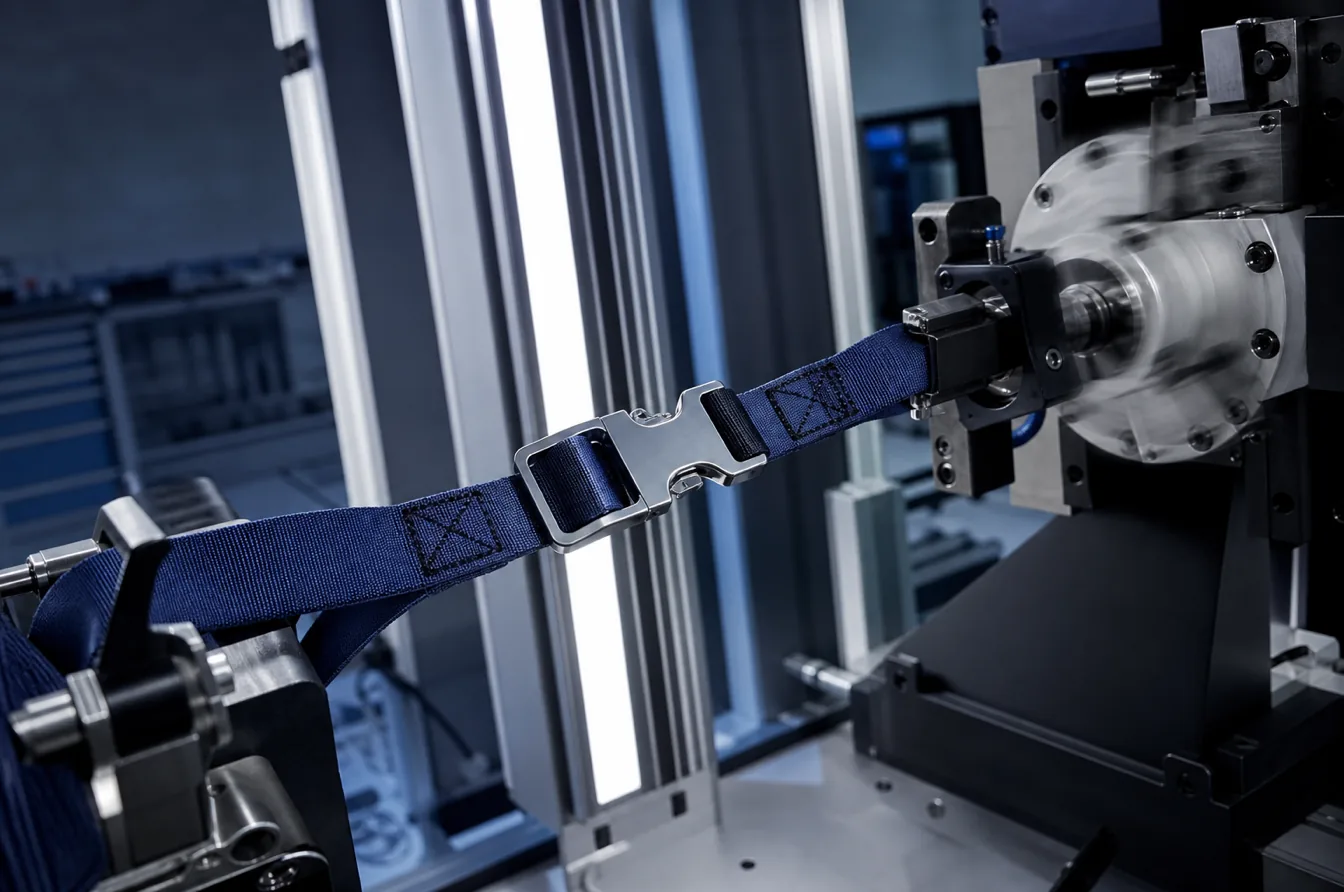
I define buckle strength from the finished product’s load case, not its nominal webbing width. Pet restraint products usually require static, cyclic, and dynamic validation with the actual webbing and attachment.
Translate Real Use into a Product-Specific Load Case
Apparel buckles usually see body movement, adjustment tension, sitting, dressing, and occasional pulling. The load may be modest, but the buckle still needs enough stiffness to avoid opening, rotating, or permanently bending during normal wear. On light garments, I also set a maximum acceptable weight because a mechanically strong buckle can still be functionally poor if it drags the fabric down.
Pet restraint hardware experiences a different pattern. A dog can accelerate, reach the end of a leash, twist, reverse direction, or pull repeatedly. These events create peaks and changing load angles that a slow, straight pull does not fully represent. Animal mass matters, but behavior, product geometry, webbing stretch, leash length, and harness placement also affect the load transferred to the buckle.
I therefore do not assign one load rating to all pets or copy a supplier’s headline breaking value into the finished-product claim. I define the intended animal range and use case, map the load path, agree an appropriate safety margin, and specify how the result will be measured. The buckle must meet the requirement without unacceptable opening, slippage, cracking, deformation, or loss of future function.
| Load factor | Apparel project | Pet restraint project | Specification implication |
|---|---|---|---|
| Source of force | Body movement and manual adjustment | Pulling, lunging, twisting, and handler action | Include realistic peak directions and rates |
| Frequency | Occasional to repeated wear cycles | Frequent closure plus repeated restraint cycles | Add endurance and post-cycle function checks |
| Weight sensitivity | High on light fabrics | Balanced against fit, strength, and animal comfort | Do not size by appearance alone |
| Critical result | Holds fit without damaging the garment | Maintains containment without unsafe deformation | Define retention and deformation acceptance |
| Rating basis | Intended garment and normal wear | Animal range, product type, and foreseeable use | Avoid a universal rating based on webbing width |
Test the Buckle and Webbing as One Load-Bearing System
A strong loose buckle can fail in a weak assembly. I have seen webbing creep through an adjuster, a fold peel open, stitches tear progressively, and a hard buckle edge cut yarns while the buckle body remains intact. In each case, a component-only certificate would describe the wrong failure point.
For pet products, I test production-representative webbing width, thickness, weave, surface finish, folded layers, bar-tack pattern, thread, stitch density, edge distance, and attachment direction. The validation also uses the intended mating buckle half because small dimensional differences can change engagement. If the product has several sizes, each construction should be reviewed rather than assuming that a result from the medium size covers the smallest and largest versions.
The test sequence should include more than a single pull to destruction. It should begin with an initial function check, followed by an agreed proof or static load, repeated loading, dynamic loading when relevant, and a final function check. Wet, dirty, cold, hot, or aged conditioning may be added when the claimed use requires it. Inspection should cover buckle engagement, webbing slippage, stitch damage, permanent set, cracks, and release operation after every relevant stage.
This assembly approach also improves supplier decisions. It shows whether the real correction is a thicker buckle wall, a wider bearing surface, different webbing, a longer fold, a revised stitch field, or tighter dimensional control.
| Assembly variable | Possible failure | What validation should reproduce |
|---|---|---|
| Webbing thickness and weave | Poor fit, creep, or incomplete engagement | Actual bulk webbing and tolerance range |
| Surface finish | Strap slips through an adjuster | Finished, coated, or treated production webbing |
| Folded layers | Local stiffness or uneven buckle seating | Final fold direction, length, and layer count |
| Stitch pattern | Progressive tear or seam opening | Production bar tack, thread, density, and edge distance |
| Load direction | Side release, twisting, or edge cutting | Straight, angled, and foreseeable off-axis loading |
| Product size | A shared buckle performs differently across the range | Each critical size and construction combination |
Which Materials and Finishes Are Suitable for Skin Contact, Sweat, and Outdoor Exposure?
A finish approved by color chip can still irritate skin, corrode outdoors, stain fabric, or lose function after sweat, saliva, dirt, and cleaning.
Apparel materials prioritize weight, touch, appearance, and care compatibility. Pet materials add retention, environmental aging, corrosion, abrasion, and material-safety controls, verified on the finished component for its target market.
Select the Base Material Around Geometry and Service Conditions
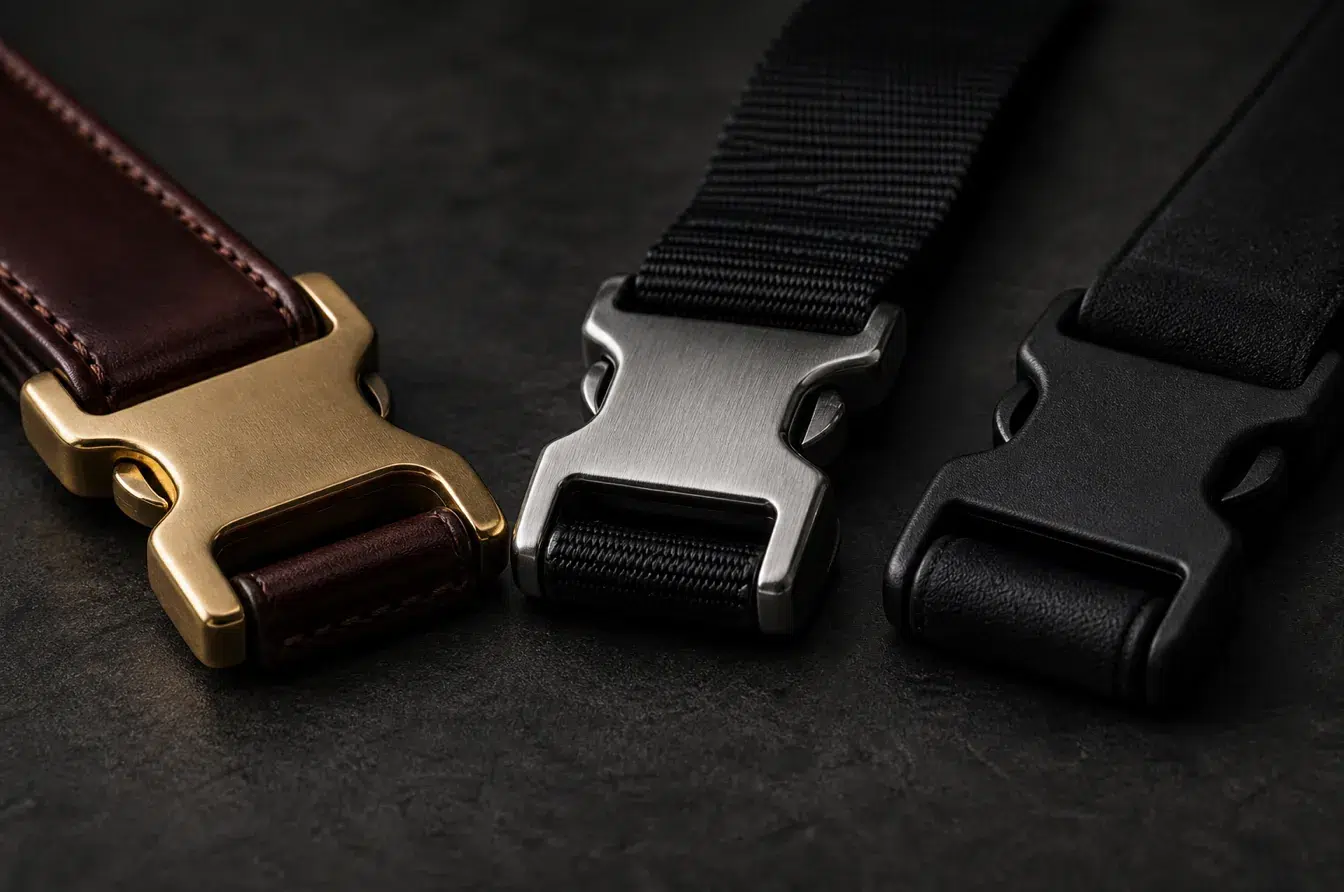
For apparel, zinc alloy and brass can provide a premium metal feel, clear logos, and a wide finish range. Steel supports economical stamped structures when corrosion protection is suitable. Aluminum can reduce weight, and engineering polymers can support smooth, light, washable closures. I choose among them by part geometry, target mass, attachment method, skin contact, garment care, and the required visual language.
Pet buckle choices often include engineering polymers such as acetal-based materials or nylon families, as well as stainless steel, aluminum, and other metals for suitable designs. But the material name alone does not establish safety. Resin grade, moisture behavior, UV stabilization, molding quality, knit lines, wall transitions, recycled content, and temperature exposure can change polymer performance. For metal parts, alloy grade, temper, casting quality, welds, springs, and joint geometry influence retention.
Chew resistance must also be separated from restraint strength. A hard material may resist tooth marks yet behave poorly under shock, and a strong metal buckle can become too heavy for a small animal. Pet buckle size should follow product function, webbing construction, fit, animal range, and failure consequence. It should not be enlarged only to look rugged or reduced only to appear refined.
| Material direction | Apparel value | Pet-product value | Information still required |
|---|---|---|---|
| Zinc alloy | Detailed shapes and decorative finishes | Selected shaped parts after suitable validation | Alloy, porosity control, section design, and finish system |
| Brass | Premium feel, forming, and rich surface options | Corrosion-capable premium parts in suitable load paths | Alloy, mass, geometry, and post-finish performance |
| Stainless steel | Clean technical appearance and durability | Strength and corrosion resistance for outdoor hardware | Grade, forming, weld or joint, and surface condition |
| Aluminum | Low mass for larger visible parts | Lightweight hardware when the design is qualified | Alloy, temper, wear, and shock-load evidence |
| Engineering polymer | Light weight, color, and smooth hand feel | Integrated latch geometry and corrosion-free operation | Exact resin, conditioning, molding, aging, and load results |
Validate the Finished Surface for Contact and Environment
Exposure must be defined before finish approval. Apparel buckles may contact skin, perspiration, perfume, detergent, dry-cleaning chemicals, fabric dye, and repeated rubbing. Pet hardware can add saliva, rain, mud, sand, salt water, pool water, UV, temperature change, and cleaning agents. Moving joints also create metal-to-metal or polymer-to-webbing wear that a static corrosion coupon cannot reproduce.
My finish specification identifies the base material, pretreatment, layer system, color and gloss limits, significant surfaces, and allowable change after testing. Validation covers corrosion, tarnish, coating adhesion, color transfer, abrasion, edge condition, and continued buckle function. Products promoted for swimming or prolonged outdoor use require a higher exposure plan instead of relying on an indoor apparel approval.
There is also no useful universal label called “pet-safe metal” or “skin-safe plating.” Chemical requirements depend on the material, contact scenario, user group, product claims, and destination market. The EU’s General Product Safety Regulation requires consumer products to be safe under normal or reasonably foreseeable use, and relevant chemical restrictions can apply in addition. I request declarations and test evidence for the actual finished buckle, not just a generic raw-material sheet.
| Exposure | Apparel validation focus | Pet-product validation focus | Post-test inspection |
|---|---|---|---|
| Skin, sweat, or saliva | Contact chemistry, staining, tarnish, and comfort | Material safety, corrosion, odor, and surface change | Color, residue, roughness, cracks, and function |
| Washing and cleaning | Declared garment care route | Product cleaning instructions and chemical compatibility | Coating adhesion, distortion, and closure operation |
| Abrasion | Fabric rub and visible edge wear | Webbing contact, dirt, sand, and joint movement | Exposed substrate, sharpness, and dimensional wear |
| Outdoor moisture | Rain exposure when relevant | Rain, humidity, swimming, and wet-dry cycling | Corrosion, swelling, seizure, and release behavior |
| UV and temperature | Storage and intended wear conditions | Outdoor aging and seasonal temperature range | Brittleness, fading, creep, and retained performance |
How Should Locking Security and Release Force Differ Between the Two Applications?
The hardest buckle to open is not automatically the safest, because unreliable intentional release can create a different failure during normal use or an emergency.
Apparel usually favors easy, comfortable operation with enough retention for wear. Pet products need a controlled balance among accidental-release resistance, intentional operating force, repeated engagement, and the product’s defined safety function.
Separate Restraint Buckles from Breakaway Mechanisms
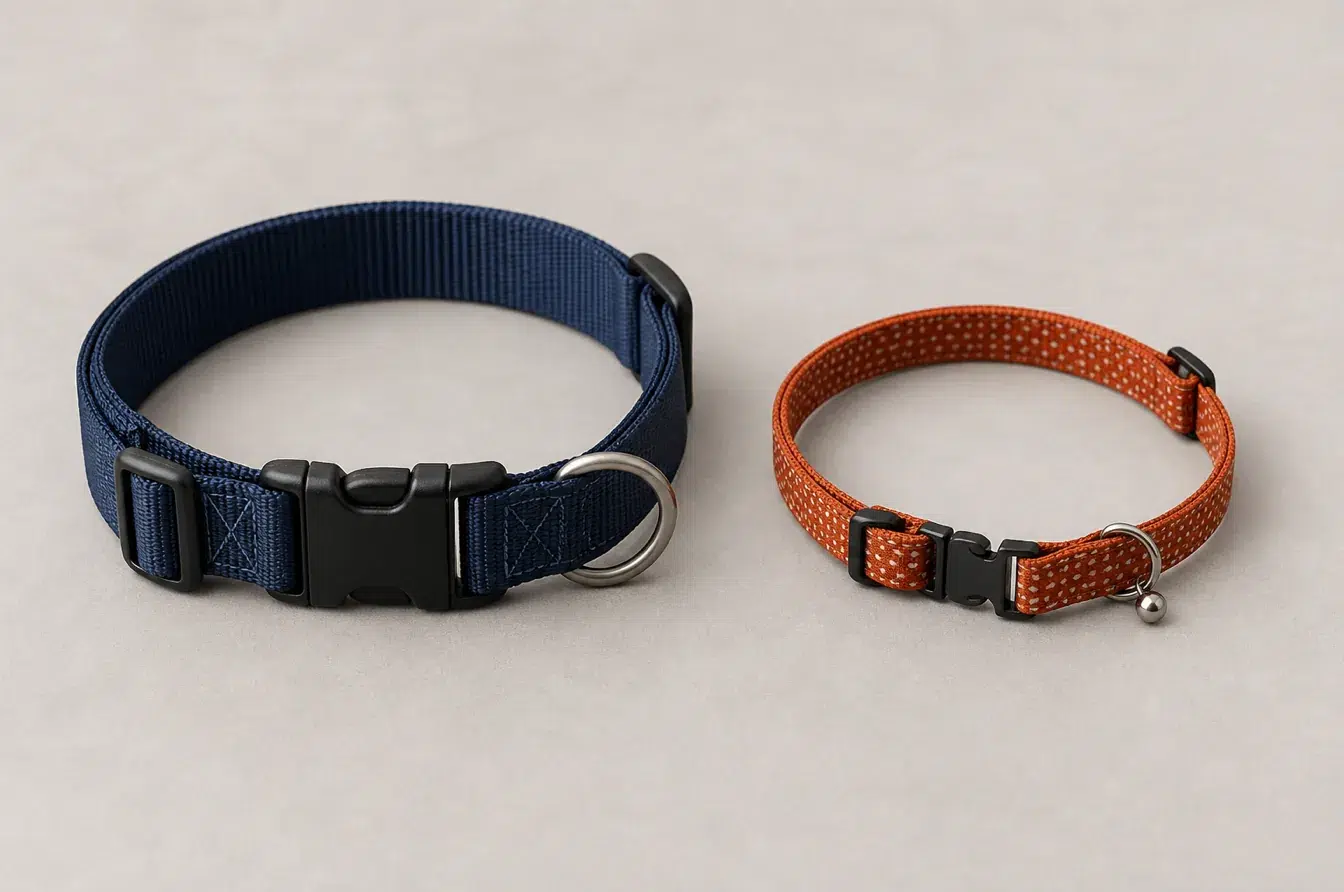
I first state whether the pet buckle must retain or intentionally separate. A buckle on a restraint collar, harness, or leash should resist opening under foreseeable pulling, twisting, rubbing, and contact with the animal or environment. A breakaway collar is designed for a different hazard: it should separate under a defined condition so an entangled animal is less likely to remain trapped.
This distinction is why I do not apply a generic breakaway-force number across pet products. A value that is appropriate for one collar size and intended animal can release too easily in another product or fail to release for a smaller animal. The product team must define the animal range, collar construction, wear position, expected use, and hazard scenario, then validate a controlled release window with qualified safety and compliance support.
Apparel mechanisms usually have a lower-consequence operating brief. I still control unintended opening, but comfort, dexterity, garment tension, and the user’s access angle often lead the design. Children’s apparel, adaptive clothing, workwear, or safety-related garments can require additional review. Again, the application decides the balance; the market category does not automatically decide it.
| Buckle application | Intended behavior | Unacceptable behavior | Release specification approach |
|---|---|---|---|
| Fashion apparel | Stay closed during normal wear and open comfortably by hand | Painful operation, snagging, or casual opening | Set an ergonomic operating range after wear trials |
| Pet restraint collar | Maintain closure during foreseeable restraint use | Opening from pull, twist, rubbing, or impact | Validate retention and deliberate operation under use conditions |
| Pet harness | Retain across changing load angles and body movement | Partial engagement or one-sided release | Test each buckle position in the complete harness |
| Pet leash connection | Maintain the handler-to-animal link | Gate or buckle opening under motion or torsion | Test dynamic load, orientation, and repeated operation |
| Breakaway collar | Retain in normal wear but separate in the defined hazard | Releases during ordinary activity or never releases when needed | Engineer and validate a product-specific release window |
Control Operating Force, Engagement, and Tolerance Together
Release force cannot be reviewed alone. The review must also cover the force and feedback needed to close the buckle, the amount of engagement, whether both sides are fully locked, and whether the user can recognize incomplete closure. A loud click is helpful only if it corresponds to complete mechanical engagement. Visual gaps, tactile feedback, and asymmetric latch behavior can reveal problems that a single force value hides.
Tolerance is critical in custom development. Changing a logo, adding a cutout, thinning a wall, increasing texture, or altering a plated layer can change flexibility and latch travel. In polymer buckles, mold shrinkage, moisture conditioning, resin substitution, and cavity variation can shift operating force. In metal mechanisms, burrs, spring variation, plating buildup, hinge clearance, and wear can do the same.
I therefore measure closure and release across several cavities or production samples, not only the best prototype. The buckle is then cycled, contaminated when the use case requires it, conditioned for relevant temperature and moisture, and measured again. Pet restraint products may also require deliberate-release checks under load when that scenario is relevant and safe to test. The aim is predictable behavior: secure against accidental activation but operable by the intended user without excessive struggle.
Cosmetic customization is treated as an engineering revision. If a change affects the latch arm, wall, slot, engagement tooth, spring, hinge, or surface buildup, the affected tests should be repeated before production approval.
| Control point | Why it matters | What to measure or inspect |
|---|---|---|
| Closing force | Excess force encourages partial engagement | Force range, complete seating, sound, and tactile feedback |
| Release force | Too low may invite accidental opening; too high impairs use | Initial range and change after cycling or conditioning |
| Latch engagement | A visible closure may still be mechanically incomplete | Engagement depth, symmetry, and retention |
| Part tolerance | Small variation changes flexibility and travel | Critical dimensions across cavities and lots |
| Contamination and aging | Dirt, moisture, wear, and temperature shift behavior | Post-conditioning closure, release, cracks, and retention |
| Custom logo or finish | A cosmetic change can alter functional geometry | Drawing review plus repeated affected performance tests |
Which Tests Should Be Completed Before the Buckle Enters Mass Production?
One successful tensile test does not prove that a buckle will resist fatigue, remain safe after aging, hold real webbing, or stay consistent in bulk.
I approve the loose buckle, the installed assembly, and the finished product through a risk-based test plan. Pet restraint programs add dynamic, cyclic, environmental, and complete-system evidence before mass production.
Build a Validation Matrix from the Intended Product
For apparel, my base plan covers dimensions, visible quality, sharp edges, operating force, attachment security, repeated opening, and compatibility with the declared care route. Additional checks include corrosion, abrasion, color transfer, skin-contact chemistry, or small-part review when the product, user, and market require them. The buckle is installed on production-equivalent fabric and reinforcement because pull-off strength can change with material thickness and setting conditions.
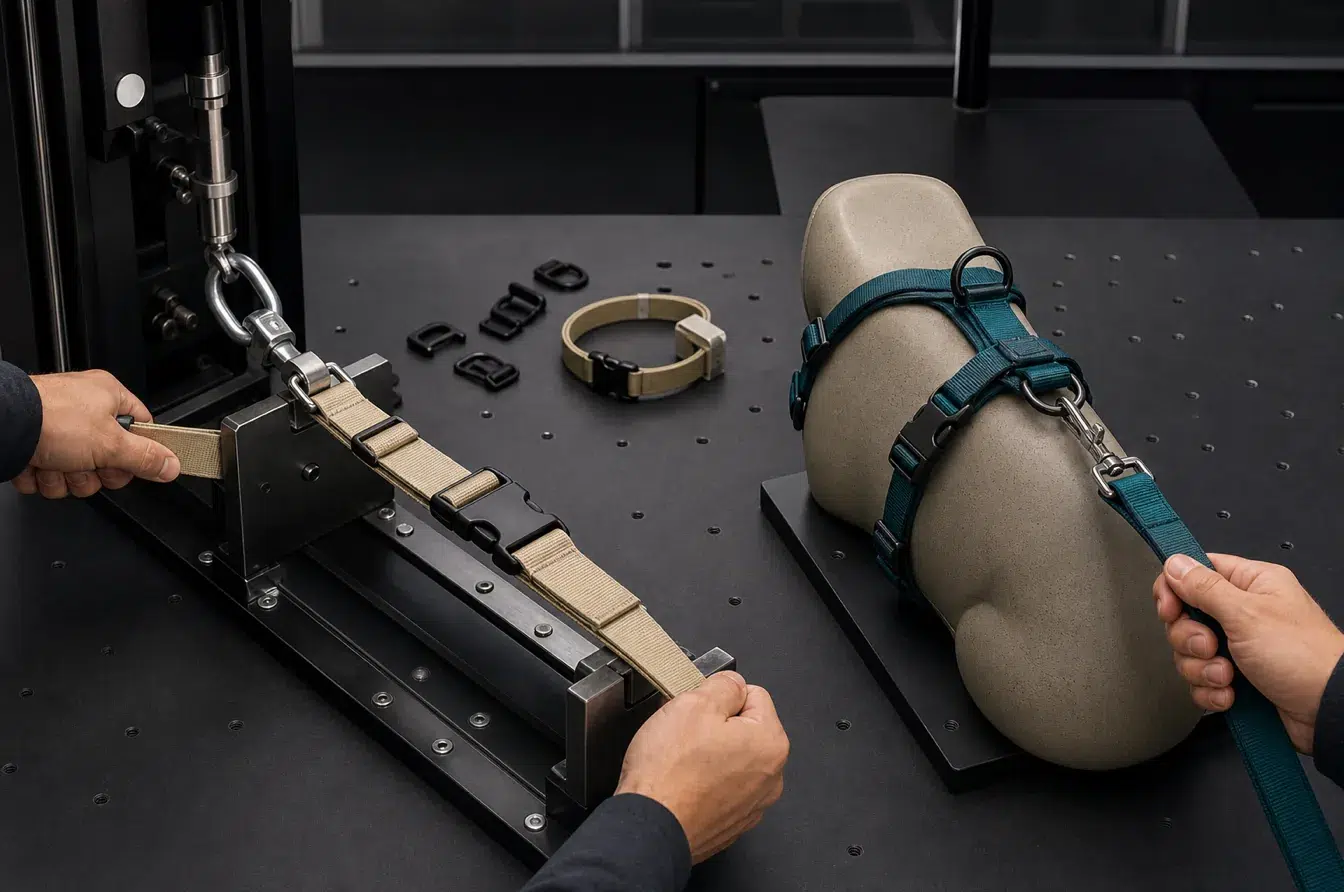
For pet products, I expand the matrix around the actual collar, harness, or leash. Typical checks can include static tensile performance, proof loading, cyclic fatigue, dynamic loading, webbing slippage, stitch and fold strength, accidental-release resistance, intended release behavior, corrosion, abrasion, temperature and moisture conditioning, sharp edges, small components, and post-exposure function. Eurofins’ overview of common pet-product failures also identifies buckle slippage, strap and seam strength, dynamic fatigue, sharp edges, environmental aging, and chemical issues as recurring concerns.
There is no single horizontal pet-product rule or universal buckle test plan that replaces this product analysis. The destination market, claims, materials, user group, and special features determine the applicable regulatory and chemical requirements. I involve a qualified laboratory or compliance specialist early enough to agree methods, conditioning, sample counts, acceptance criteria, and documentation before tooling and bulk materials are locked.
| Validation group | Apparel buckle | Pet buckle or restraint assembly | Approval evidence |
|---|---|---|---|
| Dimensional and visual | Fit, logo, edges, finish, and mating parts | Critical latch, bearing, webbing, and engagement dimensions | Controlled drawing and approved limit samples |
| Mechanical | Attachment, operation, and repeated use | Static, proof, dynamic, cyclic, slippage, and deformation | Results tied to exact construction and sample identity |
| Environmental | Care cycle, sweat, rub, and storage | Moisture, corrosion, dirt, UV, temperature, and cleaning | Post-conditioning appearance and function |
| Material safety | Contact and market-specific restrictions | Market-, material-, and exposure-specific restrictions | Declarations and reports for the finished component |
| Complete product | Comfort, drape, snagging, and attachment | Fit, load path, release, twisting, and foreseeable misuse | Finished-product risk review and test record |
Lock the Production Specification and Control Every Change
After development samples pass, I require a pre-production sample made with the intended tool, cavity, resin or alloy, finish line, assembly method, webbing, stitching, and packaging. A machined prototype or hand-finished show sample cannot prove that molded or cast bulk parts will behave the same way. Production-route evidence matters most where failure affects restraint.
Critical characteristics should be marked on the drawing and control plan. These can include latch thickness, engagement depth, hinge clearance, buckle-bar radius, webbing slot, spring force, mold cavity, alloy or resin grade, weld condition, coating buildup, and burr limits. The inspection method, sampling frequency, acceptance rule, and traceability record should be agreed before the purchase order.
Bulk control must also include change notification. A resin substitution, recycled-content change, new plating supplier, tool repair, mold transfer, cavity addition, revised logo, different webbing finish, or stitch adjustment may change performance even when the product looks similar. The change-review process should determine which tests must be repeated before the change enters production.
Finally, I use pilot production when the mechanism, tool, supplier, or safety function is new. Pilot units reveal cavity variation, assembly damage, operating-force drift, webbing mismatch, coating wear, and packaging problems. They also provide enough finished products for repeated validation. This gate is often faster and less expensive than investigating a failed bulk shipment or field complaint.
| Production control | Apparel focus | Additional pet-product focus |
|---|---|---|
| Pre-production approval | Appearance, fit, attachment, and care | Production-route mechanical and assembly validation |
| Critical dimensions | Visible alignment and garment interface | Latch, load path, engagement, and webbing bearing surfaces |
| Material traceability | Base material and finish consistency | Exact load-bearing resin, alloy, spring, joint, and batch |
| In-process checks | Defects, burrs, color, and operation | Cavity variation, engagement, proof checks, and joint integrity |
| Change control | Reapprove appearance and affected function | Repeat risk-based performance tests before implementation |
| Bulk release | Inspection and garment installation sample | Inspection, traceability, assembly evidence, and agreed testing |
Conclusion
I separate apparel and pet buckle specifications by function, failure consequence, load, environment, release behavior, and assembly evidence before appearance or price enters the decision.