- Loading...
A beautiful metal part can still fail when its weight, strength, attachment, or finish does not match the product that carries it.
I specify custom metal hardware by application first. Apparel favors comfort and washability, bags need stable load transfer, footwear adds flex and abrasion, and pet products demand secure retention under sudden pulling and outdoor exposure.
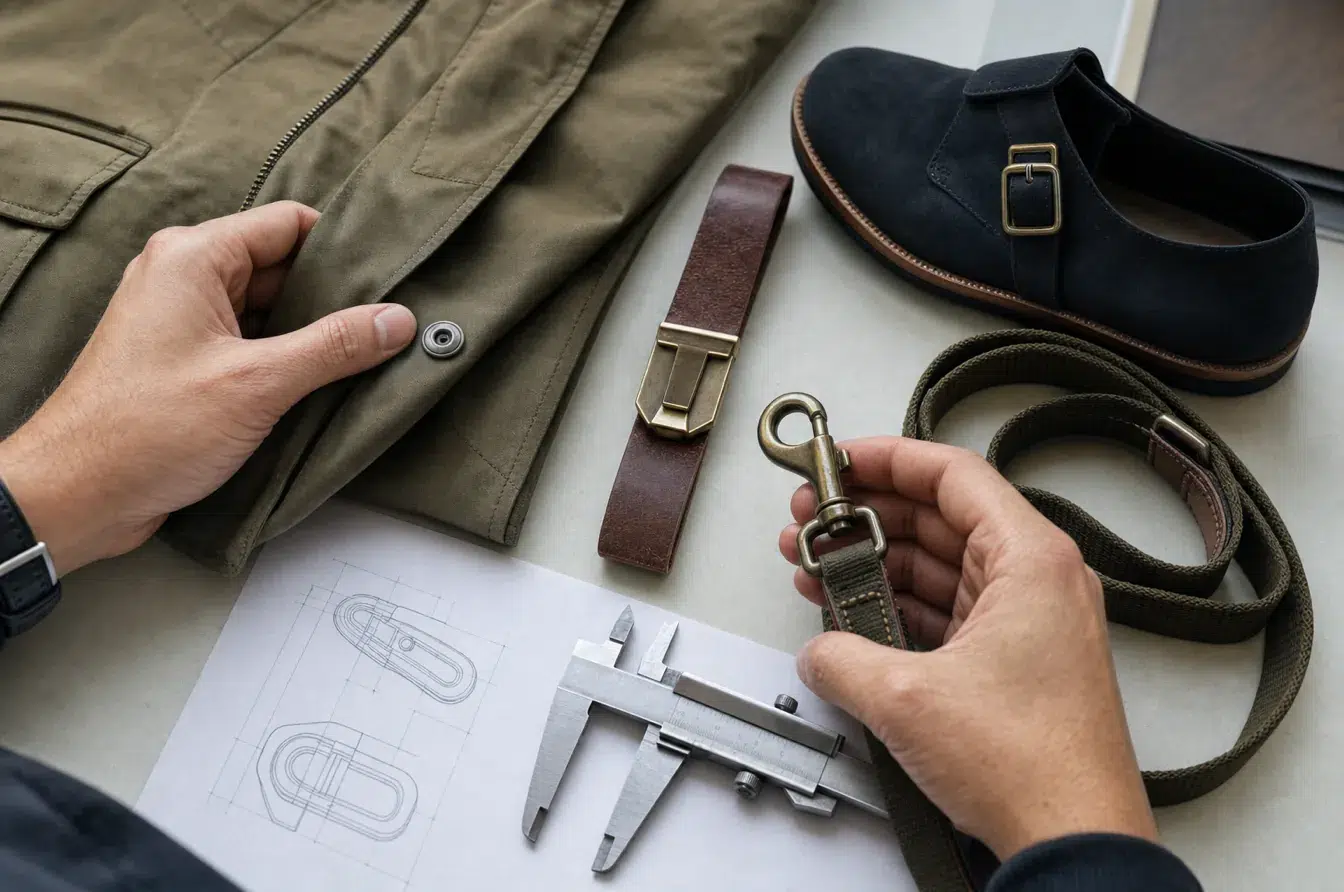
A buckle, D-ring, rivet, eyelet, or logo plate may appear in all four categories, but the shared name tells me very little. I still need to define the load path, movement, contact material, environment, user risk, and assembly method.
This is why I never begin a custom project by asking only, “Which metal should we use?” I begin with the finished product and work backward. The correct specification is the one that lets the hardware, surrounding material, and attachment survive together.
What Functional and Performance Requirements Distinguish Each Product Category?
The same catalog buckle can feel excessive on apparel, unstable on a bag, restrictive on footwear, and unsafe on a pet harness.
I distinguish categories by primary function, load pattern, movement, exposure, and consequence of failure. These factors determine hardware size, section thickness, weight, clearance, attachment, and the evidence required before approval.
Start with the Load Path, Movement, and Failure Consequence
For apparel, I usually protect comfort and appearance before I pursue maximum strength. A button, snap, rivet, chain, or decorative stud should feel balanced on the fabric, avoid sharp contact, remain stable during wear, and tolerate the intended laundry route. Excess mass can make a light garment sag. A large backing part can print through the fabric, and a strong prong can still cause failure if it cuts delicate yarns.
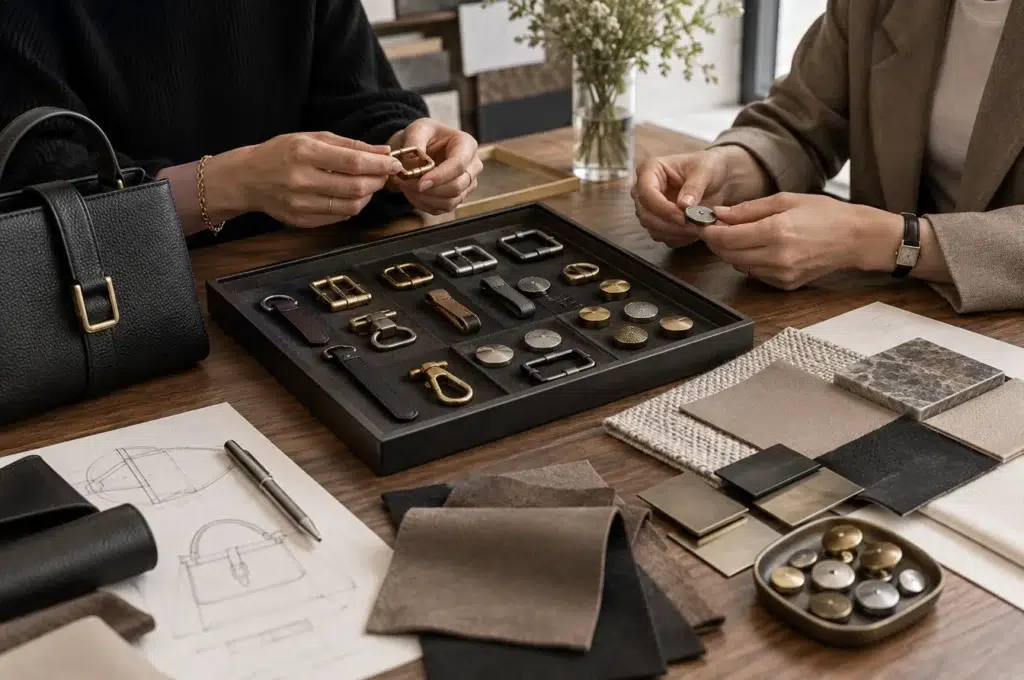
Bag hardware works in a different load system. A D-ring or swivel hook may carry the bag continuously, but walking, lifting, and setting the bag down also create repeated peaks and direction changes. The metal part must resist opening, bending, and wear, while the strap end, reinforcement, stitching, and edge distance must distribute the force. I consider the weight of the fully loaded bag, not the empty showroom sample.
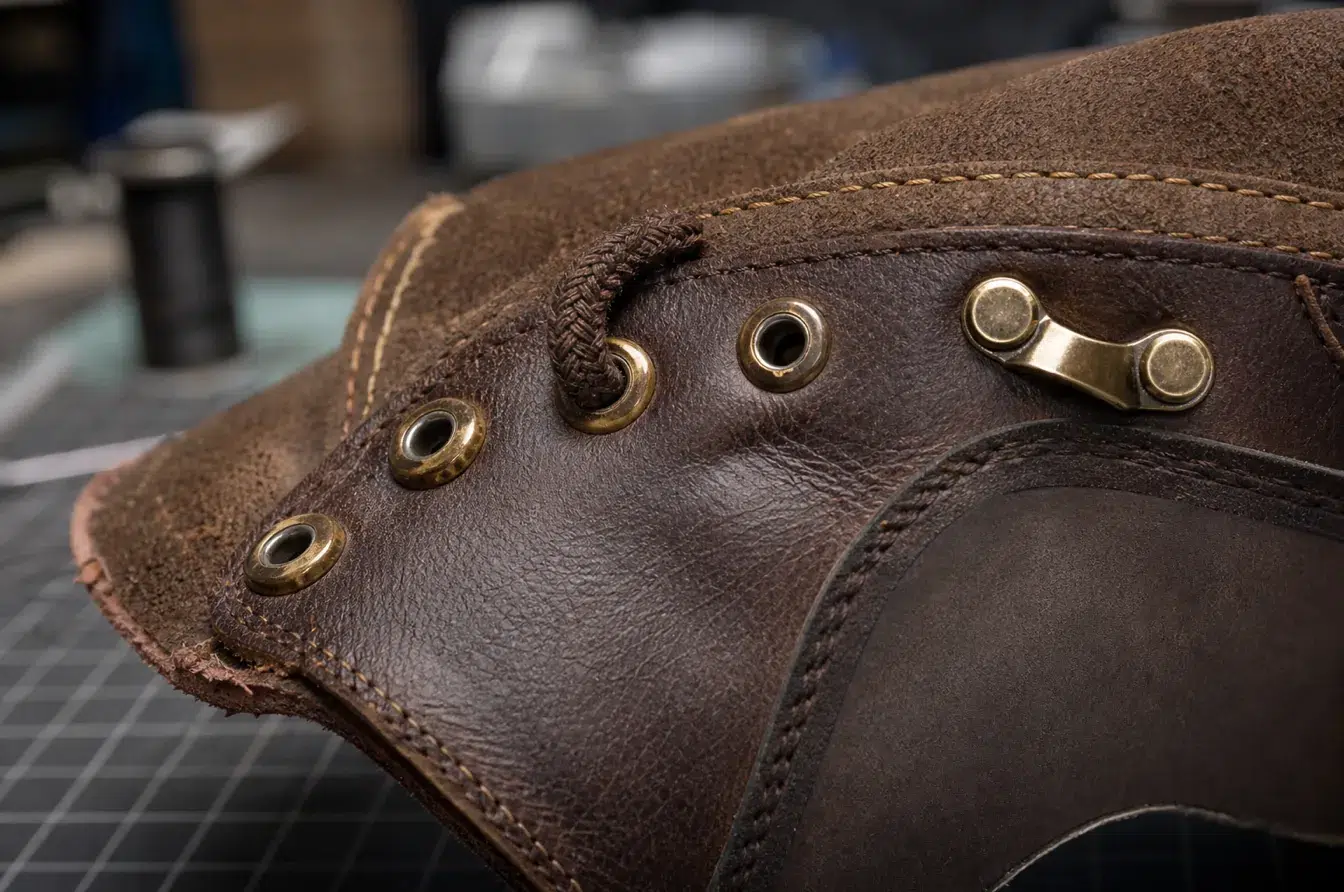
Footwear hardware experiences frequent movement within tight assembly limits. Eyelets, speed hooks, buckles, and ornamental parts may see lace tension, lateral pull, repeated flexing, impact, abrasion, perspiration, and cleaning chemicals. A few tenths of a millimeter can affect setting quality or lace movement. Low profile, controlled wall thickness, smooth edges, and consistent attachment geometry often matter as much as the base metal.
Pet hardware raises the consequence of failure. A leash clip, D-ring, O-ring, buckle, or adjuster may receive a sudden pull rather than a slow laboratory load. Outdoor moisture, mud, salt, sand, repeated opening, webbing abrasion, and animal movement add more variables. I do not assign safety from a material name or a supplier’s maximum-load headline. I define a product-specific working load, an appropriate safety margin, and an installed-system test plan based on animal size, product type, use environment, and foreseeable misuse.
| Product category | Primary design priority | Typical load and movement | Main consequence to control |
|---|---|---|---|
| Apparel | Appearance, low weight, comfort, and washability | Low structural load with body movement and laundering | Fabric damage, skin discomfort, detachment, or visual change |
| Bags | Carrying reliability, access, and brand expression | Continuous load with lifting shocks, swing, and repeated opening | Strap separation, deformation, wear, or loss of contents |
| Footwear | Precise fit, repeated movement, and compact assembly | Lace or strap tension, flex, impact, abrasion, and perspiration | Cracked upper, loose fitting, lace damage, or restricted movement |
| Pet products | Retention, safe handling, and outdoor durability | Sudden pulling, cyclic loading, twisting, dirt, and water | Escape, handler injury, connection failure, or unsafe release |
Engineer the Attachment Interface, Not Only the Metal Part
In development meetings, I often see teams review the front face and ignore the back. Yet the interface may fail before the visible metal does. A rivet can remain intact while it pulls through fabric. A D-ring can keep its shape while a narrow webbing loop tears. An eyelet can pass a component check and still crack a shoe upper during setting.
I therefore record the complete material stack. For apparel, that may include shell fabric, interlining, seam allowance, reinforcement patch, and wash shrinkage. For a bag, I include leather or synthetic thickness, skiving, folded layers, reinforcement, thread, and stitch distance. For footwear, I check the upper material, coating, lining, foam, counter, and the space available for a die. For pet products, I check webbing width, weave, thickness, fold length, stitch pattern, and whether the hardware rotates or concentrates load at one edge.
The attachment method must suit both the hardware and the substrate. Prongs distribute force differently from a tubular rivet. A screw back allows service but can loosen if the thread, locking method, and access are poorly designed. Sewing holes support a softer interface, but their edge finish and spacing affect tear initiation. Backing plates increase bearing area, but they also add weight and stiffness. Hollow rivets can be practical for decorative or light-duty work, but I do not use a thin-wall construction as a default for a safety-critical pet connection.
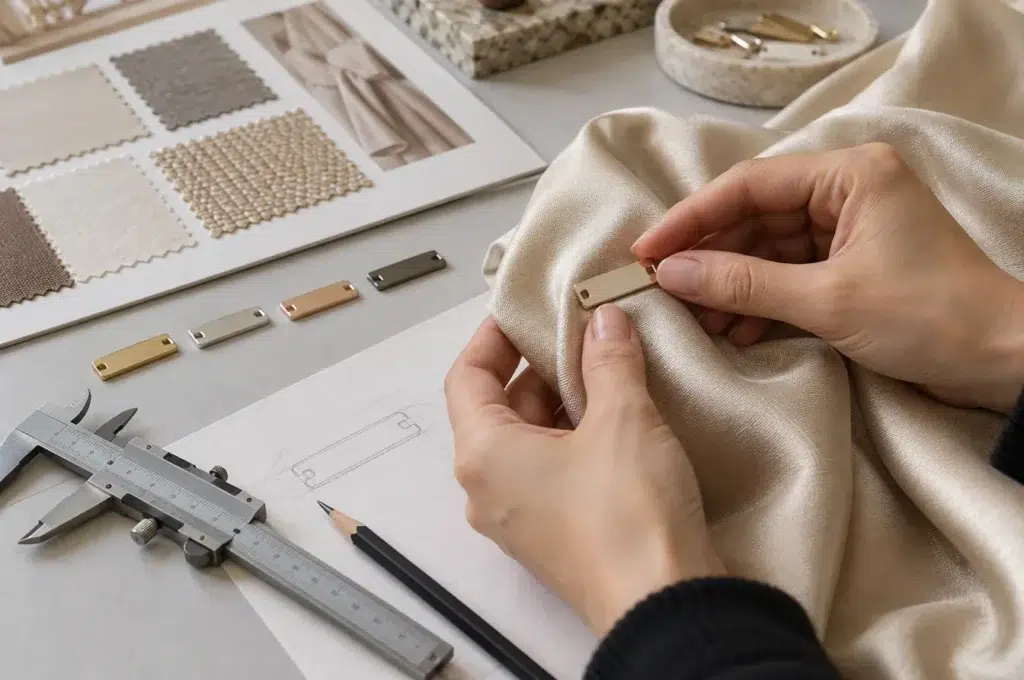
I approve the front and rear structures as one drawing. The drawing includes interface dimensions, tolerances, edge radii, post or screw engagement, installation direction, and the compressed material range. Then I set samples on production-equivalent materials with the intended machine and dies. This exposes tilting, spinning, crushing, puckering, marking, and partial engagement before tooling or bulk plating makes the problem expensive.
| Interface question | Apparel | Bags | Footwear | Pet products |
|---|---|---|---|---|
| What supports the back? | Interlining or small washer | Reinforcement patch or broad backing | Upper reinforcement within limited space | Folded webbing, stitch field, or engineered backing |
| What controls fit? | Fabric stack and wash change | Leather thickness, skiving, and strap width | Upper stack, hole size, and setting access | Webbing width, thickness, fold, and movement |
| What failure should I inspect? | Pull-through, snagging, puckering | Tear-out, rotation, screw loosening | Cracking, lace cutting, loose setting | Webbing cut, ring opening, clip release, or stitch failure |
| What must the sample reproduce? | Final fabric and laundry process | Loaded assembly and edge construction | Final upper materials and setting dies | Finished collar, leash, or harness under realistic load direction |
How Should Materials and Manufacturing Methods Be Selected for Each Application?
Choosing a familiar alloy without checking geometry and process can create weak sections, excess mass, poor detail, or unnecessary tooling cost.
I choose material and manufacturing together. The best combination must deliver the required shape, load capacity, weight, corrosion performance, finish quality, production volume, and repeatability in the final assembly.
Match the Base Metal to Geometry and Service Demand
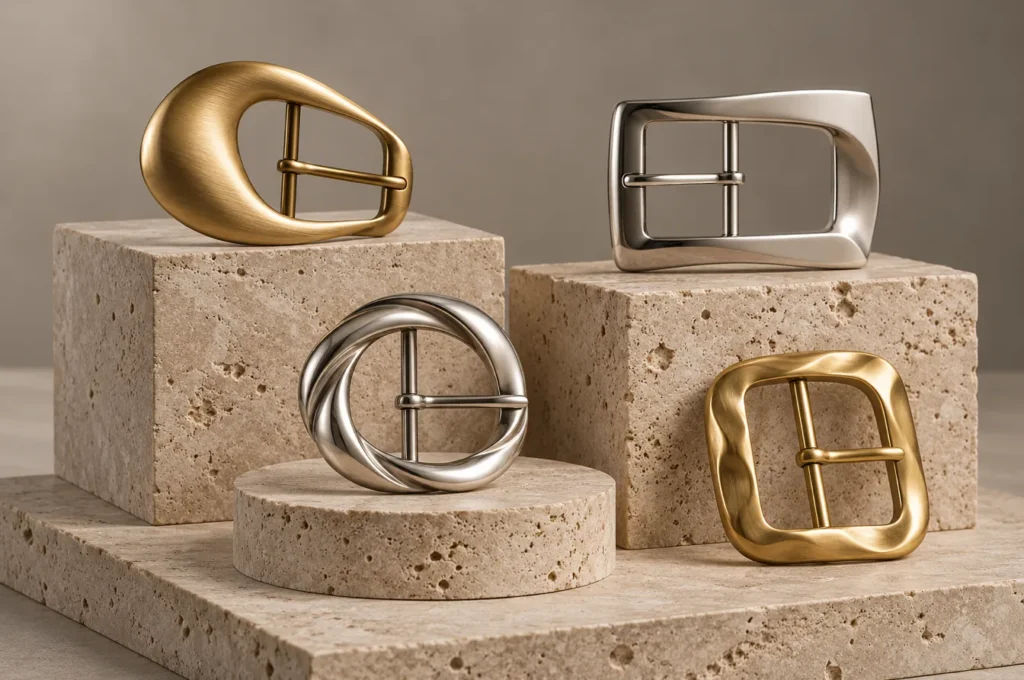
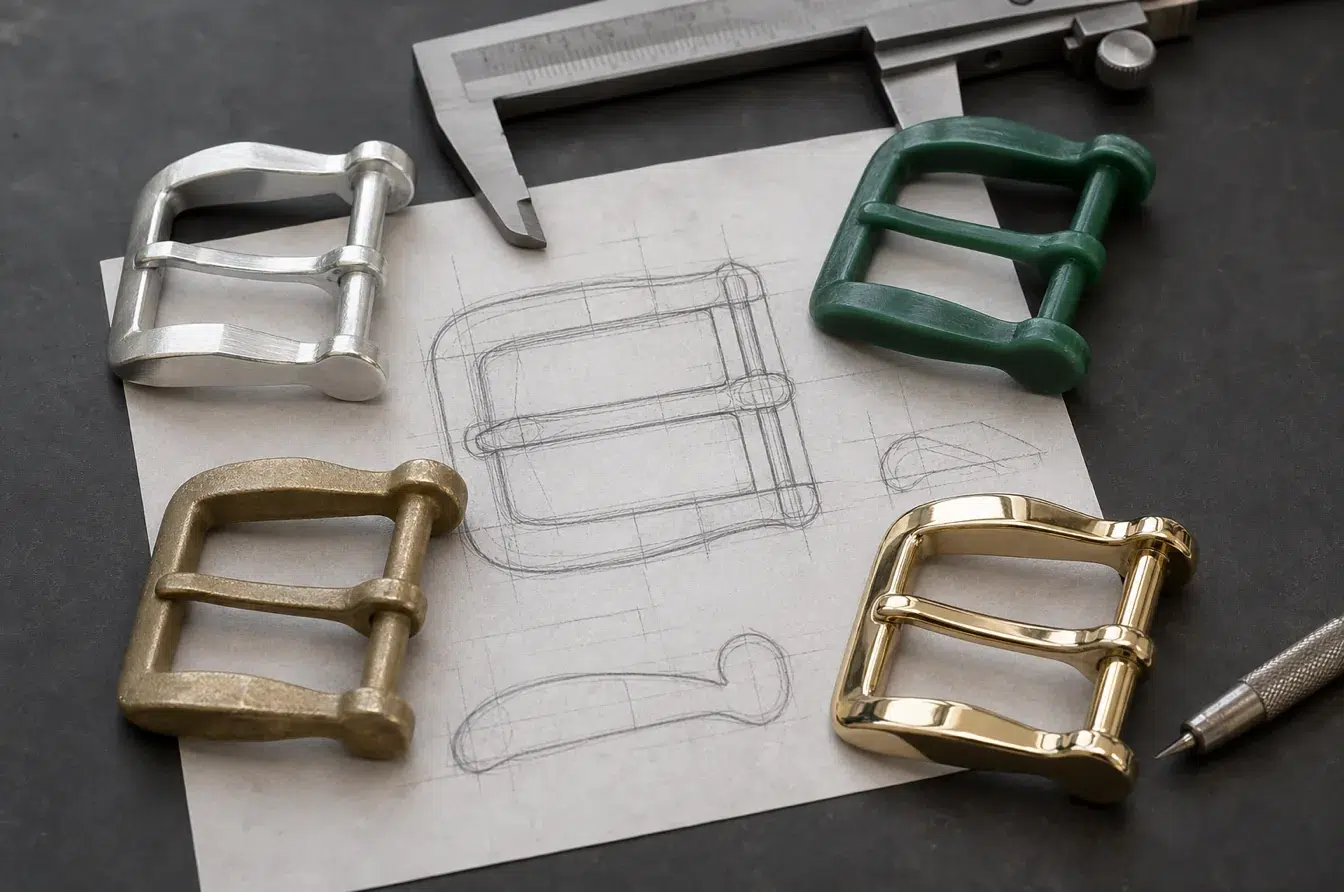
Zinc alloy is valuable when I need complex three-dimensional form, deep logos, sculpted edges, or integrated details. Die casting can reproduce these features efficiently after tooling is established. It is common in branded apparel and bag hardware, and it can also serve selected footwear and pet applications. However, a material category does not prove strength. Thin corners, porosity, poor gating, and high local stress can make a zinc-alloy part brittle. I avoid placing a decorative-grade casting into a critical load path without mechanical validation.
Brass combines good formability, useful corrosion behavior, a premium hand feel, and reliable response to many decorative finishes. I often consider stamped brass for snaps, eyelets, plates, and light-to-medium structural parts. Solid or cast brass can also support premium bag and pet components when section design and testing are suitable. Brass is heavier and more expensive than some alternatives, so I use its mass deliberately rather than treating it as automatic proof of quality.
Stainless steel is a strong candidate when corrosion resistance and mechanical retention lead the brief. I often evaluate it for pet D-rings, leash clips, outdoor bag parts, and selected footwear components. The grade, wire or sheet condition, joint design, welding quality, and passivation still matter. “Stainless steel” is not a complete specification, and an unsuitable grade or contaminated surface can disappoint outdoors.
Aluminum reduces weight, which makes it attractive for large apparel trims, travel bags, and products where mass affects comfort. It can be stamped, machined, cast, or extruded depending on the design, and anodizing can create durable color directions. But low density should not be confused with universal weakness or universal strength. I specify the alloy and temper, then size the section for the actual load. For shock-loaded pet hardware, I use aluminum only when the complete design and production route have been qualified for that duty.
| Material direction | Best design value | Strong starting applications | Main engineering caution |
|---|---|---|---|
| Zinc alloy | Complex 3D form and branded detail | Logo plates, buckles, pulls, decorative trims | Porosity, thin edges, brittleness, and coating dependence |
| Brass | Formability, premium feel, and finish flexibility | Snaps, eyelets, buckles, plates, and selected rings | Added mass, alloy variation, and cost |
| Stainless steel | Strength and corrosion resistance | Pet connections, outdoor bags, technical footwear | Grade definition, forming limits, welding, and surface contamination |
| Aluminum | Low weight and clean technical character | Large trims, travel hardware, light products | Alloy and temper selection, wear, and section sizing |
| Steel or iron | High strength and economical stamped or wire forms | Tacks, rings, hooks, frames, and internal structures | Rust protection, edge control, and coating damage |
Let the Manufacturing Route Shape the Design
Stamping suits sheet-metal shells, washers, eyelets, plates, and frames. It can provide fast repeat production, controlled thickness, and useful strength from work-hardened sheet. The geometry must respect bend radius, draw depth, burr direction, grain behavior, and tool access. For a large run, progressive tooling can lower unit cost, but the tool investment and change cost must be justified.
Die casting suits complex zinc-alloy bodies, raised branding, recessed color fill, and integrated three-dimensional forms. I plan draft angles, parting lines, ejector marks, gate locations, polishing allowance, and plating drainage at the design stage. A beautiful rendering that ignores these features often becomes thick, heavy, or difficult to polish. I also place load-bearing sections away from avoidable porosity and validate them through sampling.
CNC machining gives me high dimensional control and quick design changes without a dedicated casting tool. It works well for prototypes, premium small series, masters, and precision mechanisms. It can also reveal whether a geometry is worth tooling. The trade-off is machining time, material waste, and a unit cost that may remain high as volume grows.
Lost-wax casting supports complex shapes, undercuts, and a crafted character in brass, stainless steel, and other alloys. I consider it for detailed buckles, sculptural bag hardware, and lower-volume premium programs. Shrinkage, surface finishing, dimensional control, and longer process cycles need attention. Metal injection molding can support small, complex, high-volume precision parts, but tool cost, feedstock behavior, debinding, and sintering shrinkage make it a specialist route rather than a casual substitute.
I do not lock the manufacturing route before comparing the design, annual volume, tolerance, finish, and validation burden. A stock base with a custom laser mark may be the best answer for a small apparel program. A custom stamped shell may fit a mature footwear platform. A machined prototype followed by die casting can reduce risk for a new bag buckle. For pet hardware, an existing proven load-bearing platform with controlled branding may be safer and faster than an untested custom mechanism.
| Manufacturing method | Design strength | Economic pattern | Best use by category | Early design check |
|---|---|---|---|---|
| Stamping and forming | Thin, strong, repeatable sheet structures | Tooling-led, efficient at stable volume | Apparel, bags, footwear, and ring components | Bend radius, burr, draw depth, and strip layout |
| Die casting | Complex 3D geometry and integrated branding | Mold-led, efficient at medium-to-high volume | Branded apparel, bags, footwear, and qualified pet parts | Draft, parting line, porosity, and polishing access |
| CNC machining | Precision and design flexibility | Low tooling, higher unit time | Prototypes, mechanisms, and premium small runs | Cutter access, material waste, and cycle time |
| Lost-wax casting | Complex form and premium crafted detail | Moderate tooling and longer cycles | Statement buckles and sculptural bag hardware | Shrinkage, thickness, surface, and tolerance |
| Wire forming and welding | Efficient rings, hooks, and frames | Process-control driven | Bags, footwear, and pet connections | Wire grade, gap, weld penetration, and finish coverage |
How Do Plating and Coating Requirements Change Across Different Use Environments?
A color chip may pass approval while the bulk hardware fades, corrodes, stains material, or exposes a different tone at high-wear edges.
I specify a finish as a complete layer system: substrate, preparation, undercoat, decorative layer, color and gloss limits, protective topcoat, and performance requirements for the real use environment.
Replace Color Names with a Controlled Finish Architecture
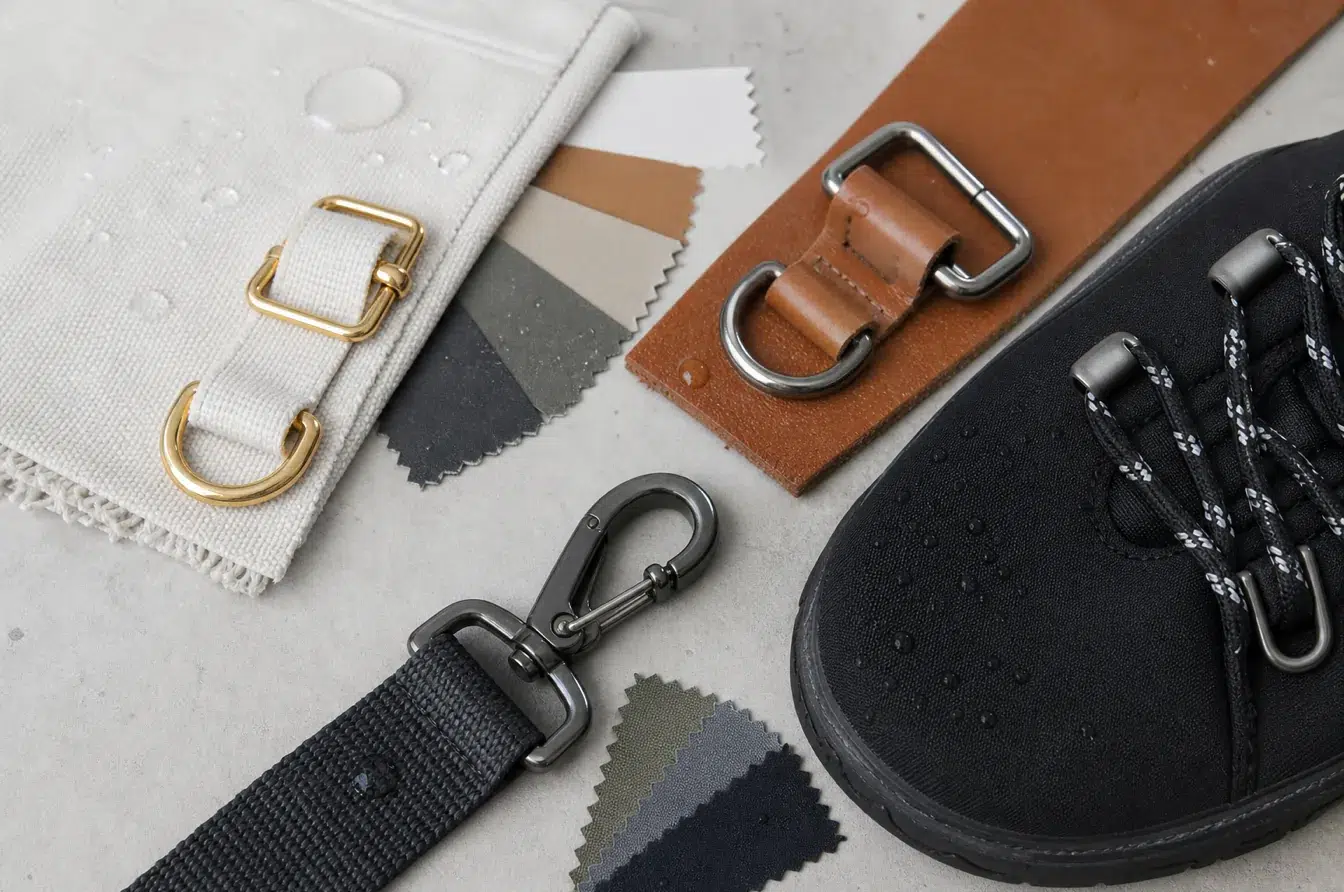
“Gold,” “silver,” “gunmetal,” and “antique brass” describe an appearance, not a process. The same color can be produced by different plating metals, electrophoretic coatings, lacquers, paints, physical vapor deposition, or combinations of these. Each route behaves differently at edges, recesses, contact points, and flexing joints.
I begin by naming the base metal because pretreatment must match it. Cleaning, activation, polishing, and strike layers influence adhesion. An underlayer can improve leveling, barrier performance, or color. The decorative layer creates the visible tone, and a seal or topcoat can improve resistance to fingerprints, oxidation, chemicals, and abrasion. For antique finishes, wiping and relief contrast also need limits because too much variation can make one lot look like several colors.
My finish specification includes an approved master and acceptable light and dark limits. I record the viewing light, gloss range, texture, rack or contact marks, significant surfaces, and whether the inside of holes or moving joints must be fully covered. I also define what color change is acceptable after testing. “No rust” is not enough if the premium rose-gold tone has already shifted or the topcoat has turned cloudy.
Plating thickness is useful only when it is tied to the layer, measurement location, and function. Raised edges and deep recesses do not always receive the same deposit. I therefore ask for a layer-stack record and verify critical locations on the actual geometry. I keep approved samples from the correct base metal and production route, because a plated flat coupon cannot reproduce every risk of a cast buckle or welded ring.
| Finish element | What I define | Why it matters |
|---|---|---|
| Substrate and preparation | Alloy, surface condition, polish, cleaning, and activation | Adhesion and final smoothness begin below the color layer |
| Underlayer | Material, purpose, and controlled thickness | It can support leveling, barrier performance, and tone |
| Decorative layer | Process, color reference, gloss, texture, and significant surfaces | It controls brand appearance and visible consistency |
| Seal or topcoat | Chemistry, gloss effect, cure, and compatibility | It influences abrasion, chemicals, fingerprints, and aging |
| Approval limits | Master, light/dark range, viewing light, and post-test acceptance | It converts a subjective color name into a production standard |
Build the Finish Test Around the Real Exposure
Apparel hardware often needs to survive laundering, detergent, moisture, perspiration, rubbing, ironing proximity, and prolonged skin contact. A delicate fashion finish may be acceptable for dry-clean-only outerwear but unsuitable for a washable children’s garment. I test the installed trim through the declared care route because fabric chemicals, wash abrasion, and contact between components can change the result.
Bag hardware receives hand oils, cosmetics, rain, strap movement, table contact, and repeated metal-to-metal friction. The most visible failure may be color loss on a swivel joint or contact edge rather than general corrosion. I therefore combine corrosion screening with dry and wet rub, opening cycles, and assembled wear. I also check whether dark hardware transfers color to pale leather or fabric.
Footwear hardware faces perspiration, road moisture, flexing, cleaning agents, and abrasion from laces, trousers, or nearby components. I use footwear-specific requirements when the project calls for them. ISO/TS 20358:2024 covers performance requirements for footwear accessories, while ISO 22775 provides methods for metallic-accessory corrosion resistance. These references help define methods, but I still agree the performance level for the exact footwear type and market.
Pet hardware may encounter rain, mud, seawater, pool water, sand, saliva, cleaning products, and long outdoor storage. A glossy coating that looks strong in a cabinet can wear rapidly where a hook rotates against a ring. I include moving-contact wear, wet-dry cycling, and post-exposure function checks. If a product is promoted for swimming or marine use, I raise the corrosion and cleaning requirements rather than reusing an indoor collar specification.
Salt-spray testing is useful for comparing coating systems and finding pores or discontinuities. ISO 9227 defines test procedures, but it does not prescribe one universal exposure duration or predict an exact service life. I therefore define the method, duration, evaluation area, allowable corrosion, allowable color change, and post-test function in the product specification.
| Exposure priority | Apparel | Bags | Footwear | Pet products |
|---|---|---|---|---|
| Moisture source | Laundry and perspiration | Rain, hands, and spills | Perspiration, rain, and cleaning | Rain, mud, swimming, and washing |
| Dominant wear | Fabric rubbing and wash contact | Hand contact, strap motion, and table abrasion | Lace friction, flex, impact, and road abrasion | Ring-hook contact, dirt, sand, and repeated movement |
| Finish risk | Skin reaction, tarnish, staining, or wash change | Edge wear, transfer, scratches, or joint discoloration | Corrosion, flaking, lace staining, or sharp exposed edges | Corrosion, seized movement, coating loss, or contamination |
| My essential validation | Declared care cycle on installed trim | Assembled rub and opening-cycle test | Flex-related wear plus footwear corrosion method | Wet-dry exposure plus loaded movement and function |
What Durability, Safety, and Compliance Tests Should Each Hardware Category Pass?
Passing one tensile or salt-spray test can create false confidence when fatigue, attachment, chemicals, sharpness, or finished-product movement remain untested.
I build a risk-based test matrix for the hardware, its finish, its attachment, and the finished product. The exact methods and limits must follow product use, target market, user group, and failure consequence.
Use a Different Test Matrix for Each Category
For apparel, I begin with attachment strength, operating force where relevant, sharp edges and points, wash or dry-clean performance, corrosion or tarnish, color transfer, and skin-contact chemistry. I add repeated opening for snaps and buttons that are used frequently. For children’s apparel, I also review small-part risk, accessible edges, and the applicable chemical and product rules for the destination market.
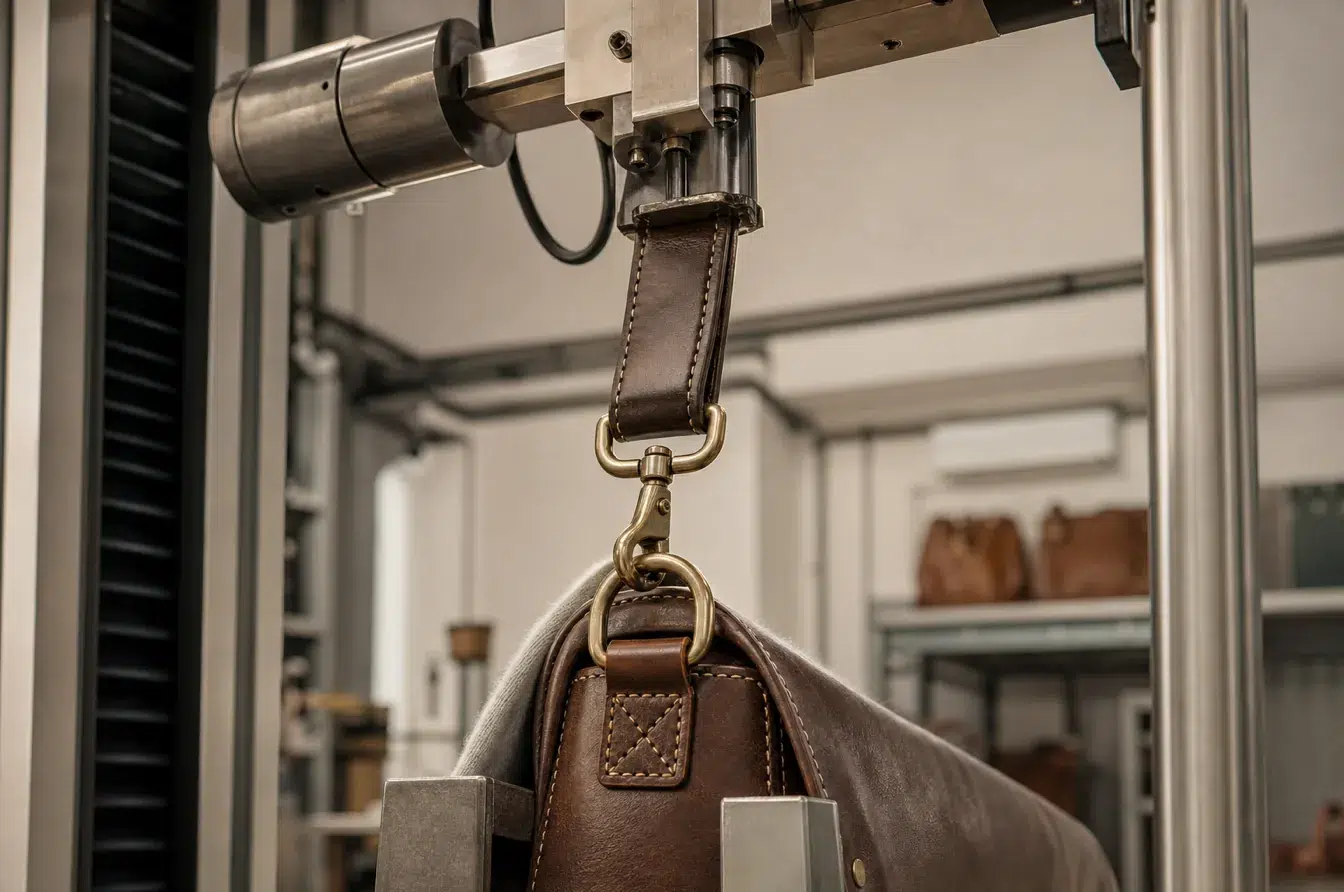
For bags, I test the loaded assembly in the directions created by use. That can include tensile pull, ring opening, hook-gate retention, buckle slip, handle or strap attachment, repeated opening, swivel cycling, abrasion, corrosion, and drop or jerk loading on the finished bag. I check permanent deformation as well as complete breakage. A bent hook that still holds may already prevent safe or convenient use.
For footwear, I combine component tests with attachment and movement. Eyelets and hooks need secure setting, smooth lace contact, and resistance to corrosion and repeated force. Buckles and ornaments need opening cycles, abrasion, and retention on the upper. ISO 24263:2020 provides a method for attachment strength of footwear straps, hooks, eyelets, and trims. I use it when applicable and add product-specific flex and wear because a pull result alone does not reproduce walking.
For pet products, I test the complete collar, leash, or harness system. The plan can include static tensile strength, proof loading, cyclic fatigue, sudden or dynamic loading, ring and hook deformation, buckle release under load, accidental-release resistance, corrosion, abrasion, temperature exposure, and post-contamination operation. If a breakaway or safe-release function is intended, I define its release window and verify consistency after aging. If retention is the purpose, I make sure the mechanism does not release under foreseeable contact or twisting.
| Category | Component tests | Attachment or assembly tests | Finished-product checks |
|---|---|---|---|
| Apparel | Operating force, edge quality, finish, and chemistry | Pull-off, prong or rivet security, and fabric damage | Wear comfort and declared care cycles |
| Bags | Ring opening, hook retention, buckle slip, cycles, and finish | Strap, handle, reinforcement, screw, and rivet strength | Loaded carry, swing, jerk, drop, and access function |
| Footwear | Eyelet, hook, buckle, zipper, abrasion, and corrosion | Setting and attachment strength on the final upper stack | Flex, walking-related movement, lace contact, and cleaning |
| Pet products | Tensile, gate retention, deformation, fatigue, and corrosion | Webbing fold, stitch field, ring, clip, and buckle as one system | Sudden pull, twisting, contamination, fit, and intended release behavior |
Treat Compliance and Finished-Product Validation as Separate Gates
Compliance is not a generic “REACH passed” line. I define the market, product, age group, contact scenario, material, coating, and specific restricted substance or safety rule. For metal parts intended for direct and prolonged skin contact in the EU, the REACH nickel restriction focuses on nickel release rather than simply asking whether nickel exists in the material. I therefore request evidence for the actual finished component and its wear condition where the rule applies.
For U.S. children’s apparel, the CPSC explains that accessible components such as buttons, zippers, and snaps can be subject to total lead and surface-coating limits. Its current clothing guidance states a 100 ppm total-lead limit for accessible component parts and a 90 ppm limit for paint and similar surface coatings in children’s products. I still confirm the product scope, exemptions, test obligations, and certificate requirements with the responsible compliance team before shipment.
Mechanical compliance and chemical compliance solve different risks. A pet buckle can meet a restricted-substance requirement and still be too weak for the intended animal. A strong bag ring can contain an unacceptable coating. A footwear eyelet can pass corrosion testing and still cut the lace. I keep each claim connected to a method, sample, date, production construction, and target market.
I also treat the finished-product trial as a separate gate. First, I inspect the loose component for dimension, function, finish, and defects. Second, I install it with production-equivalent tools and materials. Third, I test the assembly in realistic directions and cycles. Finally, I inspect the full product for balance, interference, pressure, noise, scratching, loosening, staining, and color mismatch after conditioning.
This sequence has solved failures that component reports did not predict. In one common pattern, a ring is mechanically strong, but the narrow radius loads only one edge of the strap loop. The webbing or leather begins to cut while the ring remains unchanged. Increasing metal strength would not solve the real problem. A broader bearing surface, revised fold, better reinforcement, or different stitch field would.
| Approval gate | Evidence I require | What it cannot prove alone |
|---|---|---|
| Material and chemical | Alloy declaration, coating system, applicable test report, and market scope | Mechanical safety or long-term attachment |
| Loose component | Dimensions, visual standard, function, strength, cycles, and finish tests | Interaction with the final substrate |
| Installed assembly | Production-equivalent setting plus directional and fatigue tests | Full-product comfort, balance, or interference |
| Finished product | Wear, load, movement, care, contamination, and user-risk review | Future bulk consistency without process control |
| Bulk release | Inspection data, traceability, critical-test sampling, and approved references | Performance outside the defined use and care conditions |
How Do Tooling, MOQs, Lead Times, and Bulk Quality Risks Differ by Category?
A low unit quote can hide mold revisions, finish development, testing, assembly trials, rejected bulk lots, or a production route that does not fit demand.
I estimate commercial risk from geometry, process, customization depth, validation burden, and forecast stability—not from category alone. Apparel often supports lighter customization, while safety-critical pet hardware needs stronger evidence and change control.
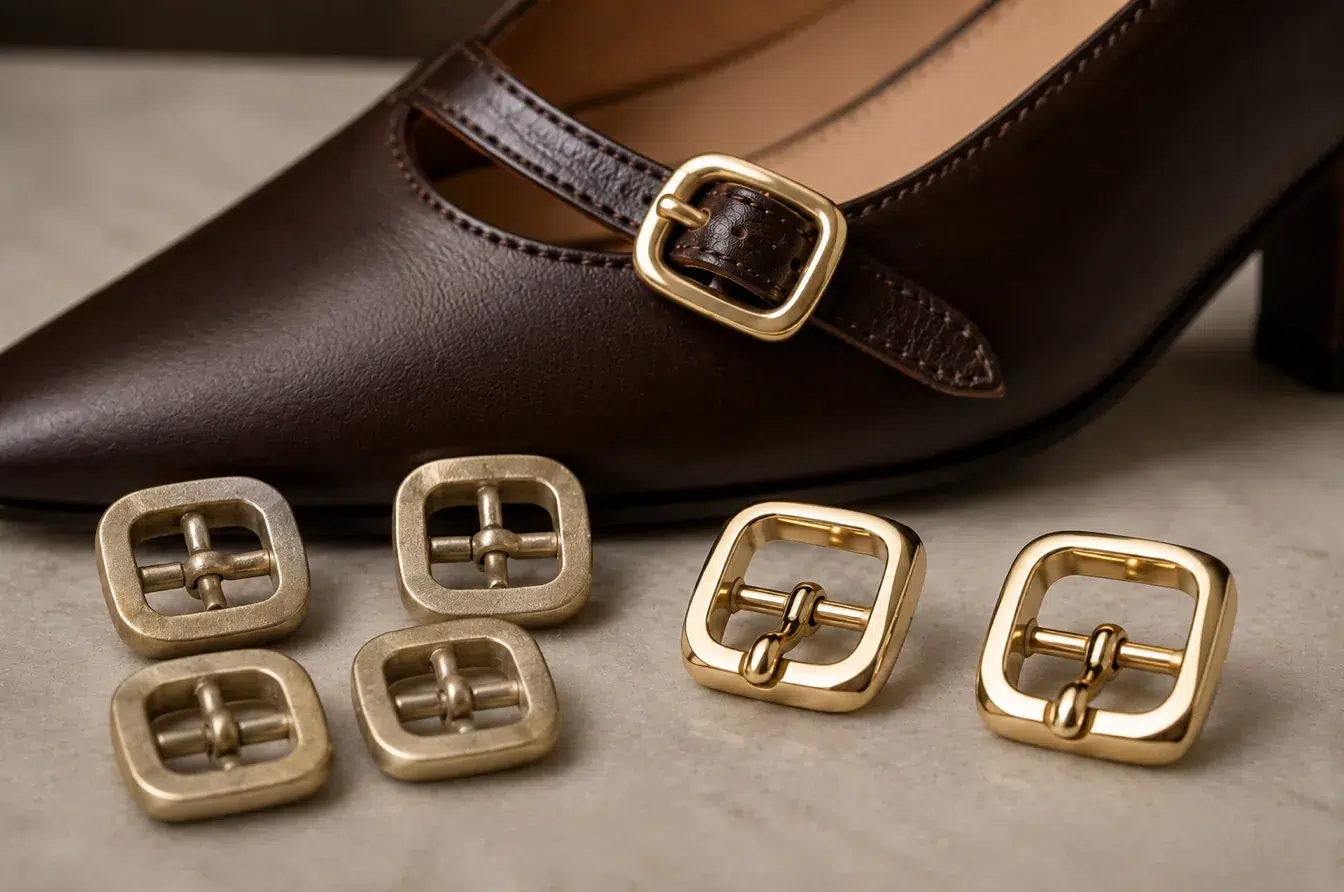
Separate Product Category from Process Economics
MOQ is not an inherent property of “apparel hardware” or “pet hardware.” It is the result of material purchasing, tooling setup, casting or stamping efficiency, plating batch size, color matching, assembly labor, testing, and the supplier’s production model. A simple custom logo on a stock apparel button can begin at a relatively low quantity. A new multi-part zinc-alloy button with a special finish can require a much larger commitment. The same logic applies to every category.
Apparel programs can often use stock backs, standard posts, shared shells, or existing button platforms with a custom face or logo. This reduces tooling and shortens development. The challenge is color coordination across many styles and repeat orders. Small parts also make visual defects, orientation errors, and mixed sizes easy to miss in bulk.
Bag hardware often needs a coordinated family: buckle, D-ring, hook, slider, zipper pull, feet, and logo plate. One part may be simple, but matching geometry and finish across different substrates and factories creates the real lead-time risk. Large visible parts also require more polishing and plating control. If one tool is delayed, the whole hardware set and bag assembly can wait.
Footwear development is sensitive to production calendars and setting interfaces. Standard eyelets or hooks may be available quickly, but a custom size can require new dies, setting tools, upper trials, and line adjustments. Small dimensional drift can stop feeding or damage the upper. I lock the hardware and setting tooling together, then protect time for fit, attachment, corrosion, and flex-related validation.
Pet products may use existing load-rated platforms for the main buckle, ring, or clip and customize only a safe surface area. A fully custom retention mechanism requires more engineering, tolerance study, fatigue testing, and liability review. The part count may look small, but the validation path can be longer because a design change can affect safety. I do not trade this evidence for an attractive low MOQ.
| Development route | Tooling pattern | MOQ tendency | Lead-time driver | Best risk-control move |
|---|---|---|---|---|
| Stock platform plus logo or finish | Low or limited custom tooling | Often lower | Artwork, sample, plating, and approval | Keep the proven interface unchanged |
| Custom stamped part | Cutting, forming, and setting tools | Volume-dependent | Tool build, trials, burr and dimensional tuning | Confirm material stack and die access first |
| Custom die-cast part | Mold, fixtures, polishing, and assembly tools | Usually favors repeat volume | DFM, mold correction, casting, polishing, plating | Approve geometry before finish development |
| Machined small series | Minimal dedicated forming tool | Flexible but costly per part | Machine capacity and finishing | Use it for learning or premium low volume |
| Custom safety mechanism | Multiple tools and test fixtures | Driven by validation and control | Engineering iterations, fatigue, and change approval | Use design gates and freeze critical interfaces |
Build Category-Specific Bulk Controls Before Purchase
Before the purchase order, I create a critical-to-quality list. It identifies dimensions that affect assembly, features that carry load, surfaces that affect appearance, and tests that protect the user. I then connect each item to a drawing, measurement method, sampling plan, approved master, and escalation rule. “Same as sample” is too vague for a component produced across several operations.
For apparel, I watch size mixing, logo orientation, cap-to-back compatibility, sharp burrs, plating color, and setting performance after washing. For bags, I add ring-gap control, hook-gate alignment, swivel function, screw engagement, buckle slip, and finish consistency across the full hardware family. For footwear, I prioritize eyelet wall and flange dimensions, setting behavior, feeding consistency, lace-contact edges, and corrosion performance. For pet products, I add material and heat traceability where relevant, weld or joint integrity, ring gap, latch engagement, spring function, proof or cyclic testing, and strict change notification.
The approved sample must represent the production route. A hand-polished CNC sample cannot serve as proof that a die-cast bulk part will have the same edge, mass, strength, and finish. I use development samples to answer design questions, then approve a pre-production sample made with the intended tool, substrate, polishing route, plating line, assembly method, and packaging.
I also divide lead time into visible stages: drawing approval, design-for-manufacture review, tool build, first tooling sample, correction, finish sampling, installed-product testing, pre-production approval, bulk manufacture, plating, assembly, inspection, and transport. This makes the critical path clear. It also shows why changing a hole position or finish late in the project can restart more than one stage.
Bulk quality risk rises when several weak controls overlap. Dimensional drift can reduce attachment strength. A rough casting can demand extra polishing and change the logo. Rework can thin a coating. Mixed plating racks can shift color. Packaging can let metal parts scratch one another. I review the process chain, not only final inspection, and I require change control for material, tool cavity, subcontractor, plating recipe, or assembly method.
| Category | Critical bulk controls | Typical hidden risk | Release evidence |
|---|---|---|---|
| Apparel | Size, logo orientation, burr, finish, back compatibility, and wash setting | Mixed parts or fabric damage appears only on the line | Approved set sample plus installation and care-cycle check |
| Bags | Load dimensions, ring gap, gate or swivel action, screws, and finish family | Separate suppliers create color and interface mismatch | Coordinated master set plus loaded assembly test |
| Footwear | Wall thickness, flange, feeding, setting dies, edge, and corrosion | Small drift cracks the upper or interrupts production | Line trial plus attachment and footwear-specific tests |
| Pet products | Alloy or wire grade, joint, latch, spring, gap, traceability, and fatigue | Unapproved process change reduces retention reliability | Pre-production validation plus controlled bulk test records |
I use pilot production when the design, process, or supplier is new. A pilot exposes cavity variation, plating-rack effects, feeding problems, assembly speed, packaging damage, and inspection ambiguity. It also gives the finished-product team enough units for repeated testing. The extra step can add calendar time, but it is usually shorter than correcting a failed full-volume shipment.
Conclusion
I specify hardware by application, then align load, interface, material, finish, testing, tooling, and bulk control so every component supports the finished product.