- Loading...
An attractive D-ring can still become the weakest point in a bag if its width, gauge, finish, or installation method is wrong.
A metal D-ring should be specified as a structural connection point, not selected as decoration. The right choice balances strap width, load, material, finish, visual proportion, and production method.

When I evaluate a D-ring, I consider both the hardware itself and the system around it. The strap, attachment tab, stitching, rivets, swivel hook, and plating finish must perform together.
Why Should a D-Ring Be Treated as a Structural Connection Point?
A D-ring transfers force between the strap and the bag body. If this connection is poorly designed, the entire product becomes less reliable.
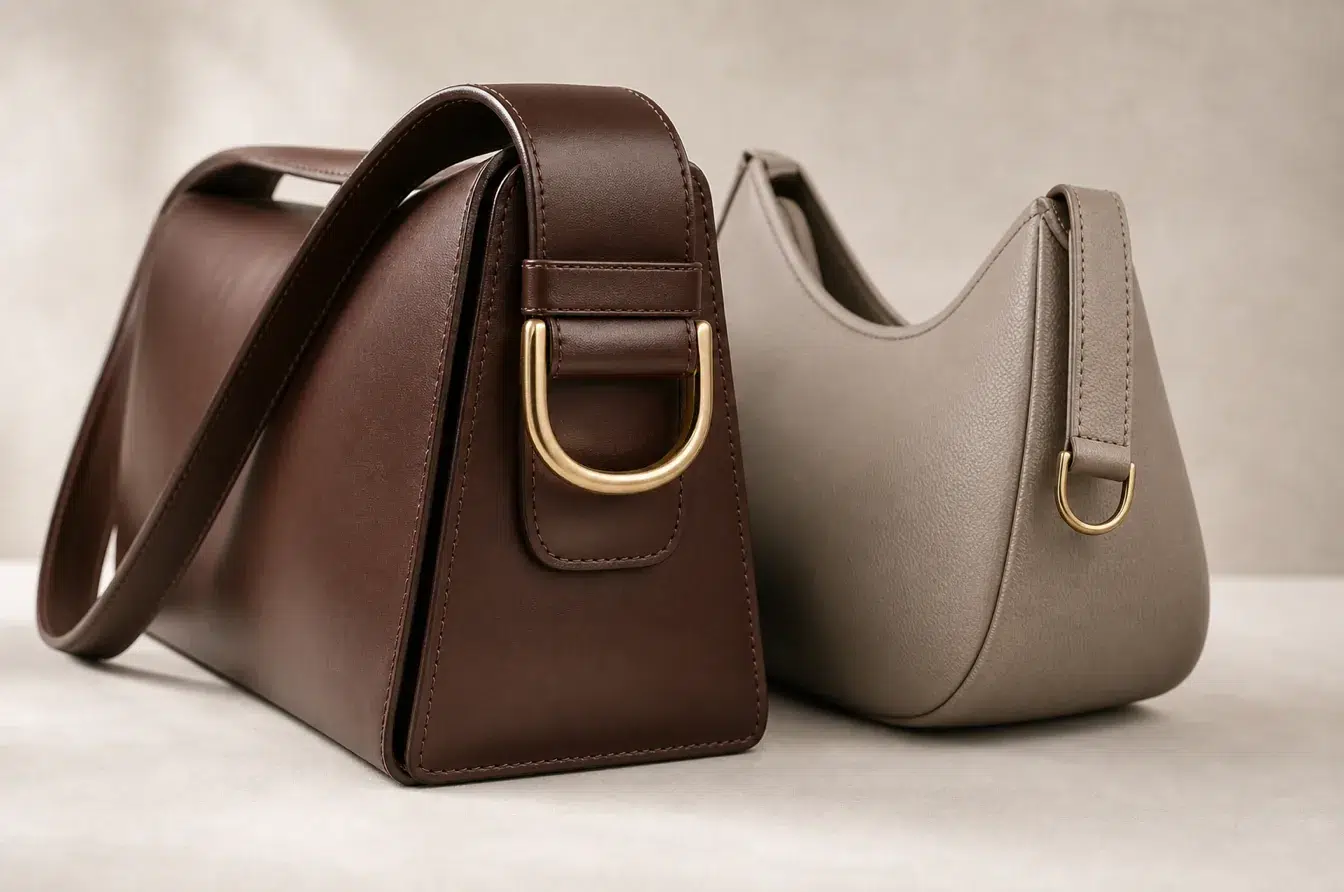
The straight side of a D-ring supports the attachment tab, while the curved side guides a hook or strap connection. Its geometry helps distribute force, but only when the ring, tab, and stitching are correctly aligned.
Design the Connection Before Selecting the Finish
I recommend defining the D-ring as a connection point during the early product-development stage. This changes the selection process. Instead of beginning with color, the design team first considers load direction, strap movement, attachment construction, and the weight of the finished bag.
At a shoulder-strap connection, force rarely remains perfectly vertical. The bag moves when the user walks, lifts it from a chair, or pulls the strap sideways. This creates changing loads at the ring and its attachment tab. A ring that appears strong during a static inspection may deform, rotate, or wear through the surrounding material after repeated movement.
The straight bar of the D-ring should sit evenly inside the tab. If the tab is too narrow or loosely constructed, pressure becomes concentrated near its edges. This can stretch leather, distort coated fabric, or pull stitches toward the seam allowance. A properly designed tab spreads that force across a larger reinforced area.
I also examine the relationship between hardware strength and material strength. A heavy ring does not automatically create a strong connection. If it is attached to a single layer of light fabric without internal reinforcement, the fabric will probably fail before the metal does.
| Connection factor | Development question | Typical risk |
|---|---|---|
| Load direction | Will the strap pull vertically, diagonally, or from multiple angles? | Ring rotation and uneven tab wear |
| Product weight | What is the expected filled weight of the bag? | Permanent deformation or seam failure |
| Tab construction | Is the tab reinforced beyond the visible seam? | Tearing around the attachment point |
| Hardware movement | Will a hook rotate or rub against the ring? | Plating loss and surface scratches |
| Use frequency | Is the connection opened daily or only occasionally? | Accelerated wear at contact points |
Visual proportion also matters. A thin D-ring may technically match the width of a thick leather strap, but the combination can still look under-engineered. In the opposite case, an oversized ring can dominate a lightweight bag and make the product feel unbalanced. Structural logic and visual logic should support the same design message.
How Should Width, Gauge, and Proportion Be Specified?
Ordering by nominal width alone leaves important variables uncontrolled. I specify internal width, metal thickness, profile, and visual scale as separate requirements.
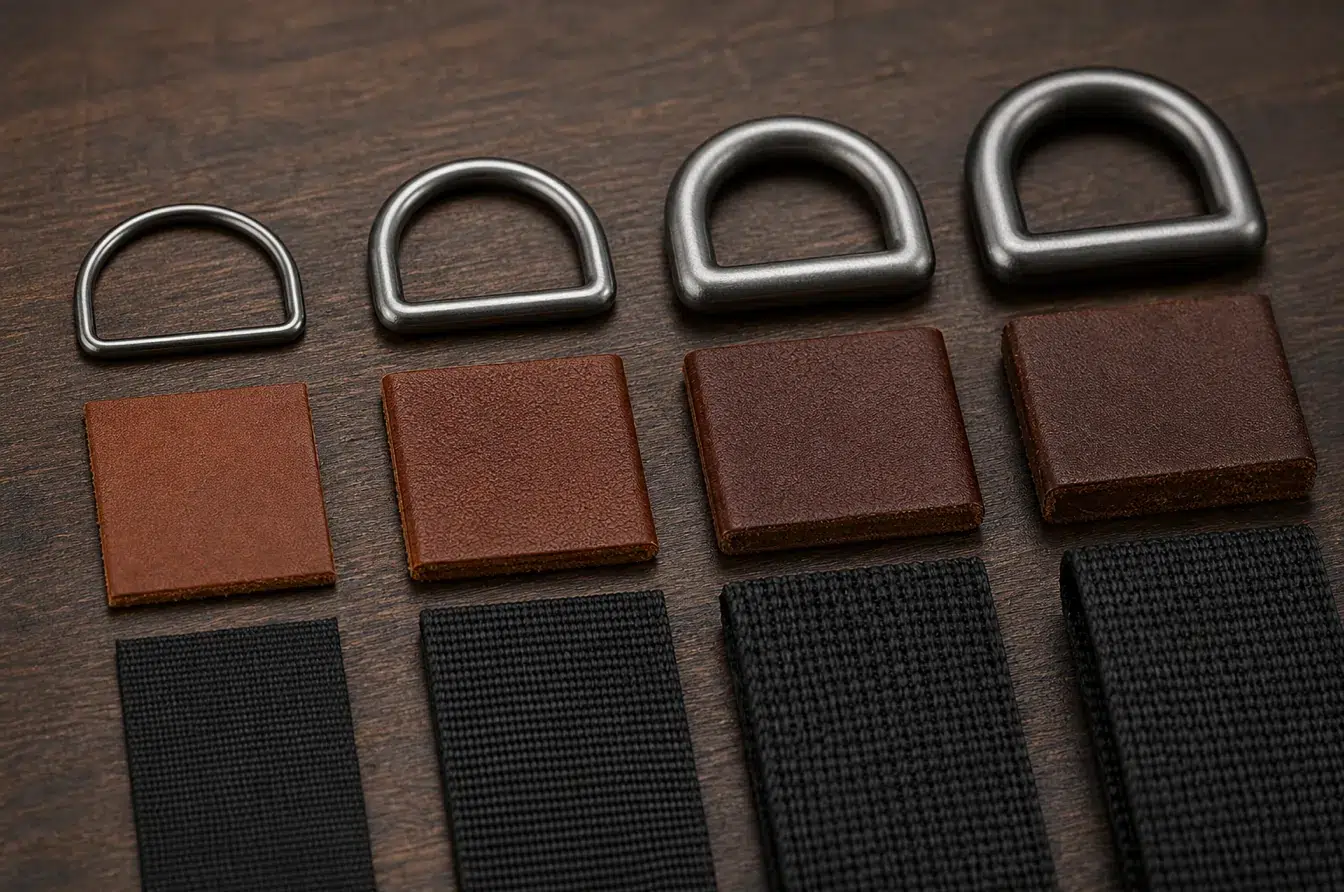
The internal width of a D-ring should normally match the finished strap or tab width at a 1:1 ratio. Gauge then determines visual weight, deformation resistance, and compatibility with hooks and attachment methods.
Apply the 1:1 Rule Without Ignoring Tolerance
The 1:1 rule is a reliable starting point: a 25 mm finished strap should normally use a D-ring with an internal straight-bar width of approximately 25 mm. This keeps the strap centered and allows the load to travel through the connection predictably.
However, the specification should include tolerances. Strap thickness, folded edges, coating, and sewing operations can change the finished width. Hardware dimensions can also vary slightly between production lots. I therefore compare actual production samples instead of relying only on catalog descriptions.
If the opening is too narrow, the strap edges may curl or compress. Leather can develop permanent marks, while woven webbing may bunch and lose its clean alignment. If the opening is too wide, the strap can slide from side to side. That movement produces uneven loading and makes the connection look less controlled.
Gauge requires equal attention. Suppliers may describe it as wire diameter, metal thickness, or cross-section thickness. Because “gauge” is not always reported consistently, I prefer to record the actual millimeter measurement on the specification sheet.
A light key holder and a travel bag may use the same internal width but should not automatically use the same gauge. The travel bag needs greater resistance to deformation and usually requires a visually stronger profile. However, thickness alone cannot confirm a load rating. Base material, casting or forming method, weld quality, ring geometry, and heat treatment can all affect performance.
| Project type | Width priority | Gauge direction | Additional check |
|---|---|---|---|
| Key holder or small accessory | Compact strap fit | Light profile | Edge smoothness |
| Small fashion bag | Precise visual alignment | Light to medium profile | Finish consistency |
| Everyday shoulder bag | Controlled strap movement | Medium profile | Repeated pull testing |
| Backpack or work bag | Stable load transfer | Medium to heavy profile | Tab and seam reinforcement |
| Travel or utility bag | High structural stability | Heavy profile | Supplier load-test evidence |
| Pet collar or leash | Secure fit under movement | Application-specific heavy profile | Dynamic safety testing |
The final choice should also reflect material proportion. Thick full-grain leather, dense canvas, and padded webbing usually need a ring with enough visual mass to appear intentional. Fine leather, silk-based textiles, and compact evening bags generally benefit from a more refined profile. Width creates compatibility, but gauge and proportion create credibility.
Which Materials and Finishes Will Survive the Product Lifecycle?
Finish approval should consider friction, corrosion, color variation, and contact with other components—not only how the first sample looks under studio lighting.
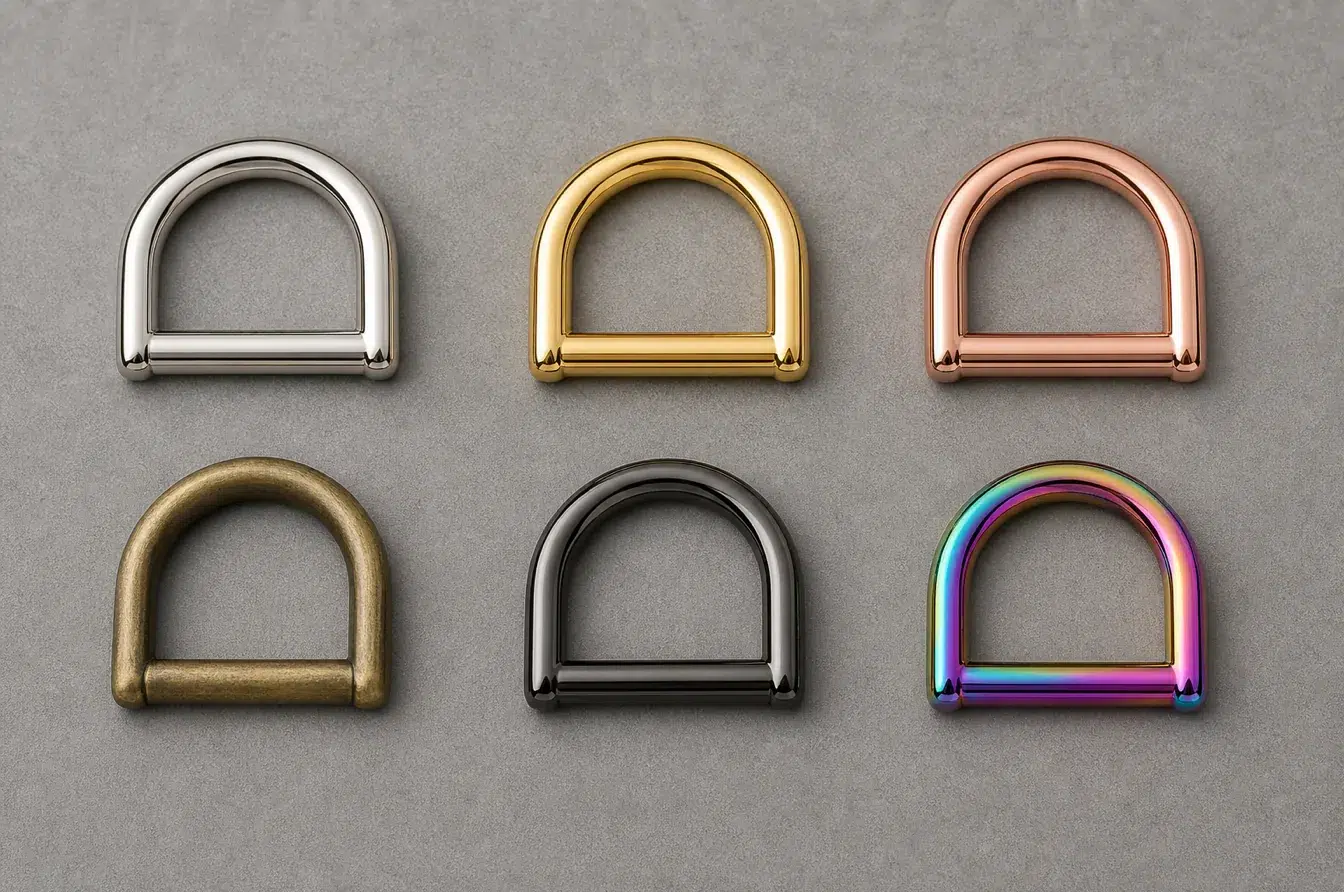
Nickel, gold, rose gold, antique brass, gunmetal, and iridescent finishes create different visual effects. Their durability depends on the base metal, plating system, topcoat, use environment, and frequency of metal-to-metal contact.
Evaluate the Base Material and Plating as One System
Different base materials create different cost, weight, strength, and finishing possibilities. Steel can provide strong performance at a practical cost, but it needs suitable corrosion protection. Zinc alloy supports complex shapes and consistent casting, although the design must control brittleness and wall thickness. Solid brass offers a premium feel and good corrosion behavior, but it increases material cost and product weight.
The finish must then be evaluated for the intended application. Polished nickel often supports modern, technical, and minimal product directions. Gold and rose gold can create a refined fashion appearance, but visible color variation between production lots must be controlled. Antique brass works well for heritage, outdoor, and vintage-inspired collections because its darker surface can make gradual wear less visually disruptive.
Gunmetal and black finishes require careful abrasion testing. When a swivel hook repeatedly moves against a D-ring, the contact area can reveal a lighter base layer. Iridescent or rainbow finishes create a distinctive appearance, but their strong color variation makes component matching more complex.
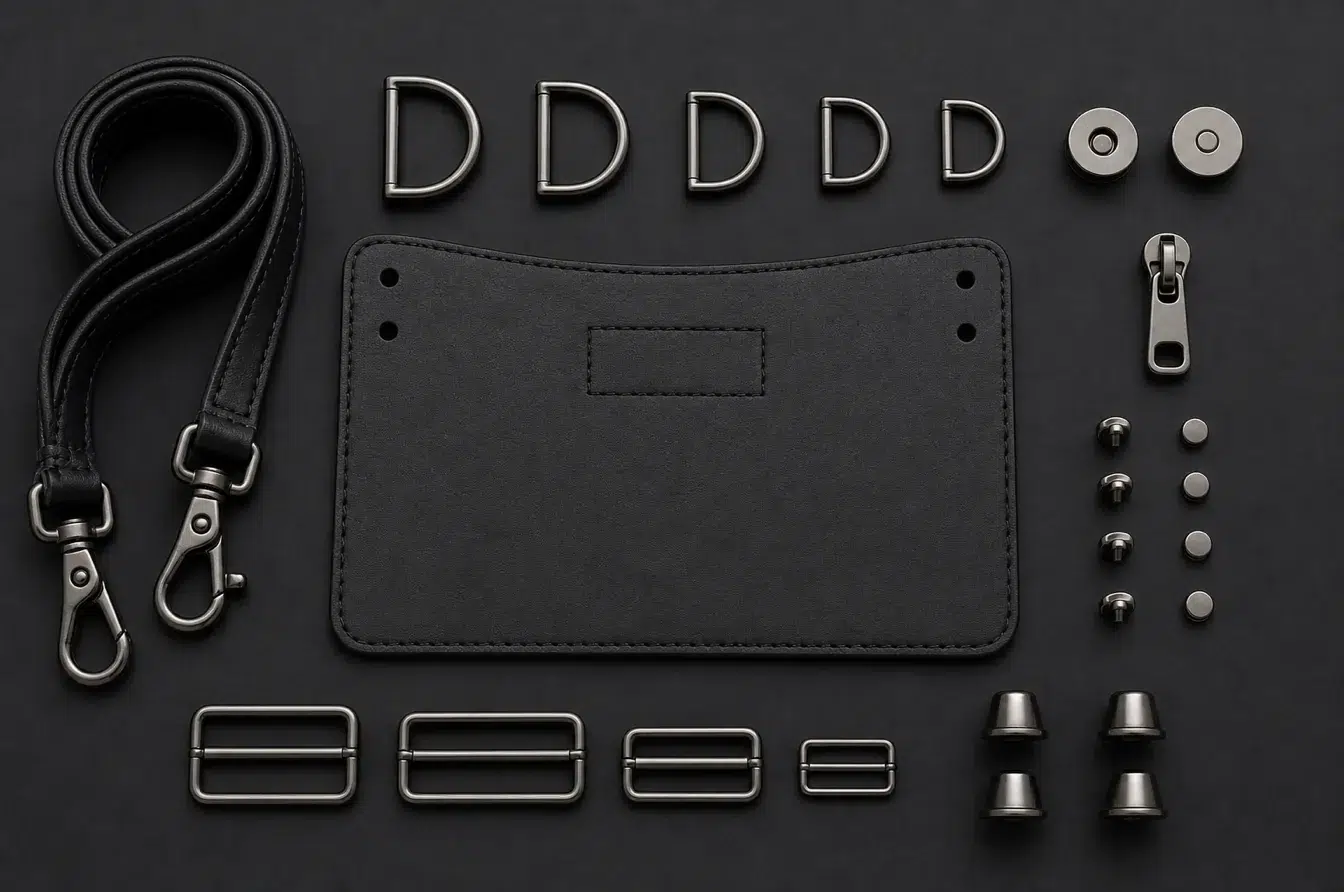
I review the complete hardware set under consistent lighting. The D-rings, swivel hooks, sliders, magnetic snaps, rivets, zipper pulls, and bag feet should have an agreed color relationship. Ordering every part under the same finish name does not guarantee a visual match because different suppliers, base metals, and plating processes can produce different tones.
| Finish direction | Suitable product language | Development concern |
|---|---|---|
| Polished nickel | Modern, technical, minimal | Fingerprints and visible scratches |
| Gold | Premium, formal, fashion-led | Lot-to-lot color variation |
| Rose gold | Soft luxury and contemporary fashion | Matching across different base metals |
| Antique brass | Heritage, vintage, outdoor | Controlled antiquing consistency |
| Gunmetal or black | Urban, understated, technical | Edge wear and exposed base color |
| Iridescent metal | Statement and youth-oriented designs | High visual variation and abrasion marks |
For frequently handled products, I request abrasion, corrosion, adhesion, and chemical-resistance information appropriate to the target market. Performance expectations should be written into the approval process before bulk production, especially when the product will encounter moisture, sweat, perfume, cleaning products, or outdoor exposure.
How Should D-Rings Work Within a Complete Hardware System?
A D-ring rarely operates alone. Its shape, opening, gauge, and finish must remain compatible with every hook, slider, strap, rivet, and protective fitting around it.
A successful hardware system uses compatible contact dimensions and a controlled visual language. The hook must move freely, the slider must suit the strap, and every visible component should share an intentional finish direction.
Check Mechanical Compatibility Before Visual Matching
When pairing a D-ring with a swivel hook, I first check the hook opening. It must pass over the ring’s metal profile without excessive force, but it should not be so large that the connection feels loose. I also rotate the hook through realistic positions to see whether its body catches against the ring, strap tab, or bag edge.
Two D-rings can also work together as a simple strap adjuster or belt closure. The two rings need matching geometry and enough spacing for the strap to pass through cleanly. A soft or thin strap may slip under load, while a very thick strap may become difficult to adjust. The edge finish of both rings must be smooth because the strap experiences repeated friction during adjustment.
For removable shoulder straps, the D-ring and swivel hook should be tested as a pair. A heavy hook connected to a light ring can feel visually unbalanced and may cause the ring to rotate. A thick ring paired with a narrow hook opening may damage the plating during assembly.
The same system thinking applies to sliders, magnetic snaps, zipper pulls, rivets, and bag feet. These parts do not need to be identical in size, but they should communicate the same level of visual weight and finish quality.
| Hardware combination | Compatibility check | Approval criterion |
|---|---|---|
| D-ring and swivel hook | Hook opening versus ring thickness | Smooth attachment and full rotation |
| D-ring and strap tab | Internal width versus finished tab width | Centered fit without compression |
| Double D-rings | Ring geometry and strap friction | Secure hold with practical adjustment |
| D-ring and slider | Strap width and hardware profile | Consistent scale across the strap system |
| D-ring and rivets | Ring weight versus tab construction | Reinforcement without excessive bulk |
| Complete hardware set | Color, gloss, texture, and ageing behavior | Intentional visual consistency |
Pet collars and leashes require even stricter system evaluation because the connection experiences sudden and changing forces. A component that works for a fashion bag should not be transferred to a safety-related product without application-specific testing.
I document the approved combination in the bill of materials rather than approving each component independently. This helps prevent a purchasing substitution that is technically similar on paper but incompatible during assembly.
Which Installation and Sampling Controls Prevent Production Failures?
Many D-ring failures begin outside the ring itself. Frayed webbing, weak tabs, short stitch lines, incorrect print scaling, and uncontrolled substitutions can all damage the connection.
A reliable installation combines reinforced materials, controlled stitching or riveting, accurate physical comparison, and an approved hardware library. These controls reduce sampling errors and make repeat orders more consistent.
Reinforce the Material Around the Ring
The attachment area should be designed according to the base material. Woven webbing may need heat cutting, edge sealing, binding, or another anti-fray method before it is folded around the D-ring. Synthetic fabric can often be heat sealed, but temperature should be controlled to avoid hard, sharp, or discolored edges.
Leather tabs require enough length to distribute force below the visible connection. If the leather is soft or stretchy, I may add a reinforcement layer or choose a firmer internal material. Coated fabrics and light textiles often need backing tape, reinforcement fabric, or a structured internal panel.
A box-X stitch pattern is useful because it spreads the load across both the perimeter and diagonal lines. Stitch length, thread type, seam allowance, and the distance from the material edge must suit the selected tab. Several extra stitch passes cannot compensate for weak or damaged material.
Rivets can support the construction, but their post length must match the compressed material thickness. An overly long rivet may remain loose, while a short one may not set securely. Washers or backing plates can help distribute pressure in suitable constructions.
| Installation method | Best use | Main production control |
|---|---|---|
| Box-X stitching | Webbing and reinforced textile tabs | Stitch density and edge distance |
| Perimeter stitching | Structured leather tabs | Reinforcement and thread selection |
| Rivet reinforcement | Leather or layered tabs | Correct post length and setting pressure |
| Hidden backing layer | Light fabric or coated material | Backing size and placement |
| Heat-sealed edge | Compatible synthetic webbing | Temperature and edge hardness |
| Bound or folded edge | Fray-sensitive woven material | Consistent finished width |
I treat anti-fray preparation, D-ring installation, and nearby magnetic-snap installation as connected technical subjects. Each operation changes the stress inside the bag panel. Reviewing them together helps prevent reinforcements from overlapping badly or creating unexpected hard points.
Build a Repeatable Sampling and Hardware Library
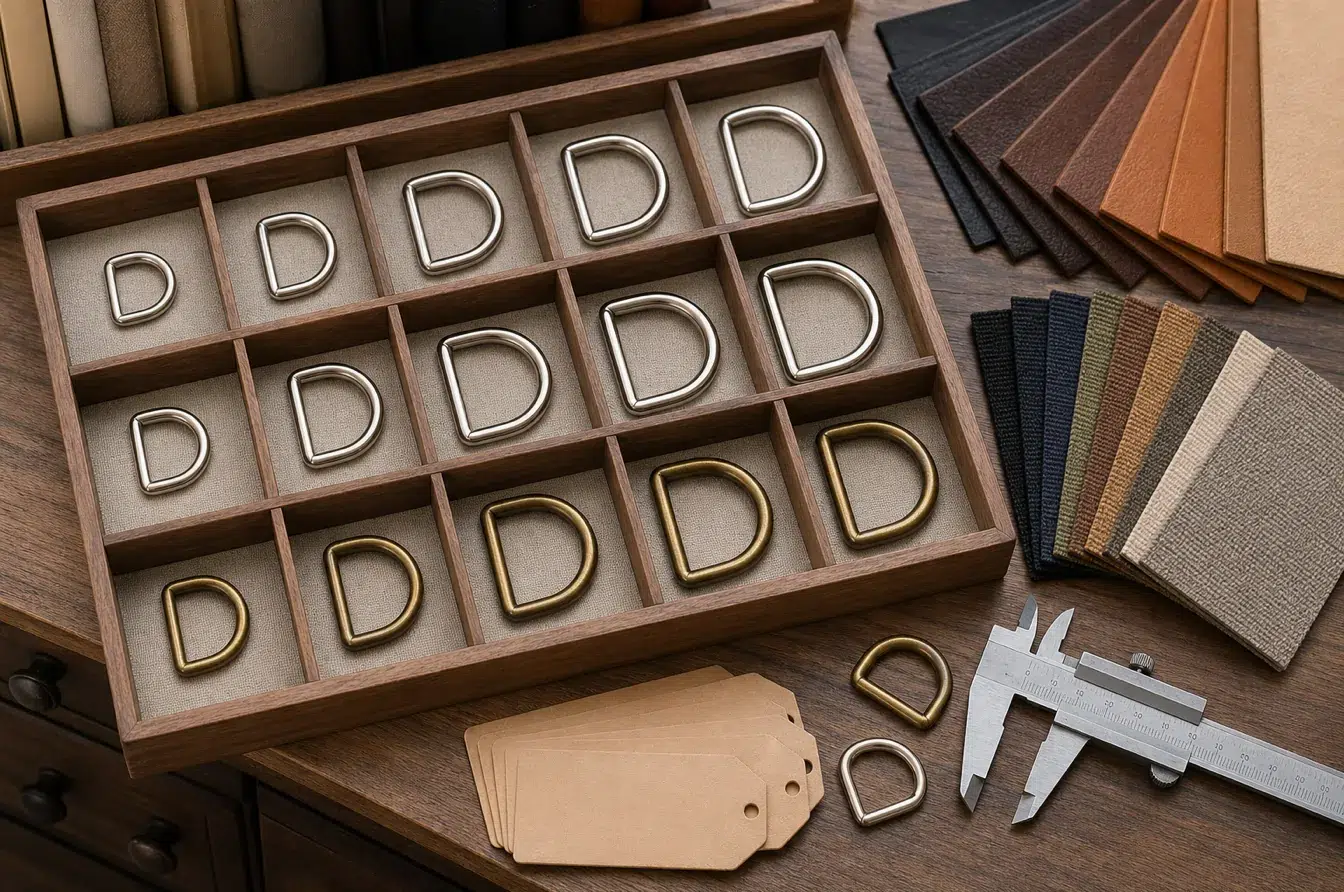
A printed 1:1 hardware chart is useful during early selection, but it must be printed at its original scale. For an 8.5 × 11-inch chart, I disable “fit to page” and confirm the printed calibration mark with a ruler. Even a small scaling error can lead to the wrong component decision.
A useful comparison chart should show at least four parameters: internal width, overall width, overall height, and metal thickness. For CAD work, I also record the profile shape and corner radius when these affect hook movement or visual appearance. The digital model should support evaluation, but a physical sample is still necessary for hand feel, weight, finish, and movement.
For ongoing development, I recommend building a controlled hardware library with common internal widths from 1/2 inch to 1 1/2 inches. Nickel and antique brass are practical reference finishes, but the final selection should follow the brand’s product direction. Each sample should carry a supplier code, base material, finish specification, measured dimensions, weight, approval date, and test status.
Before adding a D-ring to the approved library, I inspect surface smoothness, symmetry, plating coverage, flash, sharp edges, and the joining area. For formed rings, the weld or interface should appear controlled and should not create a weak or abrasive point.
| Library record | Why it matters |
|---|---|
| Supplier and item code | Prevents confusion during reordering |
| Internal and external dimensions | Supports strap and hook compatibility |
| Actual metal thickness | Controls strength direction and visual scale |
| Base material and finish | Supports cost and durability evaluation |
| Approved mating components | Preserves the tested hardware system |
| Test reports and sample date | Identifies current performance evidence |
| Golden sample location | Provides a physical production reference |
The approved sample should remain linked to the bill of materials and technical pack. If a supplier changes the base metal, plating process, factory, tooling, or ring thickness, I treat the part as a revised component that requires confirmation rather than a routine repeat order.
Conclusion
A professional D-ring specification connects proportion, performance, finish, installation, and sourcing control so the entire bag feels intentional and remains reliable in use.