- Loading...
Custom fashion hardware MOQ can vary sharply even between nearly identical drawings, as I have seen when different production routes sit behind them.
MOQs vary because each material, forming method, finish, and assembly route carries a different combination of fixed setup cost, usable yield, batch capacity, and handling work. The minimum is the volume at which that specific production system becomes practical.
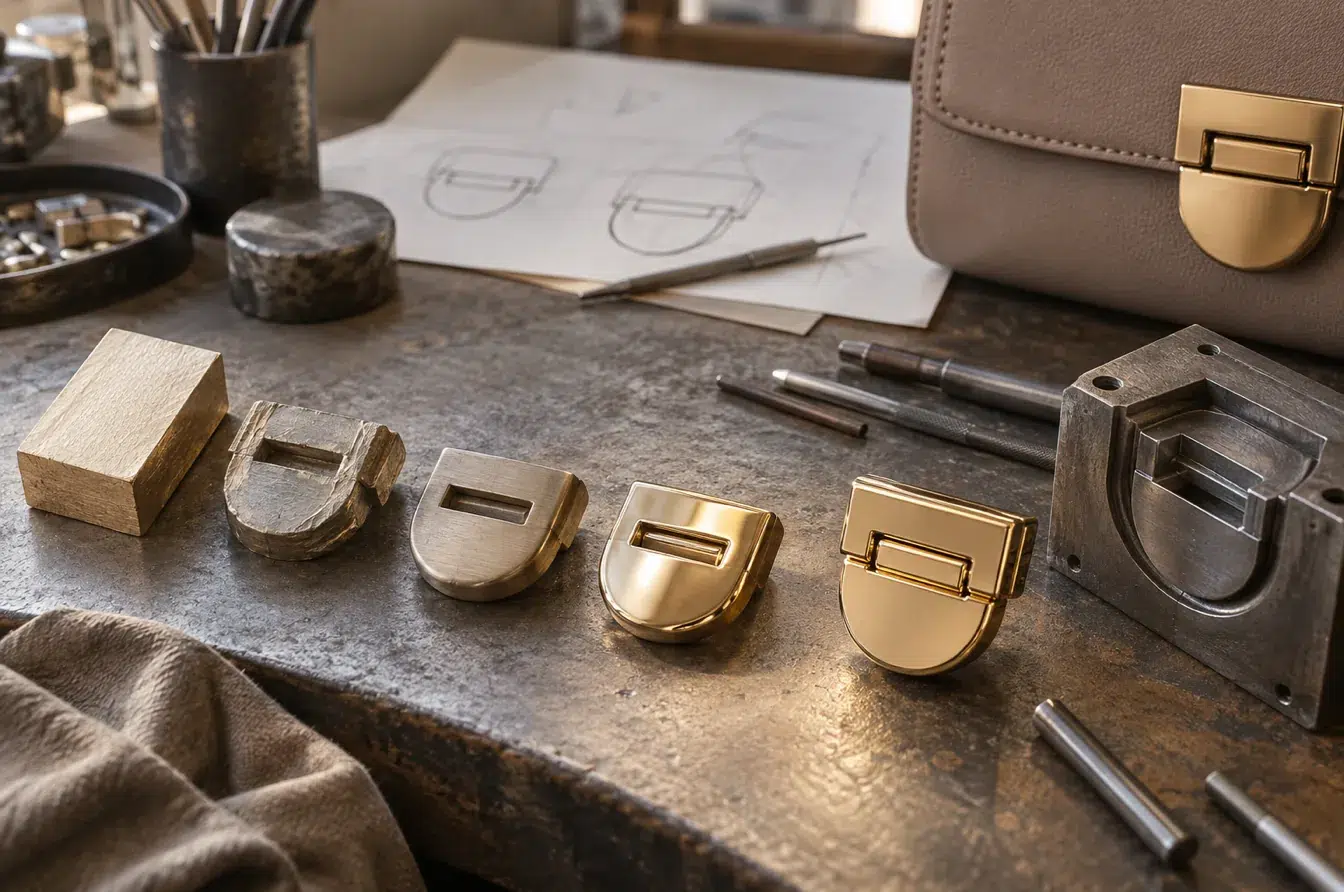
Custom buckles, zipper pulls, buttons, rings, hooks, sliders, logo plates, cord ends, chains, and decorative trims do not share one production model. A useful MOQ comparison must connect the quoted quantity to the exact part configuration and every operation needed to reproduce it.
What Production Costs and Batch Requirements Actually Determine MOQ?
An MOQ feels arbitrary when a quotation gives one number but does not identify the production constraints behind it.
MOQ is the smallest economically workable batch for a defined SKU, material, process, finish, and quality plan. It balances fixed preparation cost with cycle time, labor, expected yield, finishing capacity, inspection, packaging, and the supplier’s available production schedule.

The Break-Even Logic Begins Before Production
Every custom run contains work that must be completed before saleable hardware begins to move through the line. Artwork and drawings require review. Tooling, dies, cutters, programs, jigs, or fixtures may need to be prepared and installed. Machines must be set, raw material must be issued, process conditions must be stabilized, and first pieces must be checked before the full batch proceeds. These activities create a fixed or semi-fixed cost whether the order contains a few pieces or a much larger quantity.
Variable cost behaves differently. Metal, resin, machine time, polishing, coating, assembly, inspection, and packing increase as more units are produced. The MOQ appears where the combined fixed and variable cost becomes workable for the factory and commercially acceptable for the order. A smaller run may still be technically possible, but it can require a higher unit price, a separate setup charge, a simpler production route, or a different place in the production schedule.
Capacity also matters. A short run can interrupt a machine or finishing line that is arranged for longer repeat batches. The resulting cleaning, material change, tool change, trial pieces, and scheduling gap create opportunity cost. For that reason, two capable factories can set different minimums for the same drawing without either number being universally correct.
| Cost layer | Typical behavior | How it affects MOQ |
|---|---|---|
| Engineering and setup | Incurred before stable production begins | Needs enough units or a separate fee to absorb preparation |
| Tooling and fixtures | Created for a shape, process, or assembly | Raises the entry cost when existing assets cannot be reused |
| Material and processing | Increases with each unit | Determines the normal piece cost after setup |
| Finishing and color change | Often managed as a separate production batch | Can establish a second minimum after forming |
| Inspection and packing | Includes both preparation and per-piece work | Increases with complexity, sorting, and presentation needs |
| Production capacity | Depends on line layout and current scheduling | Makes the same small order more or less attractive to different factories |
MOQ Belongs to a Configuration, Not an Entire Catalog
A factory-wide statement such as “the MOQ is one quantity” often hides the variables that actually control the order. MOQ normally belongs to a specific combination of design revision, size, base material, manufacturing route, logo treatment, finish, color, assembly, and packaging. Changing one of those fields can create another production lot even when the product name remains unchanged.
This distinction becomes important when a collection shares one hardware design across several products. A total order may appear large, but splitting it among multiple sizes, finishes, or logo versions can leave each production lot below an efficient loading quantity. One buckle ordered in gold, silver, black, and antique tones is not necessarily one finishing batch. The raw parts may share tooling, while every color requires separate preparation, processing, approval, and sorting.
A comparable quotation should therefore identify the MOQ level precisely. Useful fields include MOQ per part number, per size, per material, per finish, and per color. The quotation can also separate the tool charge, setup charge, unit price at different quantities, and repeat-order conditions. This structure shows whether the minimum comes from physical production, commercial scheduling, or a combination of both. It also prevents a low headline MOQ from becoming several larger commitments after the variants are confirmed.
How Do Zinc Alloy, Brass, Stainless Steel, Aluminum, and Plastic Hardware Differ in MOQ?
A cheaper material does not automatically produce a lower MOQ when its geometry, stock form, or finishing route is harder to standardize.
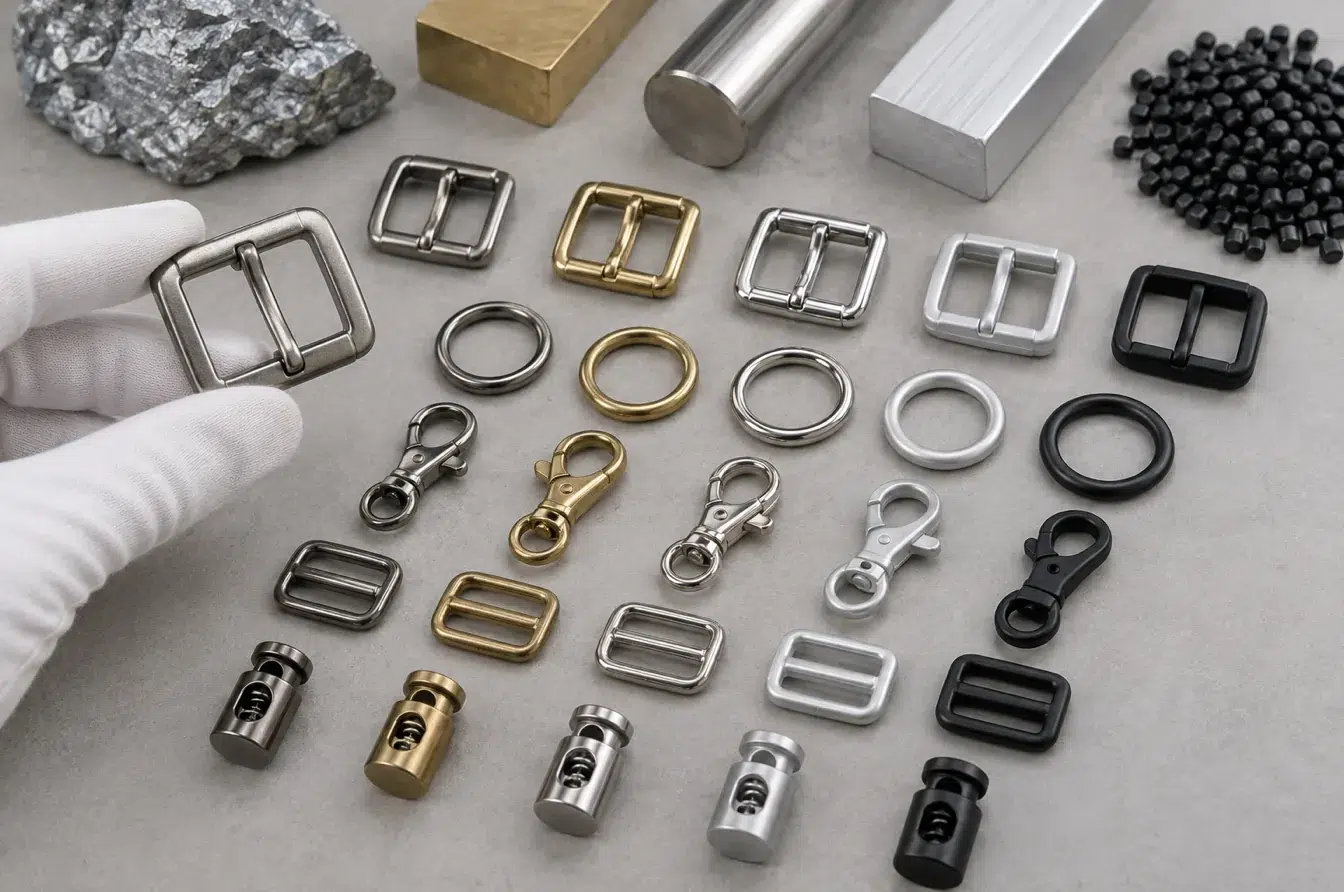
Material choice affects MOQ through availability, purchase form, manufacturability, scrap recovery, surface preparation, and compatibility with the intended finish. The same design may require different tools and process settings when moved from zinc alloy to brass, stainless steel, aluminum, or plastic.
Material Price Is Only One Part of the Calculation
Base-material price influences unit cost, but MOQ is more sensitive to how the material enters and moves through production. A common alloy, sheet thickness, wire diameter, or resin can often be issued from regular stock or combined with other planned work. A special grade, unusual thickness, proprietary color, or low-use material may require a dedicated purchase from an upstream supplier. The hardware factory may then need to buy more material than one order consumes, hold the balance, or charge the project for the unused commitment.
Yield changes the calculation again. A material that forms cleanly in the selected geometry may produce a high proportion of usable parts. Another material may require wider trimming margins, slower cutting, extra deburring, more polishing, or greater allowance for cosmetic rejection. Scrap may have recovery value, but recovery rarely removes the lost machine time and handling work. The effective material cost is therefore based on acceptable finished units rather than only the weight entering the process.
Storage and traceability can also influence the minimum. Standard materials move through the factory regularly, while a special material may occupy space and remain tied to one design. A sound material decision considers annual demand, repeat frequency, finish compatibility, weight, strength, appearance, and process efficiency together. Selecting a material only from its price per kilogram can create a false expectation about MOQ.
| Material family | Common production characteristic | Possible MOQ influence |
|---|---|---|
| Zinc alloy | Suits detailed die-cast shapes and integrated decoration | Tooling and casting setup favor repeatable production runs |
| Brass | Can be stamped, formed, machined, polished, or assembled | Route and stock form may matter more than raw-material price |
| Stainless steel | Often stamped, formed, machined, or fabricated | Hardness, cutting time, tooling load, and finish route shape economics |
| Aluminum | Low weight but sensitive to alloy, forming, machining, and surface route | Special grades or color-sensitive finishing can divide batches |
| Plastic or resin | Supports molded colors and lightweight geometries | Tooling, resin type, drying, and color preparation can set the minimum |
A Material Change Can Require New Geometry and Tooling
Material substitution is not always a direct one-for-one change. A die-cast zinc alloy buckle depends on molten flow, draft, wall thickness, shrinkage, gate position, and part removal. A brass or stainless steel version may need stamping, forming, machining, brazing, welding, or assembly. A plastic version needs geometry that fills, cools, releases, and supports the required attachment points without distortion. The visual outline may remain similar while the internal engineering changes substantially.
These differences affect existing tooling. A cavity designed for one casting alloy cannot automatically process another material. A stamping die depends on sheet behavior, forming force, springback, and edge condition. A machining fixture must hold the selected material securely and allow tool access to every surface. Injection tooling must match resin flow and shrinkage. When the material changes the production route, the earlier mold, die, program, or fixture may no longer be suitable.
Finishing must be reconsidered at the same time. Zinc alloy, brass, stainless steel, aluminum, and metallized plastic do not accept polishing, plating, coating, or color preparation in identical ways. A finish that looks simple on a design board may require different cleaning, activation, underlayers, masking, or curing on another substrate. The most reliable material comparison therefore evaluates the complete finished component, not an unfinished shape with the same drawing.
How Do Die Casting, Stamping, CNC Machining, and Injection Molding Affect MOQ?
Two factories can quote different minimums for the same drawing because each may select a different route to make it repeatedly.
Die casting and injection molding favor repeat volume after tooling, stamping depends on die and strip setup, while CNC machining reduces hard-tool dependence but adds machine time per part. The economical MOQ changes with the route, complexity, cycle time, cavities, yield, and secondary operations.
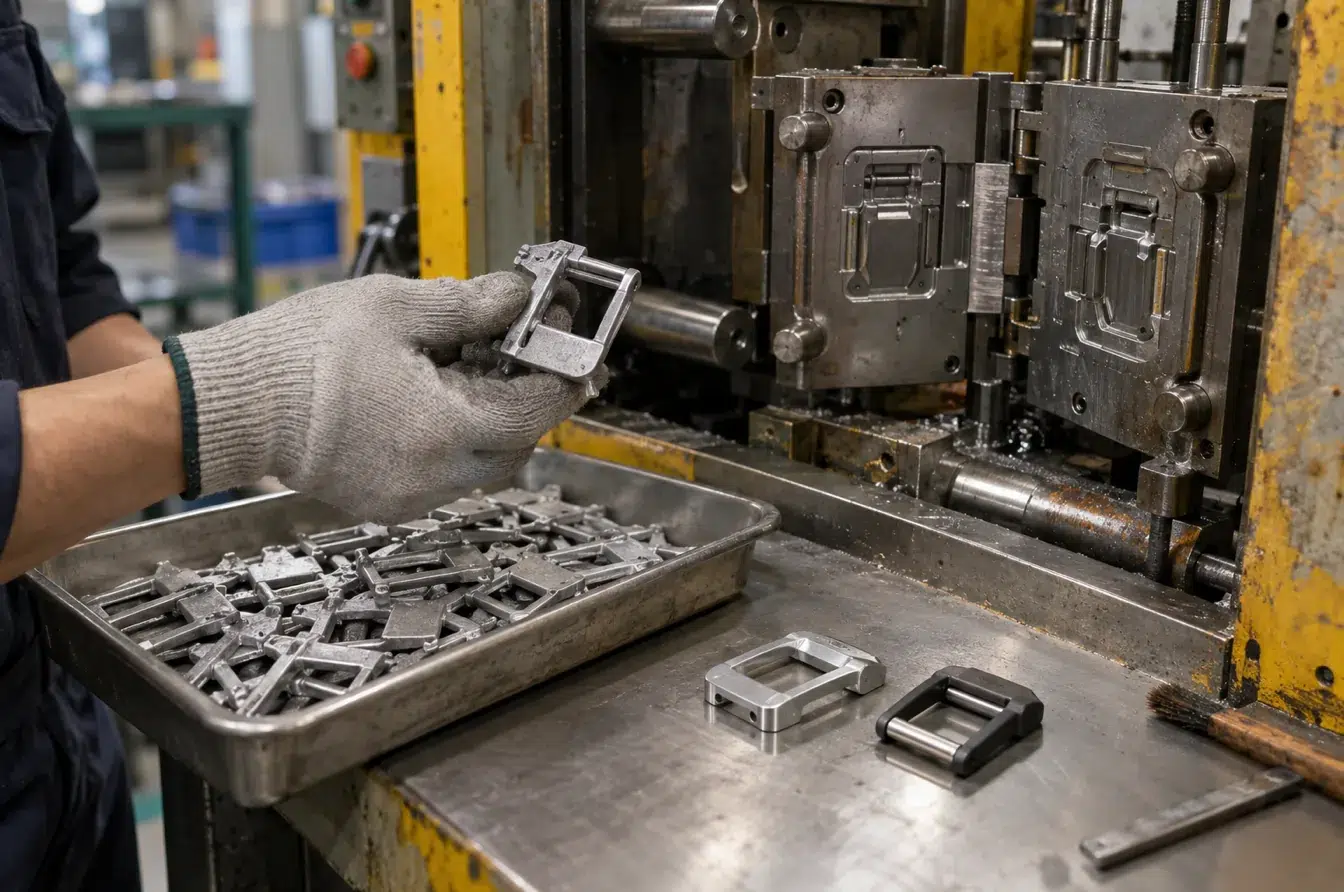
Tool-Light and Tool-Dependent Routes Exchange Different Costs
CNC machining can produce development parts without a shape-forming mold, which makes it useful for prototypes, pilot quantities, or geometries that do not justify dedicated tooling. That flexibility does not make the process inexpensive per unit. Each part occupies machine time, uses cutters, requires holding and repositioning, and may need substantial manual finishing. Unit cost can remain high even when the formal MOQ is low.
Die casting and injection molding reverse that pattern. Engineering and tooling create a higher entry cost, but a stable multi-cavity process can reproduce parts efficiently after approval. The required batch must support mold installation, machine setup, material preparation, trial cycles, trimming, and process stabilization. Stamping sits between these patterns depending on whether the part uses a simple blanking die, several forming stages, or progressive tooling. Wire forming and standard blank conversion may be more flexible when suitable tools and feedstock already exist.
No process has one universal MOQ. Part size, cavity count, press or machine capacity, changeover time, cycle length, operator involvement, and expected reorder volume all affect the result. The production route should be selected from geometry, function, finish, quantity profile, and lifetime demand. Choosing a process only because it advertises a low minimum can produce a poor unit-cost or repeatability outcome later.
| Manufacturing route | Main fixed preparation | Typical volume behavior |
|---|---|---|
| Die casting | Mold, machine setup, melt preparation, trial cycles | Becomes more efficient across repeated stable cycles |
| Stamping and forming | Cutting or forming dies, strip setup, press adjustment | Economics depend heavily on tool complexity and repeat volume |
| CNC machining | Programming, fixtures, tool selection, first-piece setup | Supports small quantities but retains higher time per part |
| Injection molding | Mold, resin preparation, color setup, process stabilization | Favors repeat batches after the molding system is proven |
| Stock-part conversion | Existing blank, marking fixture, minor secondary work | Often reduces tooling exposure when geometry remains standard |
| Multi-part assembly | Component supply, fixtures, work instructions, fit checks | Minimum can be controlled by the least flexible component or step |
Geometry and Secondary Operations Can Override the Primary Process
The process name alone does not explain the full MOQ. Two die-cast parts can have very different economics when one is a solid logo plate and the other is a hollow clasp with thin walls, deep recesses, moving interfaces, and several cosmetic faces. Fine lettering, undercuts, sharp internal corners, narrow slots, hidden pins, and critical strap openings may slow cycles, complicate release, increase tool maintenance, or reduce usable yield.
Secondary operations can become the real constraint. Cast parts may require trimming, drilling, tapping, grinding, polishing, or assembly. Stamped parts may need several forming stages, deburring, welding, or riveting. Machined parts may require multiple setups and separate surface preparation. Molded plastic components may need inserts, overmolding, printing, or manual removal of gates. Every extra handoff adds setup, work-in-process handling, inspection points, and the possibility of rejection after earlier value has already been added.
Functional hardware adds tolerance relationships. A turn lock, snap hook, slider, hinged buckle, or magnetic closure cannot be costed as one visible shell. Mating parts must align after forming and finishing, and springs, pins, screws, magnets, or rivets may have their own purchase or production constraints. The practical MOQ can therefore be set by the least flexible subcomponent rather than the largest or most expensive part.
Why Can Plating, Enameling, Polishing, and Color Matching Raise MOQ?
A raw component may be economical at low volume, yet its selected finish can create a much larger practical batch.
Finishing adds its own setup and loading rules. Electroplating, PVD, paint, enamel filling, polishing, and color matching depend on fixtures, bath or chamber use, masking, curing, cleaning, handling, inspection, and the number of finish variants sharing one production lot.
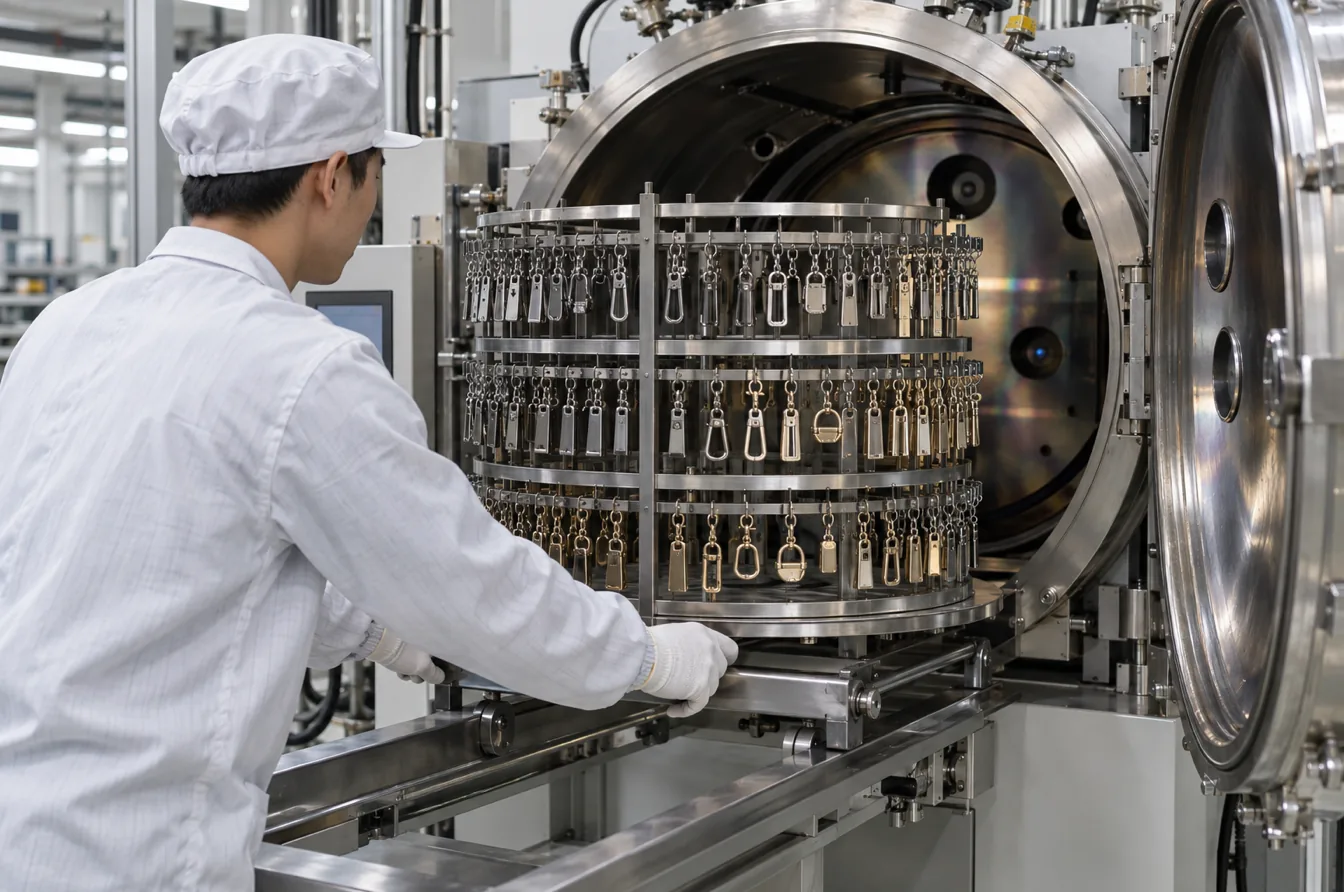
Finishing MOQ Is a Second Production System
Finishing should be treated as a separate production system rather than a decorative step added at the end. Electroplating may require cleaning, activation, underlayers, decorative deposits, protective layers, rinsing, drying, and controlled rack or barrel loading. PVD depends on chamber preparation, fixtures, target and recipe selection, loading density, vacuum cycles, and compatible substrate preparation. Paint and other cured coatings require mixing, spraying or immersion, flash time, oven capacity, and cleaning between colors.
The commercial batch is not always controlled by piece count. Surface area, part geometry, rack position, contact points, masking, and chamber or bath loading can determine how efficiently a lot uses the equipment. A large flat buckle and a small eyelet may occupy very different amounts of usable rack space. Delicate presentation faces may also require individual handling, while robust small components may tolerate bulk processing. The resulting minimum reflects the actual line configuration.
Manual work remains important for many fashion effects. Enamel filling, selective polishing, antique wiping, brushing, masking, and multi-tone details add preparation and inspection. Small orders can be technically possible but difficult to schedule efficiently because the setup is repeated for little output. When finishing is subcontracted, the hardware supplier must also meet the specialist processor’s practical batch requirements and queue structure.
| Finish route | Main batch constraint | Planning implication |
|---|---|---|
| Rack electroplating | Rack space, contact positions, bath sequence, handling | Decorative faces and geometry affect loading efficiency |
| Barrel electroplating | Barrel load, part movement, contact behavior | Small robust parts may batch efficiently, but delicate parts may not suit it |
| PVD | Chamber load, fixture density, recipe, substrate preparation | Small color lots can leave expensive capacity unused |
| Paint or cured coating | Color mixing, application setup, cleaning, oven schedule | Each color can behave as a separate production run |
| Enamel filling | Color preparation, manual application, curing, cleanup | Multiple colors and fine recesses increase handling |
| Polishing and brushing | Surface area, geometry access, cosmetic standard | Labor and usable yield can control the economic minimum |
Color and Appearance Split One Order Into Multiple Lots
Fashion collections often divide one base component among several tones, gloss levels, textures, and accent colors. These variants may share the same raw part and forming tool, but they do not automatically share one finishing batch. Gold-tone, silver-tone, black, antique, matte, polished, brushed, and painted versions require separate process conditions or handling. A collection quantity can therefore become several small finish lots with independent setup and approval work.
Color matching increases this separation. A custom tone needs an approved color master, defined substrate, surface preparation, gloss, texture, and viewing condition. The apparent color can shift when the base material, polish, coating thickness, rack position, cure, or top layer changes. Mixing unrelated parts into one batch may improve loading, but only when their substrates, preparation, geometry, quality expectations, and finish system are compatible.
Variant planning should happen before the MOQ discussion is closed. Combining products around a shared hardware color can make a finish batch more efficient. Keeping one signature finish across several bag, garment, footwear, belt, or accessory styles can also spread setup without increasing every finished-product quantity equally. When every SKU receives a unique finish, the commercial effect should be calculated as separate lots rather than one headline order.
How Can Brands Reduce MOQ Through Existing Tooling, Shared Finish Batches, or Design Changes?
Lower MOQ becomes realistic when the production constraint changes, not when the same cost structure is simply squeezed into fewer pieces.
Practical MOQ reduction comes from reusing tooling, standardizing materials, simplifying geometry, consolidating finishes, sharing one component across products, separating samples from bulk production, or accepting a higher unit cost for a controlled pilot. Each change should preserve the approved appearance and function.

Change Variables in Order of Design Impact
The lowest-impact lever is often a change in sourcing configuration rather than product identity. Existing rings, sliders, snaps, buckle frames, or zipper components can retain their proven geometry while receiving a selected finish or discreet marking. A standard blank can carry a laser logo. A stock slider can be paired with a custom puller. One signature component can be shared across several products while less visible hardware remains standardized.
Hybrid customization creates a useful middle position between catalog hardware and a completely new part. It concentrates tooling investment in the element that carries the strongest visual identity. It can also reduce the number of molds, materials, and finish lots required for a collection. The tradeoff is that standardized geometry may not deliver complete exclusivity, so visible signature pieces and hidden functional pieces should be evaluated differently.
More significant changes include simplifying an undercut, reducing the number of components, replacing raised relief with surface marking, using a regular material grade, or selecting a finish already running at the factory. These adjustments can improve yield and shorten setup, but they require design approval because appearance, tactile quality, attachment, wear, and function may change. MOQ reduction should never depend on an undocumented material or process substitution.
| MOQ lever | Constraint reduced | Main tradeoff to review |
|---|---|---|
| Use an existing mold or standard blank | New tooling and trial work | Reduced exclusivity or fixed geometry |
| Add laser marking or printing | Shape-forming tool for branding | Different depth, feel, and wear behavior |
| Standardize material and stock form | Upstream purchase commitment | Possible change in weight, appearance, or function |
| Consolidate finish colors | Repeated line setup and partial loading | Less color variation across the collection |
| Share one component across products | Fragmented SKU quantities | Attachment and proportion must suit every application |
| Simplify geometry or assembly | Tool complexity, cycle time, yield loss | Visual and functional details require reapproval |
| Accept a higher pilot unit price | Fixed cost spread across too few units | Higher launch cost but lower inventory exposure |
Build an RFQ That Exposes Every MOQ Layer
An effective RFQ separates MOQ into tooling, base material, forming, finishing, assembly, packaging, and commercial scheduling. It identifies the drawing revision, annual forecast, first-order quantity, repeat pattern, sizes, color split, surface area, critical faces, logo method, assembly structure, and packaging needs. This allows the supplier to explain which minimum belongs to each operation rather than returning one number without context.
Alternative quotations make the tradeoffs visible. One option may use private tooling and the preferred finish. Another may use an existing mold with custom marking. A third may retain the design but combine finish production with a planned repeat order. Unit prices at several quantities can show where setup becomes less dominant. Repeat-order terms can also reveal whether MOQ changes after the tool, fixture, program, and finish standard already exist.
The strongest negotiation question is not simply whether the MOQ can be lowered. The useful question asks which constraint is setting it and which controlled change would reduce that constraint. If the answer is tooling, reuse or separate tooling payment may help. If it is material, a stocked grade may help. If it is finishing, color consolidation or a shared compatible batch may help. If it is line time, a different schedule or higher pilot price may help. This approach lowers inventory through process design rather than by transferring unexplained risk into quality or delivery.
Conclusion
MOQ becomes manageable when material, process, finish, SKU structure, and forecast are treated as one production system rather than separate purchasing details.