
- Loading...
I have seen custom hardware orders delayed because three short phrases—lead-free, nickel-free, and nickel release—were treated as if they described the same requirement.
Lead-free controls the amount of lead in a material or component, nickel-free defines a specified restriction on nickel content or use, and nickel release measures how much nickel migrates from a finished surface. Import decisions must connect each claim to the product, finish, market, and contact conditions.
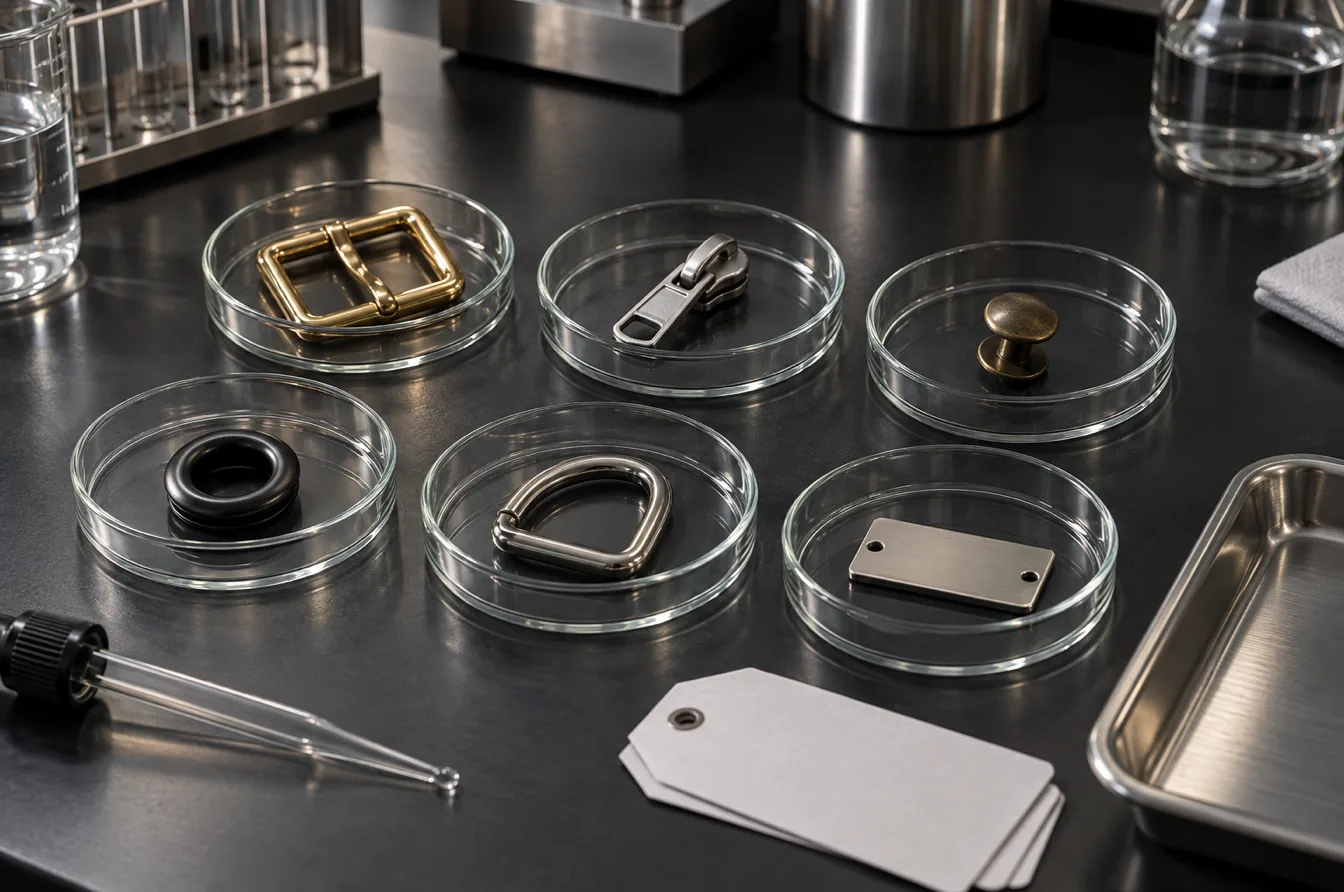
These terms often appear together in quotations, material declarations, and testing requests, but they answer different questions. A buckle can satisfy a lead-content requirement and still have an unsuitable nickel-release result. A plated component can be described as nickel-free even when that wording applies only to the visible coating. A base alloy may contain nickel while the finished surface releases very little under the applicable test conditions.
The correct approach begins before sampling. Each component needs a defined material, finish, application, contact condition, destination market, and consumer group. That information determines which test is relevant, which sample should be submitted, and whether a result can represent the planned bulk production.
What Is the Difference Between Lead-Free, Nickel-Free, and Nickel Release Requirements?
The three terms sound similar, so a quotation can appear complete while leaving the most important technical question unanswered.
Lead-free concerns lead concentration, nickel-free needs a written definition, and nickel release measures migration from a finished surface. None of these results automatically proves the other two. A useful specification separates the claims and assigns a test method, sample configuration, and acceptance requirement to each one.

Three Terms Control Different Risks
Lead-free is normally treated as a total-content requirement. The analysis determines how much lead is present in the tested material or component. Depending on the construction, separate materials may include the base alloy, solder, paint, enamel, plating, or another applied layer. A result for one material does not automatically cover every material in an assembled buckle, snap, zipper pull, or decorative plate.
Nickel-free is less precise unless the purchasing document defines it. It may mean no intentionally added nickel, no nickel in the plating sequence, no nickel in the outer layer, or nickel below an agreed content threshold. These definitions can produce very different constructions. A supplier may use a nickel-containing alloy beneath a coating while describing the visible finish as nickel-free. That wording may meet one commercial request but fail another.
Nickel release is different because it evaluates migration rather than total composition. The test measures nickel released from the relevant finished surface under controlled conditions. This is especially important for metal parts that remain against skin. Surface preparation, plating layers, topcoat condition, wear, geometry, and exposed area can all influence the result.
| Requirement | What it evaluates | What it does not prove | Essential specification detail |
|---|---|---|---|
| Lead-free | Lead concentration in the tested material or component | Nickel content or nickel migration | Applicable limit, material, component, and market |
| Nickel-free | A defined restriction on nickel content or intentional use | Acceptable nickel release unless separately tested | Whether the claim covers alloy, plating, topcoat, or the complete part |
| Nickel release | Nickel migrating from the finished contact surface | Total nickel percentage in the complete component | Contact category, test method, finish, and acceptance limit |
Marketing Language Must Become a Measurable Specification
Loose phrases work poorly in a purchase order because factories, plating suppliers, laboratories, and buyers may interpret them differently. “Environmental finish,” “hypoallergenic metal,” or “nickel-safe” may sound reassuring, but none defines the exact material stack or the required test outcome. The wording must be converted into measurable requirements before the first production-representative sample is made.
A clear specification separates the base material from the surface system. For example, a zinc-alloy body may receive a copper layer, a barrier layer, a decorative color layer, and a clear protective topcoat. The document should identify which layers must avoid intentionally added nickel, whether the finished surface requires nickel-release testing, and whether the lead requirement applies to the base alloy, coating, or every relevant material.
The same discipline applies to color variants. Bright gold, antique brass, matte black, silver tone, and painted finishes may use different chemicals or process routes. A passing result for one finish should not be treated as universal coverage when the plating stack, topcoat, supplier, or process changes. Each approved report must remain connected to a defined construction rather than to a broad product name.
Which Types of Fashion Hardware Need Lead and Nickel Testing?
Testing every metal item in the same way wastes cost, but testing only the most visible part can leave important materials unchecked.
The test plan should map every accessible material and every part with realistic skin contact. Buttons, rivets, snaps, zipper parts, buckles, rings, hooks, eyelets, chains, metal logos, spring components, and decorative trims may need different evaluations according to their materials, placement, and end use.

Component Mapping Defines the Real Test Scope
A finished product rarely contains only one metal. A snap button may include a cap, socket, stud, spring, post, and decorative cover. A swivel hook may combine a cast body, steel spring, pin, washer, and plated surface. A zipper can include teeth, slider, puller, top stops, bottom stops, and locking parts. These components may come from different production sources and may not share the same alloy or finish.
Lead-content planning should identify each accessible homogeneous material rather than treating the complete accessory as one undivided object. Hidden solder, paint, enamel, or a small spring can matter when it is accessible or when the applicable requirement covers that material. Composite or grouped testing may be practical in some programs, but only when the grouping logic is technically justified and a failed result can still be traced to the responsible material.
Nickel-release planning starts with contact. A metal jeans button touching the waist, a bra adjuster resting against skin, a swimwear ring exposed to wet and salty conditions, or a watch component worn for hours presents a different exposure pattern from an external handbag logo plate. Product drawings should mark the metal surfaces that can remain in direct contact with skin during normal use.
| Hardware type | Materials requiring review | Typical contact question | Main testing concern |
|---|---|---|---|
| Jeans buttons and rivets | Cap, tack, post, coating, paint | Does the rear or edge remain against skin? | Lead content and nickel release where applicable |
| Zippers | Teeth, slider, puller, stops, locking spring | Which parts touch the hand or body repeatedly? | Component content and finished-surface release |
| Buckles and strap adjusters | Frame, tongue, bar, pin, coating | Is contact brief, repeated, or prolonged? | Material content, release, and coating durability |
| Swimwear and lingerie rings | Ring body, joint, finish, topcoat | Does the part remain on wet or perspiring skin? | Nickel release from the production finish |
| Logo plates and charms | Body, solder, enamel, attachment | Is the trim external or accessible during wear? | Lead content and intended-use review |
| Piercing components | Post, backing, decorative body | Is any part inserted into the body? | Correct nickel-release category and limit |
Placement Can Matter as Much as the Hardware Category
The product name alone cannot decide the test. A buckle on the front of a belt may remain close to skin for long periods, while the same buckle used on a removable handbag strap may have only occasional hand contact. A decorative ring on swimwear may be exposed to perspiration, salt, sunscreen, moisture, and movement. An identical ring on an exterior luggage panel has a very different use condition.
Design reviews should therefore include both intended and reasonably foreseeable contact. Sharp edges, movement, coating abrasion, assembly orientation, and the way a product shifts during wear can expose surfaces that appeared hidden in a flat drawing. Small mating components also deserve attention because wear can remove coating at contact points and reveal an underlying layer.
Early mapping improves efficiency. Low-risk parts can be documented without unnecessary duplicate work, while high-contact parts receive the correct finished-surface evaluation. It also prevents a late request for testing after bulk plating has begun. The result is a test plan connected to product architecture rather than a generic list copied across every apparel, bag, footwear, jewelry, or accessory program.
How Do Product Use and Target Markets Determine Which Tests Apply?
A test result can be technically accurate and still be irrelevant when the wrong market, user group, or contact condition was specified.
Test selection depends on destination market, adult or children’s use, product category, accessibility, skin contact, and surface construction. The same component can require different evidence when used in a child’s garment, adult handbag, piercing product, belt, shoe, lingerie item, or swimwear style.

Market and Consumer Group Come Before the Test Name
Lead requirements are not identical across every market or product category. Children’s products often apply stricter controls to accessible components, while adult fashion items may follow another restriction based on the article type or foreseeable use. Jewelry, hair accessories, garment trims, footwear parts, and bag hardware should not be assumed to share one universal lead threshold.
Nickel-release requirements are commonly driven by direct and prolonged skin contact. Piercing components form a separate category because they are inserted into the body. A laboratory request must identify the product use so that the relevant sample preparation, contact surfaces, and acceptance limit are applied. “Nickel release test” alone does not provide enough context.
Target-market review should occur at the quotation stage. Waiting until shipment can reveal that the selected alloy or plating sequence cannot meet the intended requirement without redevelopment. Early definition allows the supplier to choose suitable raw material, barrier layers, decorative finishes, topcoats, and process controls before tooling samples or color approvals are finalized.
| Product context | Decision that sets the scope | Typical testing direction |
|---|---|---|
| European skin-contact fashion hardware | Which finished surfaces have direct and prolonged contact? | Nickel release on the production-representative finish |
| Regulated children’s product | Which components and coatings are accessible? | Total lead by relevant component plus category-specific checks |
| Adult external bag decoration | Is meaningful skin contact reasonably expected? | Material and finish review followed by targeted testing |
| Piercing jewelry | Which parts enter the pierced body area? | Piercing-specific nickel-release evaluation |
| Swimwear or lingerie hardware | How do moisture, perspiration, movement, and wear affect contact? | Finished-surface release and coating-durability review |
Product Configuration Can Change the Applicable Decision
A component should be evaluated in its real assembly, not only as an isolated catalog part. Orientation can expose the reverse side of a plate, the cut edge of a stamped trim, or the inner surface of a ring. Riveting and crimping can crack a coating. Welding or soldering can introduce another material. Polishing after assembly can thin a protective layer at raised details and edges.
The intended life of the product also matters. A decorative item worn briefly may present different contact from a daily-use belt buckle or watch component. Coated hardware needs additional attention because the outer layer may initially prevent release but become less protective after abrasion and corrosion. When a wear-preparation step applies, the release test should follow that preparation rather than using only a pristine sample.
The test request should describe these conditions without relying on assumptions. Useful inputs include product photographs, drawings, contact-area markings, assembly method, base alloy, complete finish sequence, topcoat, intended consumer, destination market, and whether the item is coated. This information helps the testing plan evaluate the actual risk created by the final product configuration.
How Are Lead Content, Nickel Content, and Nickel Release Tested?
Using one screening method for every claim can produce fast numbers, but those numbers may not answer the required compliance question.
Lead and nickel content tests examine elemental composition, while nickel-release testing measures migration from a finished surface under controlled exposure. Screening tools can support development and incoming inspection, but the final method must match the specified requirement and the exact production-representative component.

Content Testing Examines the Material Itself
Lead-content testing begins with a defined sample. A complex part may need to be separated into base metal, coating, paint, enamel, solder, or other relevant materials. The laboratory then prepares the selected material and measures the elemental lead concentration. The result applies to that tested material, so the report should show exactly what was sampled.
Elemental screening can be useful before formal production testing. A rapid, non-destructive scan can identify unexpected lead or nickel and help compare incoming batches. However, screening has detection, geometry, coating-depth, and calibration limitations. It should not be treated as proof of nickel-release performance because detecting nickel does not show how much will migrate from the surface.
Nickel-content testing has a similar limitation. It can confirm whether nickel is present or estimate its concentration in a material or coating system, but it cannot substitute for a migration test when the requirement is based on release. A component containing nickel may still have a low release result, while an unsuitable coating or exposed underlayer can create a poor release result even when the outer finish was described as nickel-free.
| Test approach | Primary question | Useful application | Main limitation |
|---|---|---|---|
| Lead-content analysis | How much lead is in the tested material? | Base alloys, coatings, paints, solder, and accessible parts | Covers only the identified sample material |
| Nickel-content analysis | Is nickel present, and at what concentration? | Alloy and plating verification | Does not measure migration from the surface |
| Elemental screening | Are unexpected elements likely to be present? | Development checks and incoming inspection | May not provide the final quantitative answer |
| Nickel-release testing | How much nickel migrates from the finished contact surface? | Skin-contact hardware | Does not report total nickel percentage |
Nickel Release Evaluates the Finished Contact Surface
Nickel-release testing exposes the relevant surface to a controlled solution that represents contact with perspiration. After the defined exposure period, the released nickel is measured and related to the tested surface area and time. Geometry therefore matters: complex openings, chains, mesh, hollow forms, textured surfaces, and partially contacting areas need correct preparation and area calculation.
Coated products may require simulated wear and corrosion before the migration stage. This preparation evaluates whether the protective surface remains effective after normal-use damage rather than only when freshly plated. The finished sample must match production in base alloy, polishing, plating sequence, decorative color, coating thickness, topcoat, curing, and assembly process.
Testing raw alloy alone cannot validate a completed plated buckle or logo plate. Testing a loose component may also miss damage introduced by riveting, bending, crimping, welding, or final polishing. For that reason, the strongest sample is normally a production-representative finished component, or the completed product when assembly can change the surface. The report should also identify which areas were tested, masked, excluded, or treated before measurement.
Which Test Reports and Compliance Documents Should Importers Verify Before Mass Production?
A passing result has limited value when the report cannot be matched to the approved finish, component, supplier, or production batch.
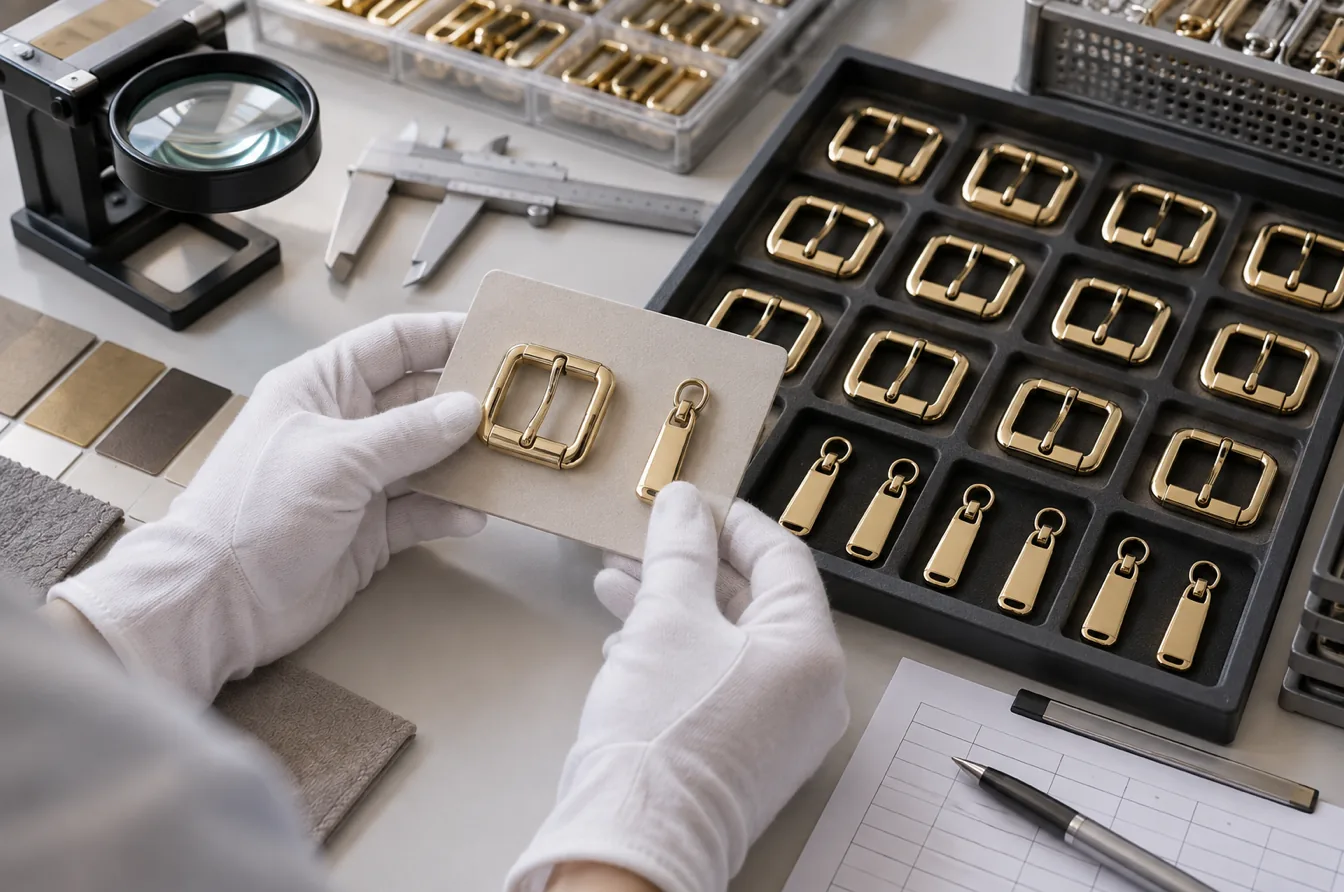
Before mass production, the technical file should connect every test result to an exact part number, material, finish code, construction, sample image, test method, date, and result. Purchase documents should also define change-control rules so that unapproved substitutions cannot silently invalidate the evidence.
The Report Must Match the Exact Approved Component
The first review point is sample identity. The part number, product name, dimensions, color, material, and finish description should correspond to the approved item. Photographs are especially useful for separating similar components and confirming whether the report covers bright gold, antique brass, matte black, silver tone, or another finish.
The second point is scope. The report should state which material or surface was tested, the method used, the applicable category, the result, the acceptance limit, and whether any wear or corrosion preparation was completed. A report for raw zinc alloy does not cover a plated assembly. A result for one color should not automatically cover another when the process route changes.
The third point is production relevance. The tested sample should come from the same supplier, alloy source, plating route, topcoat, and assembly process planned for bulk goods. Old reports can remain useful only when the current construction is demonstrably unchanged. A generic statement covering all factory products cannot replace component-specific evidence.
| Report field | Why it matters | Warning sign |
|---|---|---|
| Part number and photograph | Links the report to the approved component | Generic product family with no identifiable sample |
| Material and finish stack | Defines the construction represented by the result | Only “metal” or “gold plating” is stated |
| Color or finish code | Separates process variants | One report is claimed to cover every finish |
| Test method and category | Shows what question was evaluated | Method named without product-use category |
| Result and acceptance limit | Allows a clear pass-or-fail review | “Pass” appears without measured result or limit |
| Sample and test dates | Supports relevance to current development | Report predates major supplier or process changes |
| Preparation details | Confirms wear treatment or sample separation | Coated part tested with no preparation explanation |
Change Control Protects the Result Through Bulk Production
An approved report represents a defined construction at a defined time. It does not automatically cover future substitutions. Changes to the alloy, recycled-material ratio, solder, plating supplier, barrier layer, decorative finish, topcoat, curing condition, polishing sequence, assembly method, or manufacturing site can affect content or release performance.
The purchase order and technical pack should prohibit these changes without written review. A controlled bill of materials, finish specification, approved physical sample, plating sequence, part drawing, and batch identifier help connect bulk production to the tested version. Incoming inspection can then compare appearance, dimensions, finish code, supplier records, and screening results against the approved reference.
Retesting decisions should follow the significance of the change. A purely administrative update may not alter performance, while a new plating supplier or topcoat can affect the surface directly. When uncertainty remains, a production sample should be tested before the full shipment is completed. This approach turns testing from a one-time document exercise into a practical control system that protects repeat orders, additional colorways, and future production lots.
Conclusion
Reliable hardware testing begins with precise definitions, representative finished samples, component-specific reports, and controlled production—not broad claims such as lead-free or nickel-free.