
- Loading...
Swimwear hardware corrosion testing should include separate saltwater immersion, chlorinated-water exposure, and finish-appropriate corrosion tests.
Custom swimwear hardware should pass separate saltwater immersion, chlorinated-water exposure, and finish-appropriate corrosion tests. Qualification should assess corrosion, discoloration, coating damage, fabric staining, and function on production-representative components, with conditions and pass-fail limits defined before testing.
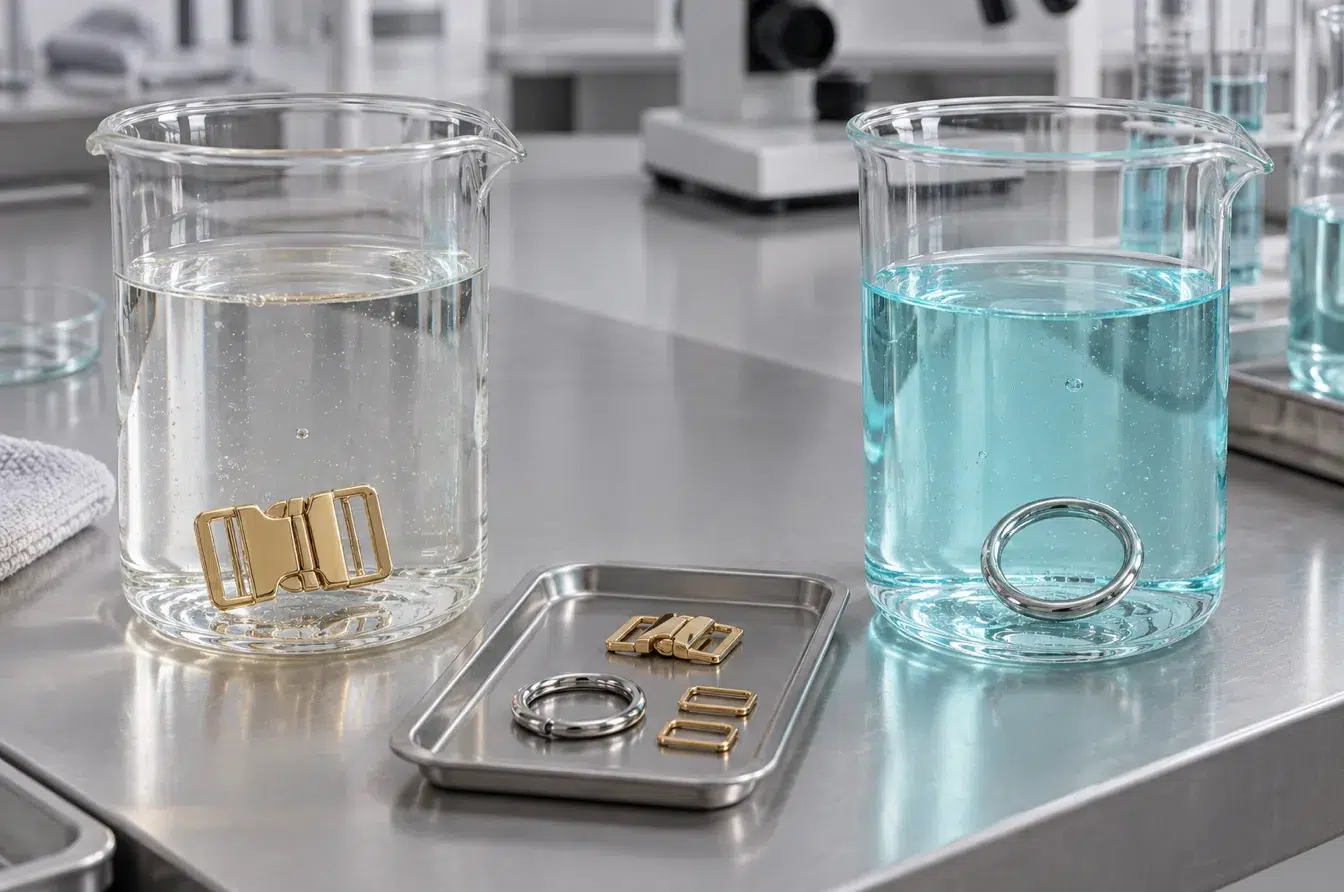
The strongest test plan begins with the real application. A decorative charm, a load-bearing strap ring, an adjustable slider, and a moving clasp do not have the same exposure pattern or failure consequences. Material, finish, construction, fabric color, and intended use all affect the required test scope.
Which Swimwear Hardware Materials and Finishes Require Water-Exposure Testing?
A material name alone cannot predict finished-component performance. Plating quality, coating coverage, geometry, joining methods, and contact between different metals often determine where corrosion begins.
Every water-exposed metal component needs screening, but risk rises for plated zinc alloy, brass, mixed-metal assemblies, porous finishes, soldered joints, and parts that trap water. Stainless steel and PVD-coated parts also require testing because grade, surface condition, geometry, and fabrication quality change actual performance.
Classify Risk by Construction, Not Appearance
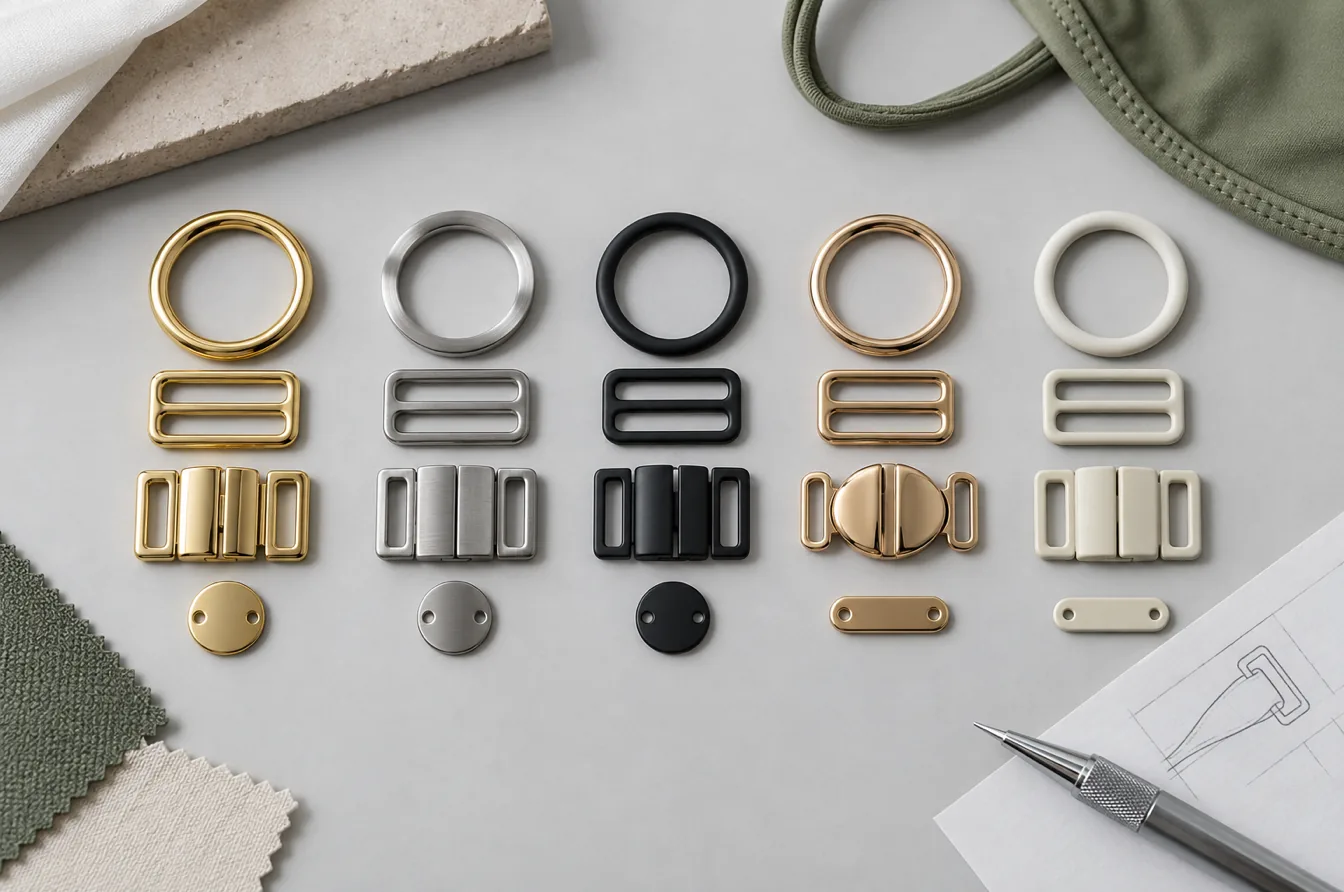
The first step is to identify the complete material and finish system rather than recording only the visible color. A gold-tone ring may be plated zinc alloy, lacquered brass, coated stainless steel, or a multilayer finish with an intermediate barrier layer. These options can look almost identical before use but react differently when water reaches an edge, pore, seam, or uncovered recess.
Component geometry also changes exposure. Deep engraving, blind holes, hinged sections, soldered joints, sharp transitions, and narrow gaps can retain liquid after the surrounding surface dries. Repeated wetting concentrates residue in these areas. Mixed-metal constructions add another risk because electrical contact between different metals in water can accelerate localized attack. The final assembled component therefore matters more than a flat test panel or an unassembled decorative shell.
Risk classification should consider both appearance and function. A small spot on a decorative logo plate may be commercially unacceptable even when strength remains unchanged. A similar mark hidden inside a clasp may be less visible, but corrosion around a spring, pin, or hinge can restrict movement and create a functional failure. Testing priorities should follow the part’s position, load, movement, skin contact, and visibility on the finished swimsuit.
| Material or construction | Typical water-exposure risk | Main testing focus |
|---|---|---|
| Plated zinc alloy | Pores, thin edge coverage, exposed base metal | White corrosion, blistering, plating lift, edge attack |
| Lacquered or plated brass | Tarnish, color change, copper-toned corrosion products | Finish continuity, discoloration, fabric staining |
| Stainless steel | Pitting or staining at crevices and contaminated surfaces | Grade verification, joints, recesses, surface condition |
| PVD-coated metal | Defects at edges, engraving, forming, or joining areas | Adhesion, color stability, exposed substrate |
| Mixed-metal assembly | Localized galvanic attack around contact points | Pins, springs, rivets, solder, and joined interfaces |
| Painted or resin-coated hardware | Cracking, swelling, softening, or peeling | Film integrity, adhesion, color transfer, roughness |
How Should Saltwater Immersion Testing Be Specified for Swimwear Hardware?
“Saltwater tested” has little value when the solution, exposure time, drying stage, and inspection method are missing. Repeatable conditions are essential for comparing finishes and suppliers.
A useful saltwater immersion specification defines solution composition, concentration, temperature, exposure time, sample orientation, rinse method, drying period, cycle count, and inspection points. Ocean-use and saltwater-pool claims need different exposure conditions because their salt levels and surrounding water chemistry are not equivalent.
Build a Repeatable Immersion and Dry-Cycle Plan
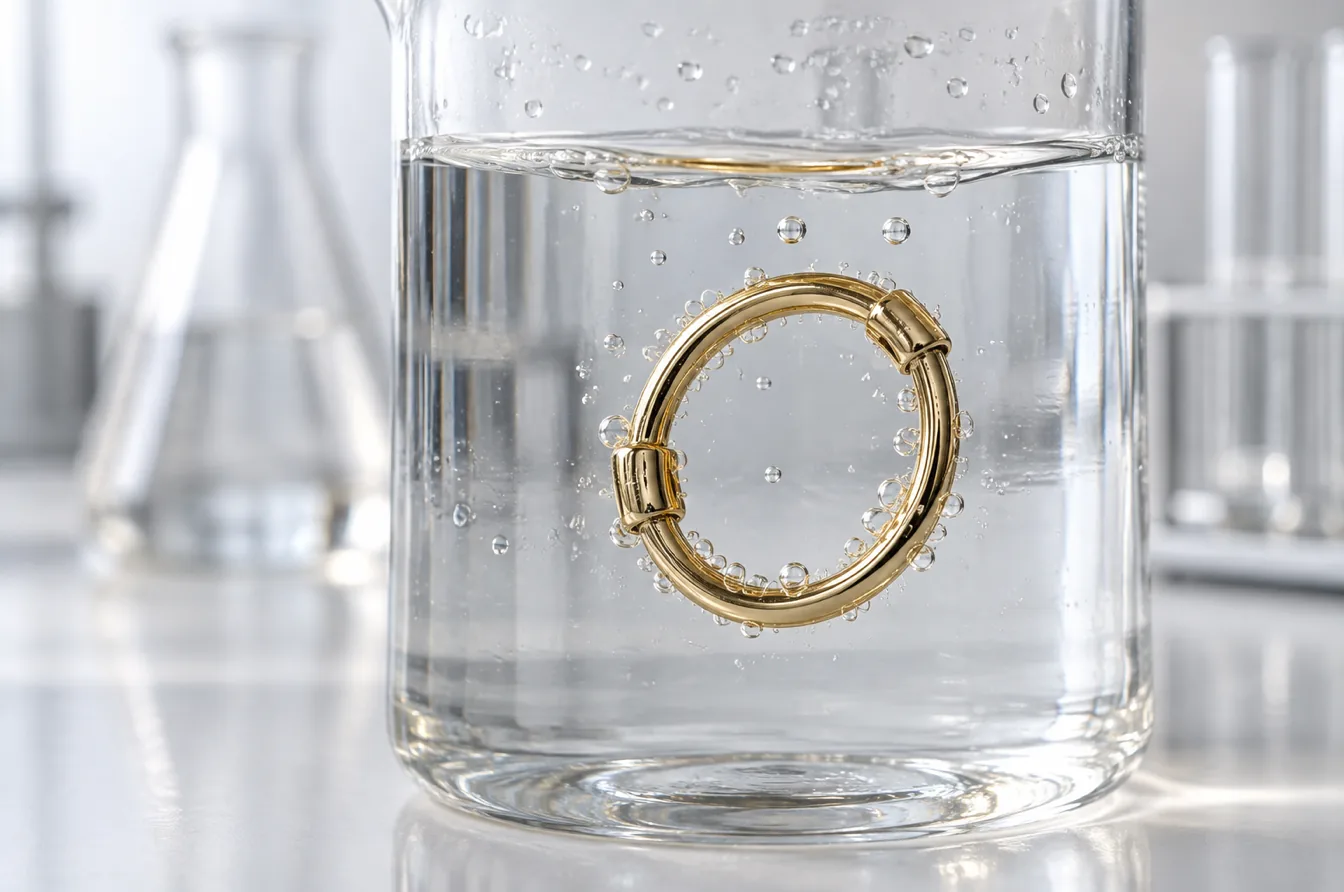
The test solution should represent the intended use rather than a vague idea of salty water. Ocean exposure and saltwater-pool exposure should be treated as different conditions. Natural seawater also varies, so a controlled laboratory solution is more useful for supplier comparison and repeat testing. The specification should state every condition that can change the result, including concentration, temperature, liquid volume, sample spacing, and whether the solution is refreshed during the test.
Continuous immersion can reveal coating weakness and base-metal attack, but swimwear hardware normally moves through wet and dry stages. A more representative plan includes immersion, draining, controlled drying, visual inspection, and repeated exposure. Drying is important because salt left in seams and recesses can become more concentrated as moisture evaporates. This often exposes weak edge coverage and trapped-liquid areas that remain unnoticed during a short continuous soak.
Production-representative samples should be used. They need the correct base metal, polishing level, plating stack, finish color, protective topcoat, assembly method, and marking process. Where a component is normally sewn to fabric or held under tension, a second sample set mounted in the intended configuration can show whether movement, pressure, or fabric contact changes the failure pattern.
| Test variable | Why it must be controlled | What the report should record |
|---|---|---|
| Salt solution | Different compositions can produce different attack | Formula, concentration, preparation date |
| Temperature | Higher temperature can accelerate reactions | Target and recorded range |
| Exposure pattern | Continuous soaking and cycling reveal different weaknesses | Immersion time, drain time, dry time, cycle count |
| Sample position | Orientation affects drainage and trapped liquid | Hanging, flat, assembled, or fabric-mounted position |
| Rinsing method | Rinsing can remove residue that continues to react | Whether rinsed, water type, and timing |
| Inspection timing | Wet and dry surfaces can look different | In-cycle and final inspection points |
| Functional check | Corrosion may affect movement before severe visual damage appears | Opening, closing, sliding, spring return, or rotation result |
How Should Chlorinated-Water Resistance Be Tested on Finished Hardware?
Chlorinated water creates a different chemical challenge from seawater. A salt-only test cannot show how a decorative finish behaves after repeated pool exposure and drying.
Chlorinated-water testing should control active chlorine level, pH, temperature, exposure duration, solution refresh, drying intervals, and cycle count. Finished hardware should be inspected after both wet exposure and drying because residue concentration can expose coating defects and attack hidden interfaces.
Reproduce a Pool-Use Cycle, Not Just a Single Soak
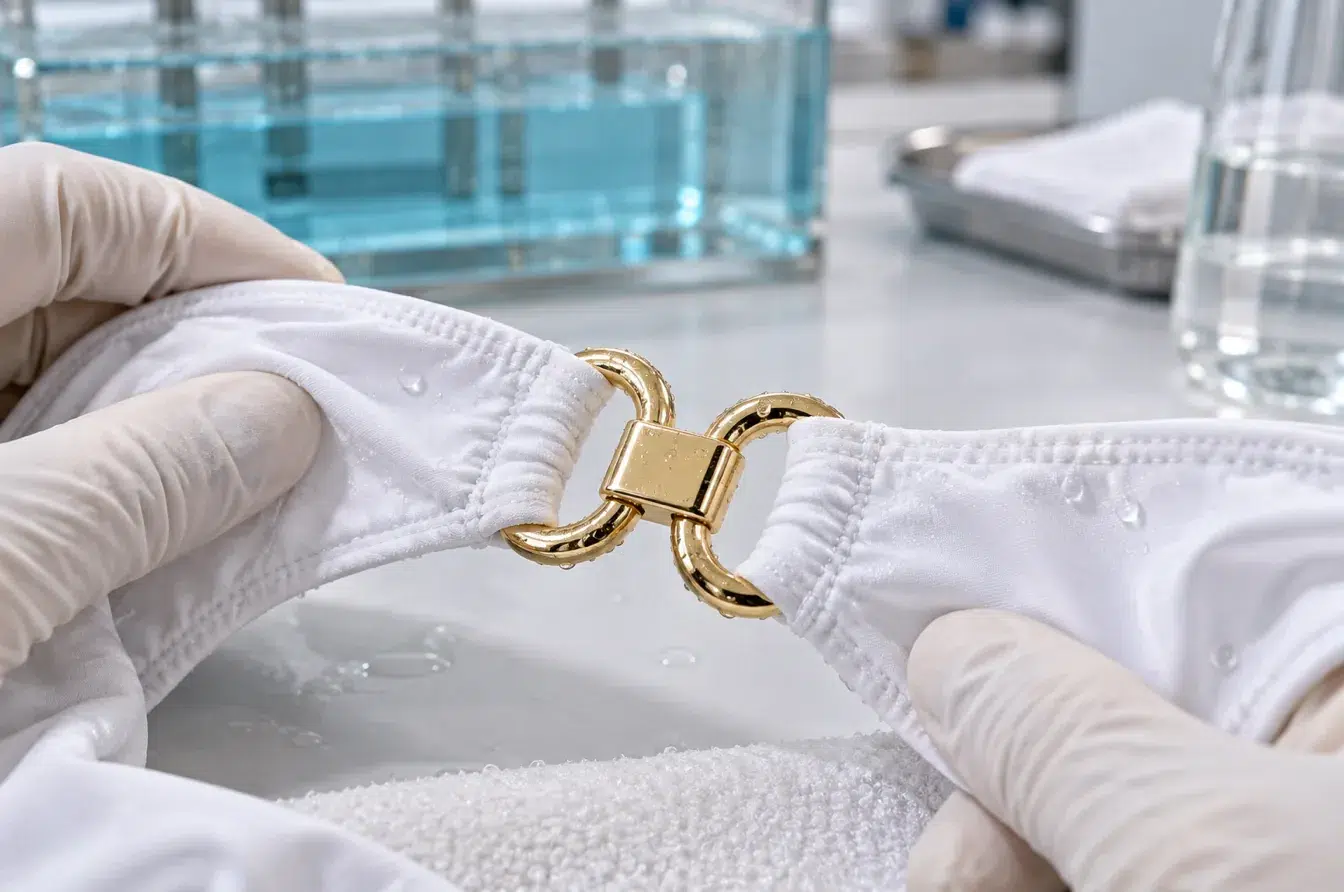
A meaningful pool test starts with defined water chemistry. The chlorine level, pH, temperature, test duration, and refresh schedule all affect the result. Without these details, two “chlorine tests” may expose samples to completely different conditions and cannot support a reliable material or supplier comparison. The test record should also state whether the solution remains stable throughout the exposure or is checked and adjusted at planned intervals.
Repeated use is better represented by cycles than by one brief soak. A cycle can include wet exposure, drainage, drying, and a scheduled fresh-water rinse when that reflects the intended care instructions. Separate sample sets can compare rinsed and unrinsed conditions when residue retention is a known concern. This helps distinguish a finish that performs well under normal care from one that depends on immediate and perfect rinsing after every use.
Testing should cover the finished component, including hidden surfaces and moving interfaces. Clasps should still open and close smoothly. Sliders should move without binding or damaging straps. Springs should return correctly. Edges should remain smooth, and decorative surfaces should retain an acceptable color and gloss. When the hardware is used with white, pastel, or high-contrast fabric, the mounted assembly should also be examined for staining, flaking, and color transfer after the final dry stage.
| Test stage | Inspection focus | Possible failure signal |
|---|---|---|
| Before exposure | Reference color, gloss, dimensions, movement | Existing defects or inconsistent samples |
| During wet exposure | Bubbles, color change, surface reaction | Coating penetration or unstable finish |
| After drainage | Residue collection around gaps and joints | Poor drainage or crevice risk |
| After drying | Spots, tarnish, pitting, peeling, roughness | Concentrated chemical attack |
| After repeated cycles | Progressive appearance and functional change | Weak coating system or poor construction |
| After fabric contact | Staining, flakes, abrasion marks | Transfer from degraded finish or corrosion products |
When Should Salt Spray or Cyclic Corrosion Testing Be Added?
Water immersion simulates direct contact, but accelerated chamber testing can reveal weak plating coverage and production variation more quickly. The chosen method should match the expected failure risk.
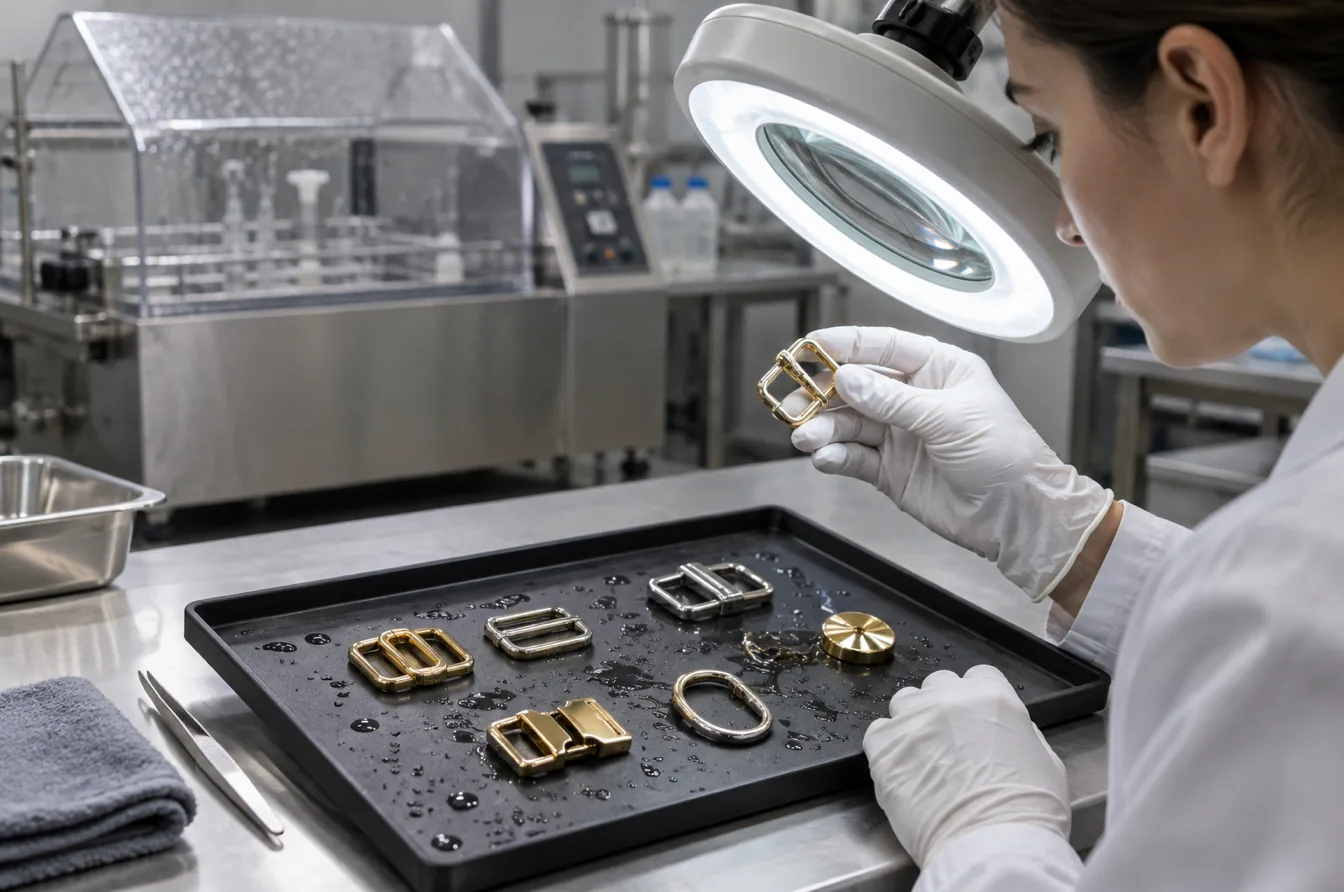
Salt spray is useful for comparing plating and coating quality, while cyclic corrosion adds wet, dry, and humidity stages that can expose failures closer to repeated swimwear use. Neither method should replace saltwater and chlorine exposure when product claims cover pools and oceans.
Choose the Method by the Failure Mechanism
A continuous salt-spray test is a practical screening tool for comparing the relative quality of the same material and finish system. It can expose thin coverage, porous plating, weak sealing, damaged edges, poor surface preparation, and inconsistencies between plating batches. It is especially useful when the design has multiple finish colors or when more than one supplier or plating line is being evaluated under the same conditions.
Test duration alone does not define quality. A result becomes useful only when the exposure method, sample construction, inspection interval, and permitted defects are stated together. Extending the test or selecting a more aggressive solution does not automatically make the result more realistic. Excessive severity may produce a failure mechanism that the component is unlikely to experience during normal swimwear use, so the method should remain tied to the product’s material and finish system.
Cyclic corrosion testing becomes valuable when drying, humidity, or residue concentration is expected to drive failure. Alternating wet and dry stages can reveal behavior around recesses, joints, and layered coatings that remains hidden in continuous fog. It is also useful during finish development when two systems appear similar in a basic screening test. The accelerated chamber result should still be checked against saltwater and chlorine cycles because laboratory acceleration ranks options; it does not directly predict a fixed number of seasons in use.
| Development situation | Suitable additional test | Decision supported |
|---|---|---|
| Comparing suppliers for the same finish | Controlled salt-spray screening | Relative plating and sealing consistency |
| Evaluating several coating stacks | Salt spray plus adhesion and thickness checks | Selection of the most stable finish system |
| Hardware has joints or trapped-water areas | Cyclic wet, dry, and humidity exposure | Crevice and residue-related risk |
| Component combines different metals | Finished-assembly corrosion cycle | Localized attack at contact points |
| Finish passes immersion but fails after drying | Cyclic corrosion test | Effect of concentrated residue and humidity |
| Plating house or topcoat changes | Repeat the approved screening program | Confirmation that production performance remains equivalent |
What Pass-Fail Criteria Should Apply to Corrosion, Discoloration, Plating Damage, and Fabric Staining?
A report marked only “pass” does not show what was inspected or how much change was accepted. Clear defect limits turn test results into usable production controls.
Pass-fail criteria should define permitted corrosion area, discoloration, pitting, blistering, plating lift, gloss loss, staining, roughness, and functional change. The same document should state sample quantity, inspection timing, photography, fabric-contact checks, and retest triggers for production changes.
Turn Test Results into Production Controls
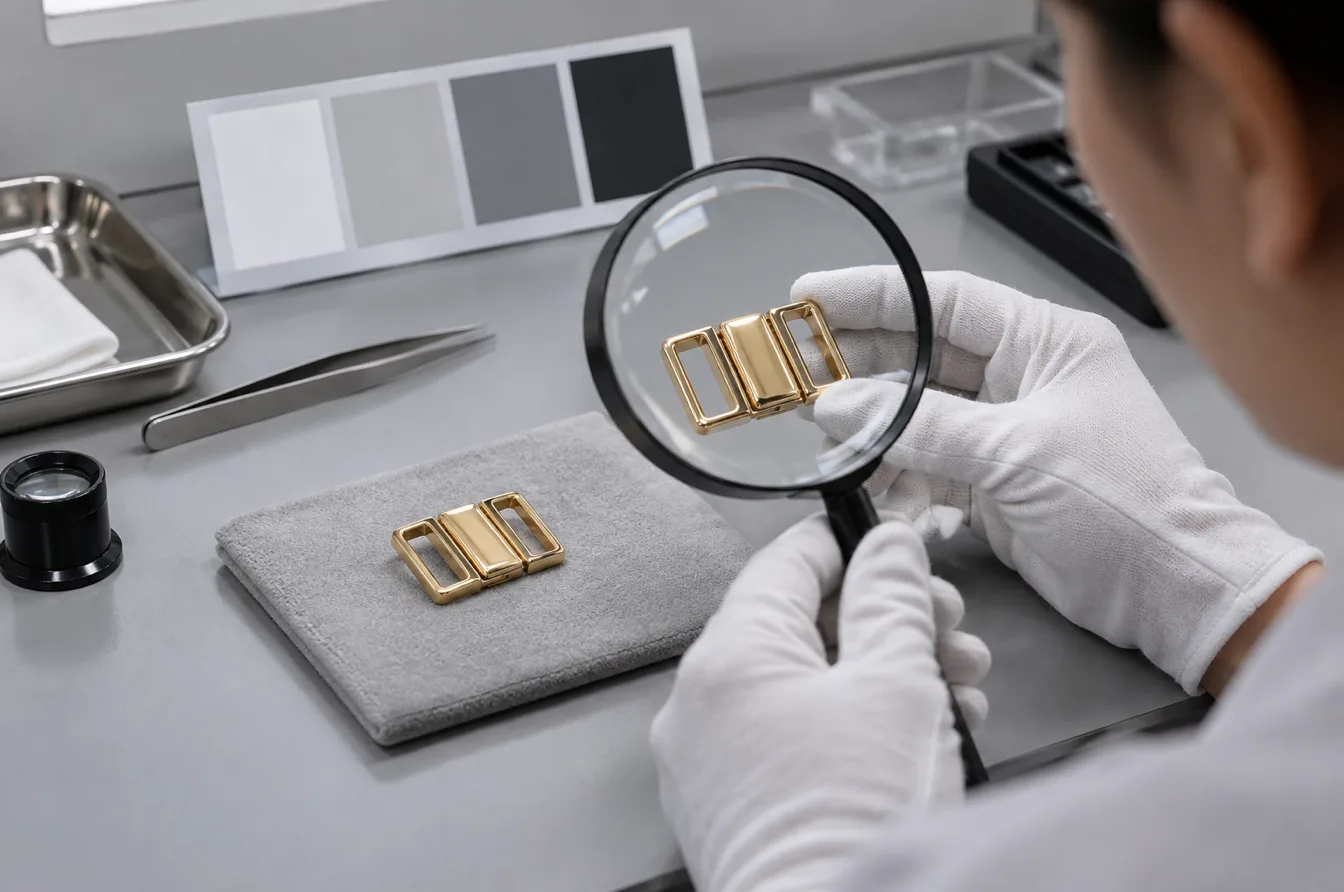
Visual acceptance should be specific to the part’s position and finish. A premium front-facing buckle may require no visible spots, color shift, peeling, or pitting on any exposed surface. A hidden internal spring may be judged mainly on corrosion progression and function, but loose corrosion products, roughness, staining, and impaired movement should still be unacceptable. Separate limits can be set for the main face, edges, underside, joints, and moving areas when the commercial impact differs.
Functional checks should follow the environmental exposure. Clasps, hooks, adjusters, swivels, and spring-loaded parts need the same operating assessment used before testing. The comparison should identify increased friction, incomplete closure, reduced spring return, deformation, sharp edges, cracking, or loss of attachment integrity. Fabric-mounted samples add another decision point: the surrounding textile should remain free from metal stains, dark marks, colored residue, loose flakes, and abrasion damage.
Every result should remain traceable to the tested construction. The report should include the component code, base material, finish color, coating description, production lot, sample quantity, test conditions, inspection schedule, individual results, and before-and-after photographs. A development approval should also define retest triggers. Changes to the base alloy, polishing, plating line, coating chemistry, topcoat, assembly method, engraving, supplier, or production site can affect performance and should not inherit the earlier result automatically.
| Acceptance area | What to evaluate | Example of an unacceptable result |
|---|---|---|
| Base-metal corrosion | Red, white, green, or dark corrosion products | Visible attack beyond the agreed location or limit |
| Decorative finish | Color, gloss, spots, tarnish, fading | Noticeable change against the approved reference sample |
| Coating integrity | Blistering, peeling, cracking, lifting | Any loose coating or exposed substrate on a visible area |
| Surface condition | Pitting, roughness, sharpness | Texture that can catch fabric or irritate skin |
| Fabric contact | Staining, transfer, flakes, abrasion | Permanent marks on the approved light-color fabric |
| Mechanical function | Opening, closing, sliding, rotation, spring return | Binding, incomplete movement, excessive friction, or failure |
| Batch consistency | Variation between samples | One or more samples showing a different failure pattern |
| Documentation | Traceability and photographs | Missing material, finish, lot, condition, or individual result data |
Conclusion
Reliable swimwear hardware qualification combines realistic water exposure, accelerated corrosion screening, and precise visual and functional limits before bulk production begins.