- Loading...
A strap system can look complete but still fail when a connection ring is expected to perform the job of an adjuster.
D-rings, O-rings, and square rings connect or guide straps, while tri-glide slides adjust strap length through friction. I select among them by function, movement, strap dimensions, load direction, material, and finish.
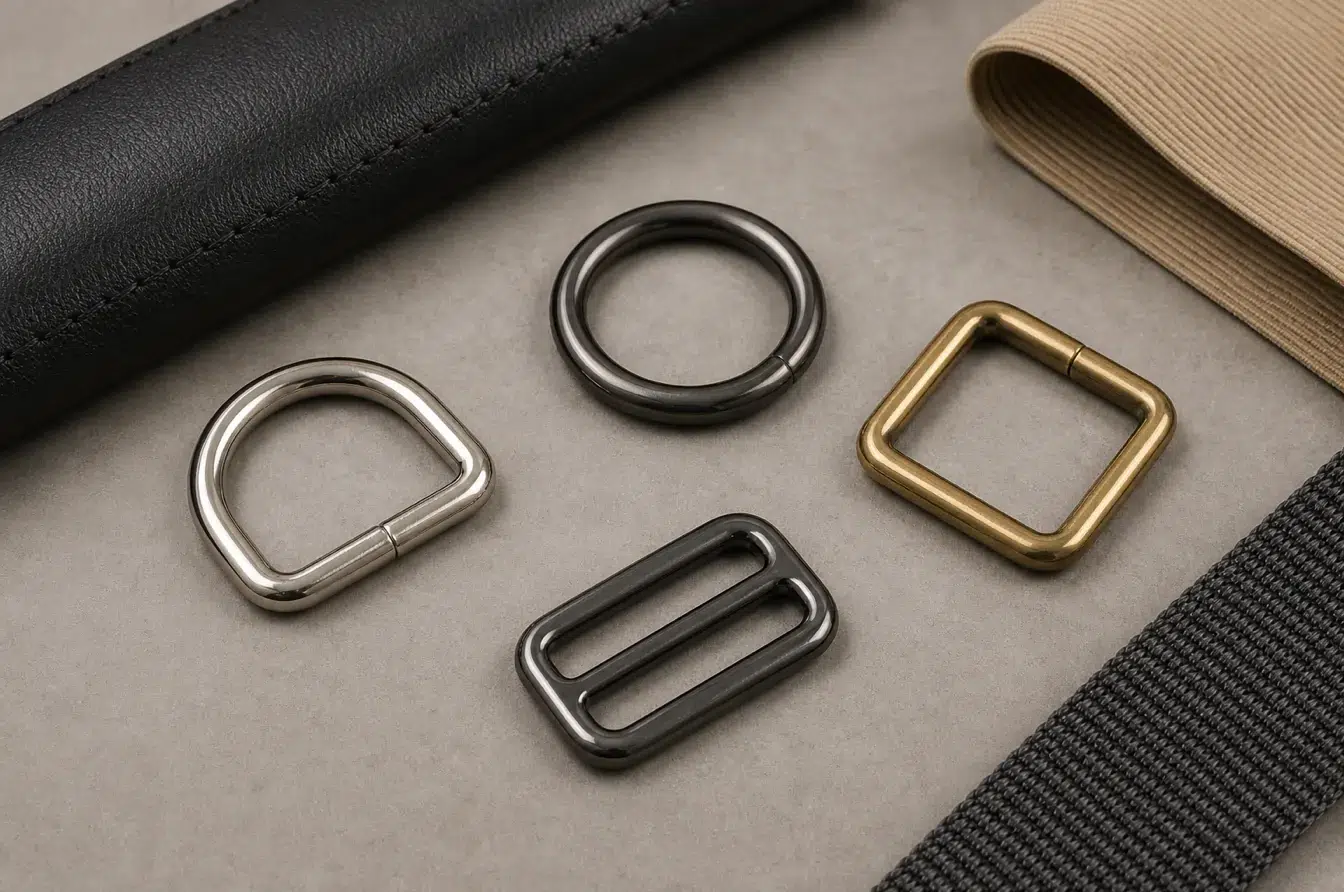
These four components often appear together in handbags, belts, lingerie, swimwear, garments, backpacks, collars, and other strap-based products. Their similar size and finish can make them seem interchangeable, but their geometries control very different behavior.
I start by asking whether the component must connect, guide, or adjust. I then review the complete load path, because a ring, slide, hook, strap, folded tab, stitch line, and rivet only work when their dimensions and movement are compatible.
How Do Shape, Load Direction, and Strap Movement Affect Hardware Selection?
Selecting hardware by appearance alone can create rotation, edge loading, strap distortion, or an adjustment system that cannot hold its chosen length.
I use D-rings for directional anchors, O-rings for freer movement, square rings for flat alignment, and tri-glides for friction adjustment. The correct choice follows the required function and load path.
Define the Job Before Comparing Shapes
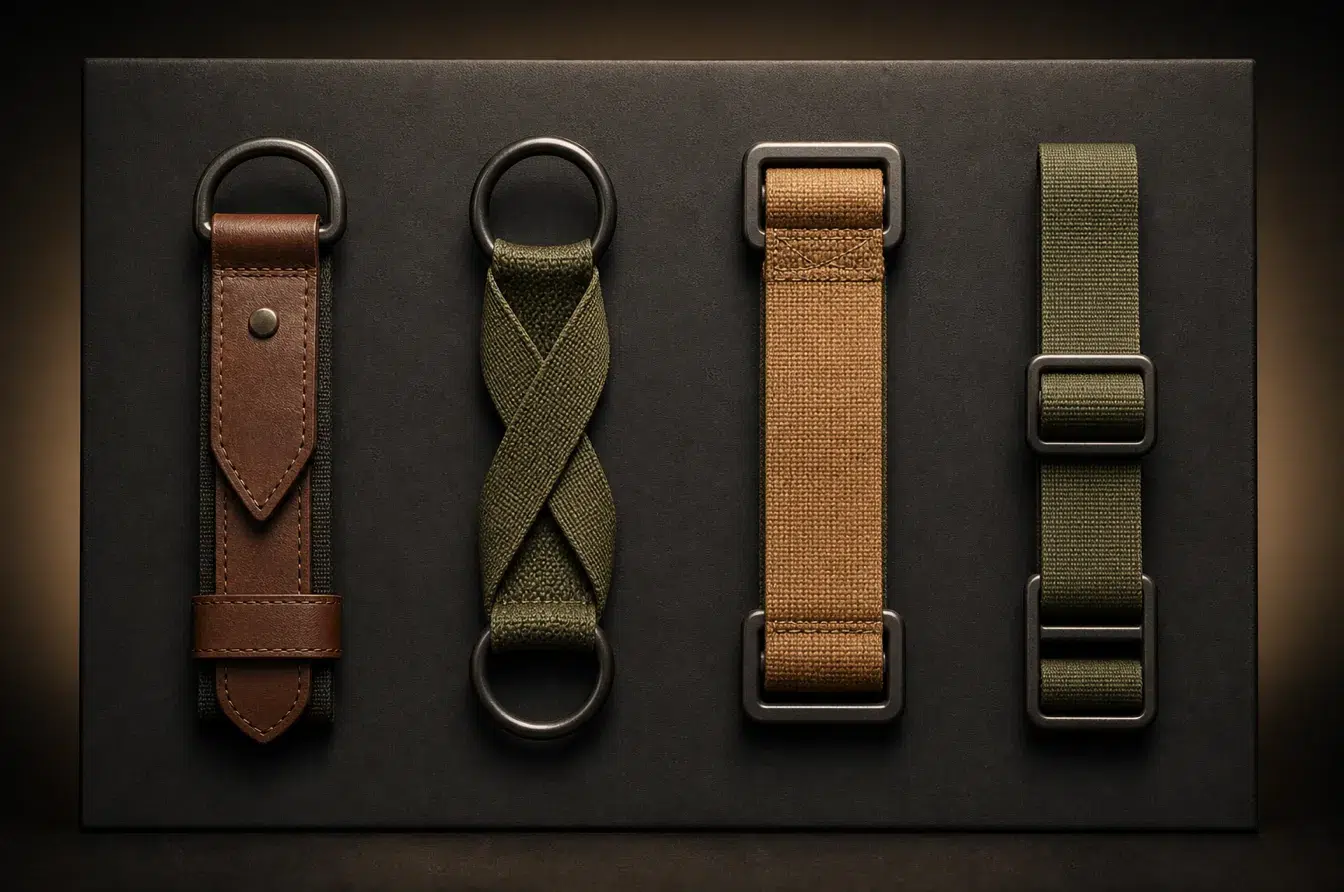
I separate these parts into two functional groups. D-rings, O-rings, and square rings create connection or routing points. A strap can be sewn around them, a hook can clip onto them, or a second strap can pass through them. A tri-glide slide has a center bar and performs a different job: it changes the working length of the strap and uses contact friction to resist unwanted movement.
This distinction matters because a ring does not normally hold a continuously adjustable strap position by itself. A tri-glide also does not open like a snap hook or side-release buckle. If I use a connection ring where the product needs adjustment, the user may have no reliable way to change and retain the strap length. If I use a tri-glide as the only connection point, the assembly may still need another part to attach it to the bag, garment, or body panel.
I therefore write a short functional statement before selecting a catalog part. It may say, “Create a stable attachment for a detachable shoulder strap,” “Allow two lingerie straps to change angle,” or “Provide repeatable length adjustment without opening the strap.” That sentence gives the supplier a much clearer target than a request for a 25 mm metal ring.
| Hardware type | Primary job | Typical movement | Common system role |
|---|---|---|---|
| D-ring | Connect or anchor | Controlled movement around a curved side | Fixed body attachment for a hook or strap |
| O-ring | Connect, route, or decorate | Free movement in many directions | Flexible junction for straps, chains, or panels |
| Square ring | Connect or guide | Restricted, more linear movement | Flat alignment for webbing, leather, or fabric tabs |
| Tri-glide slide | Adjust and hold strap length | Intentional sliding during adjustment | Friction control on an adjustable strap section |
Follow the Force and Movement Through the Assembly
After defining the job, I trace the load from one end of the product to the other. A D-ring may receive force through a snap hook and transfer it into a folded leather tab. The tab then transfers that force into stitching, rivets, reinforcement, and the bag body. The ring can be strong while the complete connection remains weak, so I never treat a component load value as proof of finished-product performance.
Shape changes the direction and concentration of this force. The flat side of a D-ring gives a strap tab a stable seating area, while its curved side allows a hook to find the load direction. An O-ring allows more rotation because every contact area is curved. That freedom can reduce forced alignment in a soft design, but it can also let a strap or hook migrate. A square ring holds flat materials along straighter surfaces, although a tight corner or narrow internal height can crease thick leather or crowd folded layers.
I also review movement when the product is worn, not only when it lies flat on a table. I check whether the hardware rotates into an uncomfortable position, whether a hook gate rubs against the ring, whether a strap gathers at one side, and whether a slide changes position under repeated tension. This practical movement review often reveals the correct shape before a laboratory load test begins.
Which Products Are Best Suited to D-Rings?
A D-ring is most useful when a flat strap tab needs a stable seat and another component needs an accessible curved connection point.
I specify D-rings for handbag side tabs, detachable straps, belts, backpacks, collars, garments, and similar products where a controlled anchor and clear load direction are important.
Use the Flat Side as a Controlled Anchor
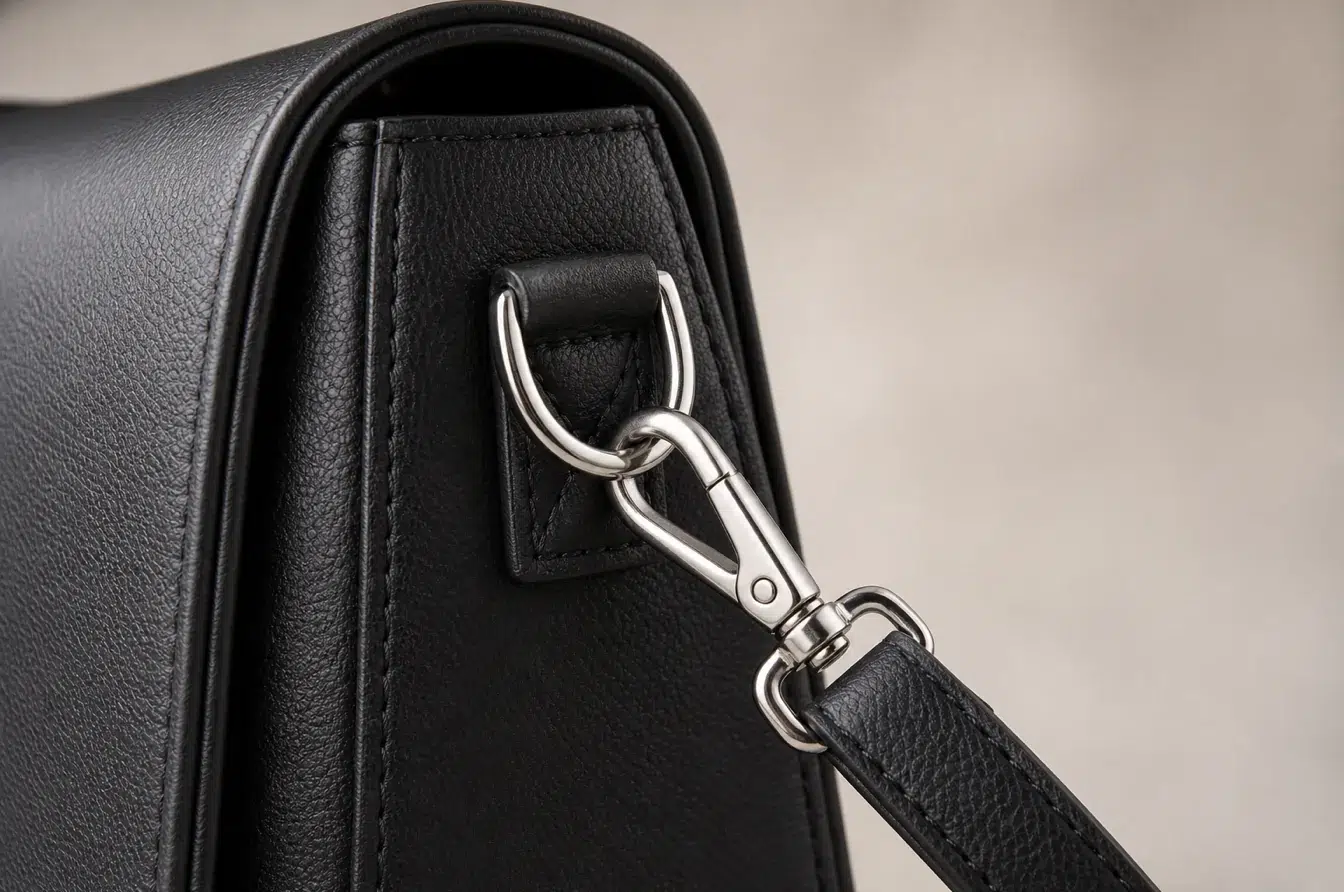
The defining advantage of a D-ring is the relationship between its straight and curved sides. I place the straight side inside a sewn, riveted, molded, or folded attachment tab. This helps the tab remain centered and gives the assembly a more predictable orientation than a fully round ring. The curved side stays exposed so a hook, chain, strap loop, or secondary connector can move as the product changes angle.
This geometry suits bag-body attachments, tote handles, crossbody straps, backpack anchors, belts, harness details, collars, and leash connection points. In apparel, I may use one or two D-rings for a belt closure or cinching detail. In swimwear or fashion garments, smaller and lighter D-rings can join straps or create adjustable visual details. The application scale changes, but the logic remains the same: the flat material receives a stable bearing surface, while the connected part uses the curved side.
I do not assume that every D-ring is suitable for meaningful load. A thin decorative ring, an open ring with an uncontrolled gap, and a welded heavy-duty ring may share the same outline but behave very differently. For any connection that must carry repeated force, I specify the base material, section thickness, opening or weld condition, deformation limit, and attachment construction together.
| Product application | Why a D-ring works | Detail I verify |
|---|---|---|
| Handbag side tab | Creates a stable hook attachment | Tab reinforcement, ring gauge, and hook clearance |
| Detachable shoulder strap | Keeps the connection easy to find | Hook gate access and off-axis movement |
| Backpack or utility bag | Directs load into a webbing anchor | Stitch pattern, fold length, and ring deformation |
| Belt or garment cinch | Supports looping and controlled tightening | Edge smoothness, ring spacing, and strap thickness |
| Collar or leash system | Provides a defined connection point | Weld quality and complete-assembly strength |
Design the Attachment Around the D-Ring
The ring is only one part of the anchor. I size the tab around the D-ring’s usable internal width, not its outside width. The finished tab must sit flat without excessive side clearance, but it also needs enough room to fold and move without binding. Thick leather, coated webbing, padding, turned edges, and multiple fabric layers can make a nominally correct size too tight after assembly.
I also review how the straight side bears against the tab. A small ring section can concentrate force and cut into soft material. A very thick section can create a bulky fold, push stitches too close to the edge, or make the attachment stand away from the product. Rounded edges and controlled polishing are important wherever the D-ring contacts leather, elastic, webbing, or skin.
For load-bearing products, I reinforce the structure under the visible tab. I check stitch direction, rivet placement, fold length, substrate strength, and the distance from holes to material edges. I then test the actual D-ring, tab, reinforcement, and product panel together. During wear trials, I look for uneven pulling, ring rotation, leather stretching, stitch opening, and finish wear where the hook rubs against the ring.
This complete-attachment approach also improves appearance. When the internal width, tab width, ring thickness, and hook proportions are balanced, the D-ring looks intentional rather than added as an isolated metal part.
When Should You Choose an O-Ring Instead of a Square Ring?
The choice between an O-ring and a square ring depends on whether the design needs rotational freedom or controlled alignment along straight edges.
I choose an O-ring for multidirectional movement and circular emphasis. I choose a square ring when flat straps should stay aligned and angular geometry supports the product’s structure.
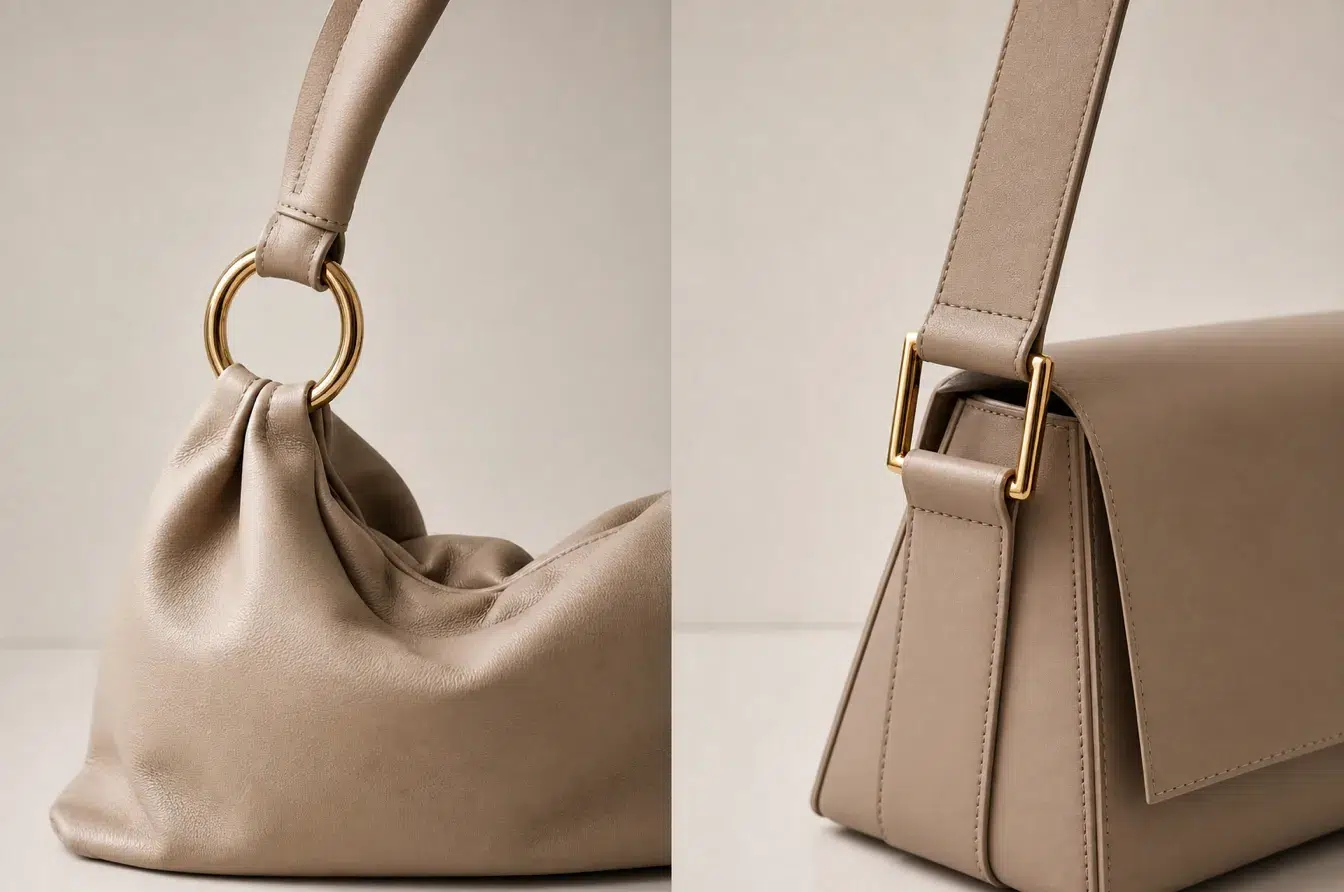
Choose an O-Ring When Movement Supports the Design
An O-ring has no fixed top, bottom, or flat seating side. Connected straps, chains, hooks, and fabric panels can change angle around the full circumference. I use this freedom in soft handbags, lingerie strap junctions, bikini panels, decorative center-front features, chain details, key attachments, and designs where several elements meet at one circular focal point.
The shape can help a soft product move naturally. A lingerie strap can approach the ring from one direction while another strap leaves at a different angle. A chain or hook on a relaxed bag can rotate as the wearer moves instead of forcing the ring into one orientation. The circle also creates a strong visual motif, so the part can function as both a connector and a deliberate design feature.
However, free movement is not always beneficial. A wide strap can gather, roll, or migrate around the curve. A hook may rotate to a position that changes how its gate contacts the ring. When a product must keep webbing flat or direct force along a consistent axis, I normally consider a D-ring or square ring instead. I test the O-ring in motion because the attractive symmetry seen in a sketch does not show how the attached materials will settle during wear.
Choose a Square Ring for Alignment and Geometric Control
A square ring gives flat webbing, leather handles, and folded fabric tabs straight bearing surfaces. I use it in structured handbags, wide belts, contemporary garment details, minimalist swimwear, and other products where the strap should remain visually aligned. Its angular form can reinforce a precise, architectural design language that an O-ring would soften.
Square does not automatically mean stronger. Performance still depends on alloy, construction, section thickness, corner radius, joint quality, and the way force enters the part. Sharp internal corners can mark leather, concentrate stress, or make a folded strap sit poorly. I specify enough radius to protect the strap and support finishing, while keeping the visual character of the square form.
I compare the two shapes with the final strap material. For a delicate elastic junction, an O-ring may provide comfortable movement and softer proportion. For a 38 mm structured leather handle, a square ring may maintain alignment and prevent the handle from drifting around the part. I also check whether the product needs a hook or chain to pass through or over the ring, because ring-section thickness and corner geometry can affect connector clearance.
| Selection question | O-ring response | Square-ring response |
|---|---|---|
| Should connected parts rotate freely? | Usually supports freer angle changes | Usually limits movement to straighter sides |
| Must a wide strap stay flat? | May allow gathering or migration | Helps maintain alignment |
| Is the hardware a circular focal point? | Creates a clear round visual feature | Creates a more architectural statement |
| Does the product use soft or changing geometry? | Often follows movement naturally | May impose a stronger orientation |
| Is the material thick or layered? | Check bunching and ring diameter | Check internal height and corner radius |
Which Products Need a Tri-Glide Slide for Strap Adjustment?
A product needs a tri-glide when its strap length must change repeatedly and remain at the selected position without opening a buckle or hook.
I use tri-glide slides on bra straps, camisoles, swimwear, dresses, handbags, backpacks, belts, harnesses, and other adjustable products where friction can control strap length.
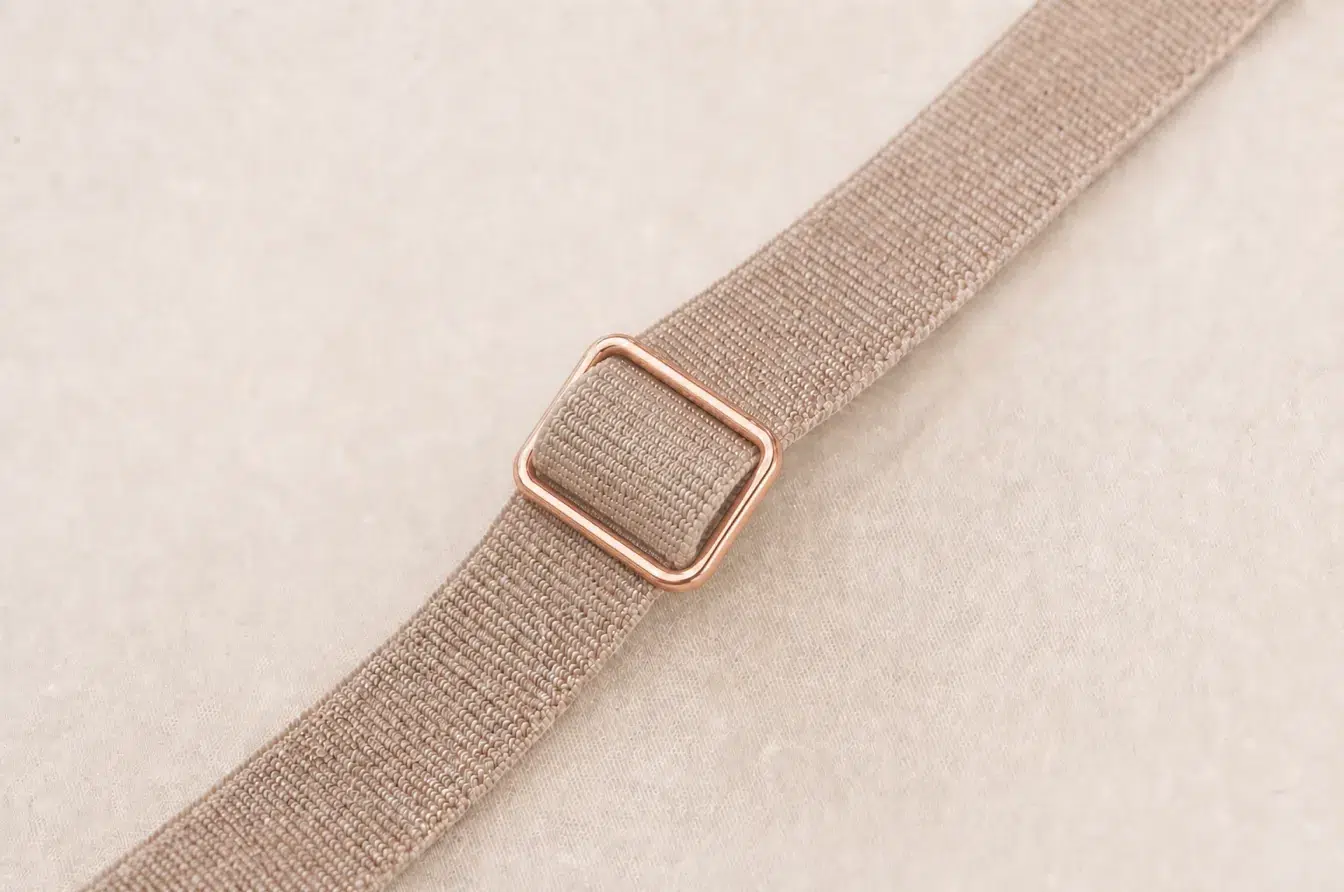
Treat the Tri-Glide as a Friction System
A tri-glide is usually a rectangular or shaped frame divided by a center bar. I route the strap over and around this bar so the material changes direction and creates several contact areas. When tension reaches the strap, friction at these surfaces helps the slide remain in position. The part adjusts the working length, but it does not normally provide quick release or detach the strap from the product.
I use small, light slides for bra straps, camisoles, swimwear, and adjustable garment details. Larger versions work with handbag straps, backpacks, belts, aprons, outdoor products, and other webbing systems. The same principle applies across these scales, but the geometry, material, mass, edge quality, and friction requirements can be very different. A bag slide should not simply be reduced for intimate apparel without reviewing comfort, profile, and the behavior of delicate elastic.
Holding performance comes from the relationship between the slide and strap. Internal width must fit the finished strap width, and the openings around the center bar must accept its thickness and folded construction. Smooth satin elastic, dense nylon webbing, waxed leather, and coated synthetic straps do not create the same friction. A slide that holds one material may creep on another or become too difficult to adjust.
| Adjustable product | Typical strap material | Main tri-glide concern |
|---|---|---|
| Bra or lingerie strap | Narrow elastic | Smooth edges, low weight, and controlled friction |
| Swimwear | Elastic or covered strap | Skin comfort, corrosion resistance, and wet performance |
| Handbag shoulder strap | Leather or woven webbing | Thickness clearance, finish wear, and load stability |
| Backpack | Woven webbing | Adjustment force, slippage, and repeated loading |
| Belt or garment detail | Fabric, leather, or webbing | Visual proportion and reliable position holding |
Thread and Test the Complete Adjustable Strap
Correct threading is essential. I confirm the routing with the intended fixed end, free end, ring, hook, buckle, and sewn return. Reversing the slide, omitting a return path, or changing which side receives tension can reduce friction even when the product looks assembled. I place a threading diagram on the technical pack so the sample room and production line do not have to infer the route.
I then evaluate both sides of performance: the strap must move when the user deliberately adjusts it, and it must resist movement during wear. If the fit is too tight, adjustment becomes slow and can abrade the strap or finish. If the fit is too loose, the strap can lengthen gradually under repeated motion. I measure adjustment force and slippage with production-representative strap material, thickness, coating, stitching, and end construction.
Wear can change the result. Repeated movement may polish the strap surface, remove coating from a metal slide, create burrs, or reduce the original friction. Water, perspiration, body oil, dirt, and cleaning can also alter how the strap passes through the part. I cycle the adjustment, apply repeated tension, condition the assembly for its intended environment, and inspect it again.
Finally, I confirm the slide’s place in the full system. An adjustable handbag strap may use a D-ring on the bag, a snap hook at the strap end, and a tri-glide farther along the strap. Each part has a different job, and the assembly only works when all interfaces share compatible width, thickness, movement, finish, and orientation.
How Should You Match Size, Material, Finish, and Load Rating to the Application?
A matching outside size or plating color does not prove that hardware will accept the strap, clear the hook, or survive the finished product’s use.
I match usable internal dimensions first, then confirm section thickness, material, finish, load path, contact conditions, and complete-assembly performance on production-representative samples.

Specify the Interfaces Before the Outside Appearance
I use the finished strap width as the first sizing reference. The usable internal width of a D-ring, square ring, or tri-glide should suit the completed leather, webbing, elastic, or fabric tab, including edge paint, coating, turned edges, padding, and manufacturing tolerance. Internal height is equally important when thick or folded layers must pass through the part.
I also specify ring-section thickness or wire diameter. This dimension affects strength, weight, visual proportion, and compatibility with hooks and chains. A snap hook can match the strap width and still fail to pass over the ring or close its gate. I therefore review the ring profile, hook opening, gate travel, chain-link dimensions, and required rotation together.
Scale changes more than strength. A small O-ring used beside lingerie elastic should feel light, smooth, and comfortable against the body. A larger ring on a handbag can become a visual anchor and accept much higher material thickness. Simply enlarging or reducing the same geometry can create the wrong weight, stiffness, edge radius, or proportion, so I approve the hardware beside the actual product materials.
My drawing identifies internal width, internal height, section thickness, overall dimensions, joint or weld condition, edge radius, and significant surfaces. This prevents a supplier from offering two parts with the same catalog size but different usable space.
| Specification item | What it controls | Common mismatch |
|---|---|---|
| Usable internal width | Strap alignment and side clearance | Strap bunches or moves sideways |
| Internal height | Passage of thick or folded layers | Strap binds or cannot be assembled |
| Ring or bar thickness | Strength, weight, and connector clearance | Hook gate cannot pass or close |
| Corner and edge radius | Strap protection and skin comfort | Material is cut, marked, or irritated |
| Joint or weld condition | Ring integrity under load | Gap opens or catches the strap |
| Manufacturing tolerance | Repeatable assembly and adjustment | Bulk parts perform differently from samples |
Match Material, Finish, and Evidence to Real Use
I choose material after I understand geometry, load, weight, environment, cost, and appearance. Steel can support strong formed parts when the grade and corrosion protection are appropriate. Stainless steel can provide corrosion resistance and a technical appearance. Brass offers weight, forming options, and a premium character. Zinc alloy supports complex decorative forms and broad finishing choices, while aluminum and suitable plastics can reduce mass. The material name alone does not establish performance; grade, process, wall or wire section, porosity, temper, weld, and finishing route also matter.
Finish must follow placement and movement. Hardware for lingerie, swimwear, and garments needs smooth edges, low discomfort, suitable contact performance, and compatibility with sweat, moisture, and care. Bag and belt hardware may prioritize visual weight and abrasion resistance. Tri-glides deserve special attention because the strap repeatedly rubs against the bars, so plating or coating wear can become both a cosmetic and functional issue.
For load rating, I define the finished product’s use rather than accepting a generic number. I consider expected force, direction, frequency, shock, adjustment cycles, environment, and the consequence of failure. I test the loose component when useful, but I approve the installed system: ring or slide, hook, strap, tab, fold, stitches, rivets, reinforcement, and product panel.
I finish with a production-representative sample and a clear change-control rule. A new alloy, thinner section, different weld, revised strap coating, new plating supplier, or altered tab construction can change performance even when the assembly looks identical. Reapproval protects both the product function and the consistency of the complete visible hardware family.
Conclusion
I choose each ring or slide by its system role, then validate dimensions, movement, material, finish, and load in the finished strap assembly.