
- Loading...
“Water-resistant” hardware may still discolor, corrode, stain fabric, or lose function when a swimsuit moves repeatedly between water, skin, sunlight, rinsing, and drying.
I specify swimwear metal hardware for separate chlorine, seawater, perspiration, cosmetic, weathering, wet–dry, care, and mechanical conditions, then verify the finished assembly against visible and functional limits.
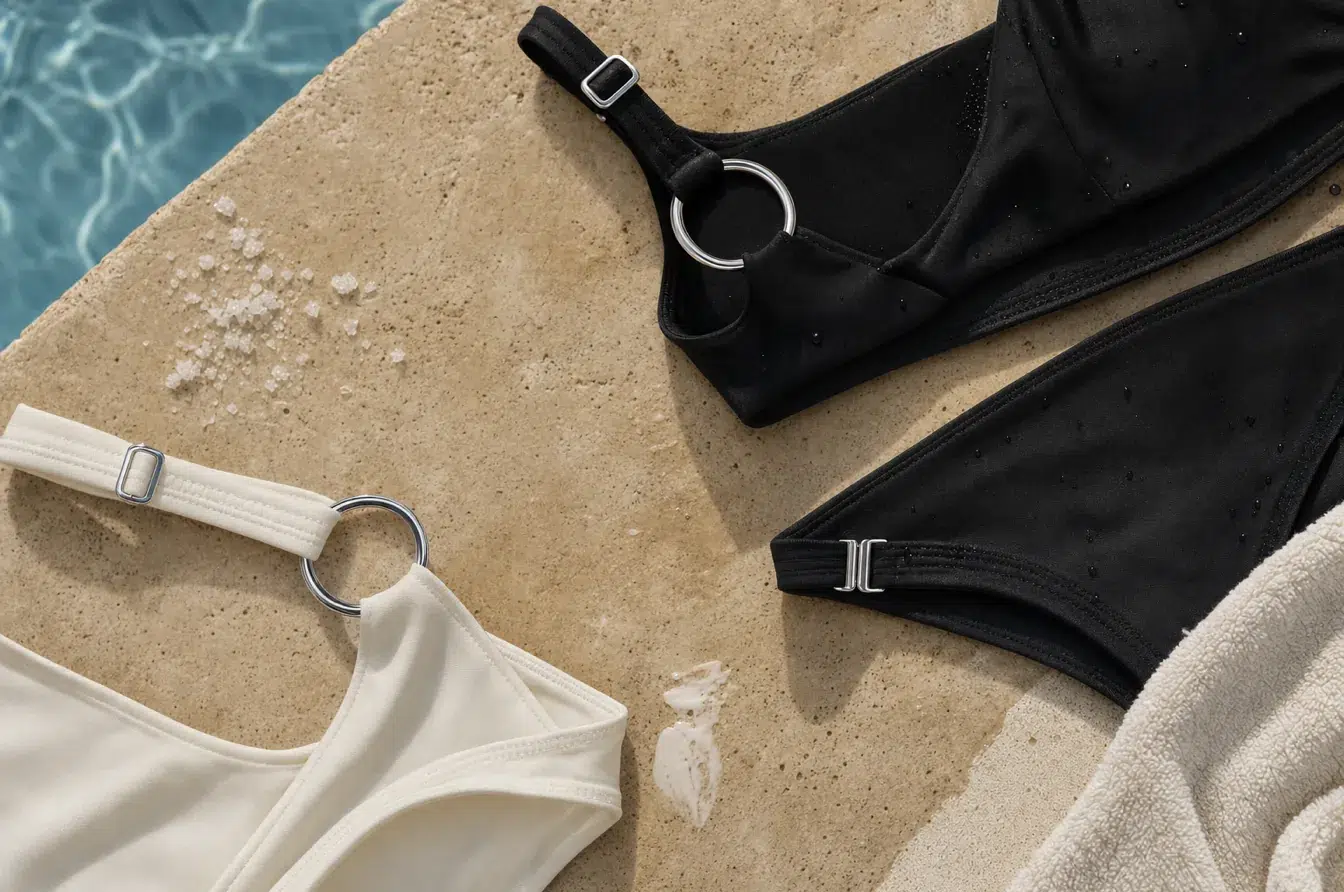
I do not treat one immersion result or a supplier’s “anti-rust” statement as sufficient evidence. A reliable approval connects the base metal, finish system, geometry, skin-contact duty, garment construction, and intended care routine to a defined set of tests.
How Do Chlorine, Saltwater, Humidity, and Heat Affect Swimwear Hardware?
A finish that survives fresh water can still fail when oxidizing chlorine, dissolved salts, damp storage, sunlight, and warm drying act in sequence.
These environments should first be tested separately, then combined in realistic wet–dry and weathering cycles because swimwear is repeatedly worn, removed, rinsed, and dried.
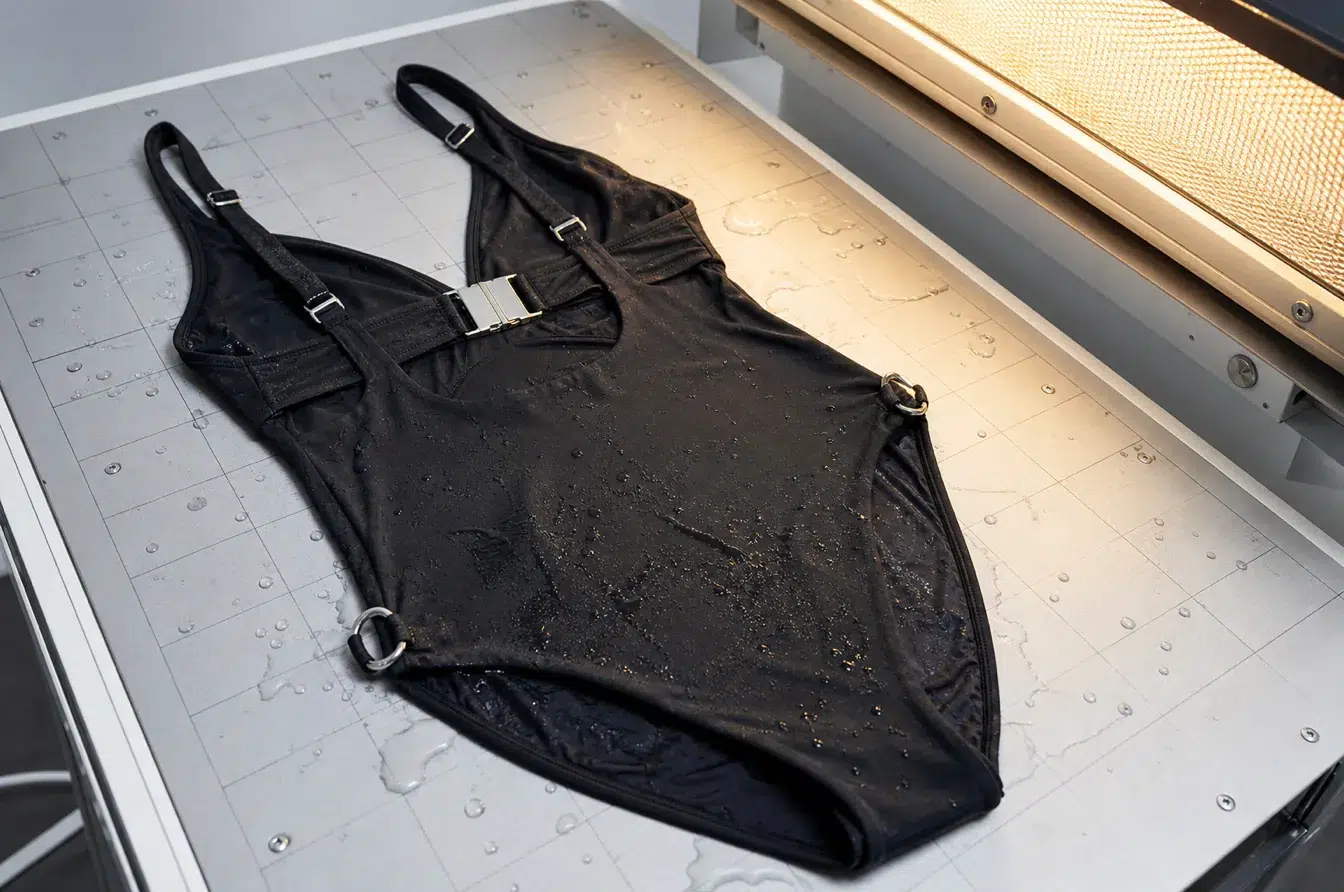
Separate Each Exposure Before Combining Them
The test plan should replace the vague word “water” with specific exposure conditions. Chlorinated pool water and seawater create different chemical environments. Pool water contains active chlorine used for disinfection, while seawater leaves chloride-rich residues on surfaces, in recesses, and between the hardware and textile. Fresh-water rinsing changes the residue but does not erase the preceding exposure.
The distinction is already clear in textile testing. ISO 105-E03 addresses color fastness to chlorinated swimming-pool water, while ISO 105-E02 addresses color fastness to seawater. These methods are useful for evaluating the garment fabric and staining behavior, but they do not constitute complete corrosion tests for the metal component. For the hardware itself, a metal-appropriate method or qualified laboratory procedure should be used, with the metal and textile results evaluated together.
Humidity matters most during the period after immersion. Water can remain under a slider bar, inside a clasp, beside a soldered joint, or between a decorative plate and damp fabric. As evaporation continues, dissolved substances can become more concentrated. Warmth can accelerate chemical reactions, while sunlight can fade colored finishes or degrade organic clear coats. The product specification should therefore define realistic temperature and drying conditions instead of applying one universal range to every swimsuit.
| Exposure | Main concern | Evidence required |
|---|---|---|
| Chlorinated pool water | Finish oxidation, discoloration, coating attack, and fabric change | Defined chlorine condition, duration, rinse, dry, and post-exposure appearance |
| Seawater | Chloride residue, pitting, crevice attack, tarnish, and staining | Separate saltwater condition and evaluation of hidden as well as visible surfaces |
| High humidity | Trapped moisture at joints, holes, bars, and attachment points | Damp conditioning with assembled samples and inspection after drying |
| Sunlight and warmth | Color shift, clear-coat degradation, softening, and accelerated reactions | Weathering condition, surface temperature, orientation, and approved color limits |
| Fresh-water rinse | Handling wear, residue removal, and delayed appearance of corrosion products | Repeated rinse-and-dry sequence based on the intended care instructions |
Use Wet–Dry Cycles and Assembled Garments
A swimsuit does not remain continuously underwater, so cyclic exposure is necessary. It moves from immersion to air, from a warm body to a towel or bag, and from concentrated residue to rinsing and drying. A short, single immersion can miss a pore in the coating that becomes visible only after several wet–dry cycles.
ISO 16151 demonstrates the broader corrosion-testing principle of alternating salt spray, dry, and wet conditions. It is not a swimwear product standard, so its cycle should not be copied without technical review. The principle is relevant because changing conditions can reveal different behavior from steady exposure. In the same way, ISO 105-B04 uses artificial weathering to assess textile color under simulated weathering and can identify sensitivity to the combined effects of light and water. For the metal finish, the laboratory should select a compatible weathering method and evaluation plan.
Loose components help diagnose the finish system, but the complete assembly also needs testing. Hardware may remain visually acceptable while the adjacent elastic, seam, or coating loses strength. A heavy ring can distort softened fabric. A rough edge can abrade a strap more quickly after environmental conditioning. A clasp can become harder to operate when residue collects in its moving interface.
For this reason, the post-conditioning inspection should cover strap elongation, seam reinforcement, edge abrasion, fabric staining, closure security, and wearer-facing comfort. The slider or clasp should also be operated before and after exposure. This approach reveals whether the hardware and garment continue to work as one product, not merely whether an isolated metal sample still looks shiny.
Can Sunscreen, Sweat, Detergent, and Body Oils Damage the Finish?
Swimwear hardware often remains trapped between damp skin and fabric, where perspiration, sunscreen, oil, cosmetics, and care products can stay concentrated for hours.
Expected contact chemicals should be screened for staining, softening, tackiness, transfer, tarnish, adhesion loss, and functional change before a finish is approved for bulk production.
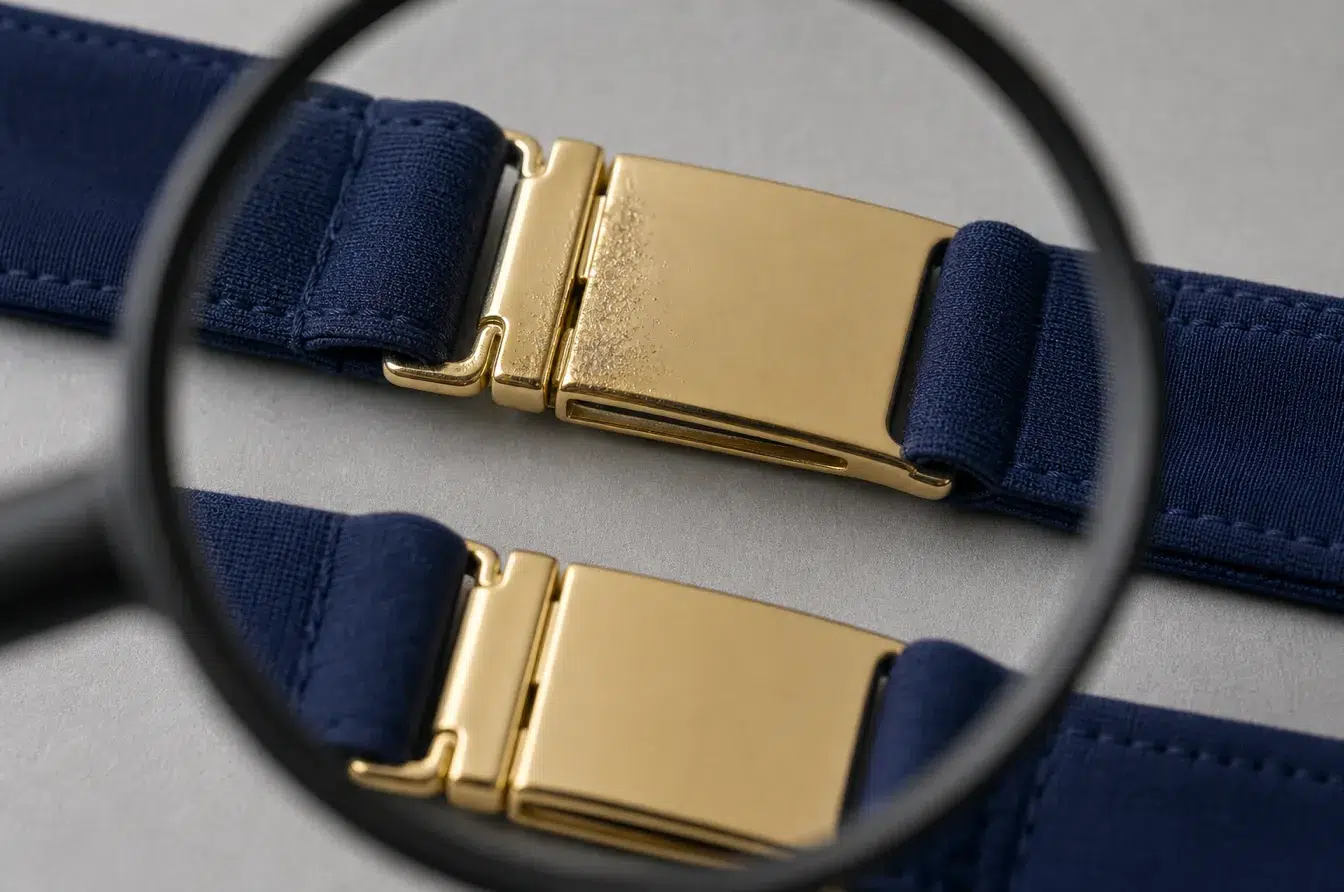
Screen the Chemicals the Product Will Actually Meet
Perspiration is both an environmental exposure and a skin-contact condition, so the validation plan must address both risks. A ring or slider at the neck, back, or hip can remain against warm, damp skin for a long period. Sweat can also carry residues into small gaps and keep them there after the wearer leaves the water. ISO 105-E04 provides a method for evaluating textile color fastness to perspiration, so it can support fabric and staining assessment. The metal part still needs a compatible corrosion and surface evaluation.
Sunscreen deserves its own test because formulations vary. Oils, emulsifiers, UV filters, pigments, fragrances, and solvents can interact differently with lacquers, colored coatings, printed details, or adhesive-backed decorations. Tanning products and body oils can create similar concerns. Representative products from the target market should be selected, or controlled chemical surrogates should be agreed with the laboratory. The product identity, amount, contact time, temperature, pressure, and cleaning step should then be recorded so the result can be repeated.
Detergent testing follows the care label, not a generic washing claim. A swimsuit intended for gentle hand washing should be tested through that sequence. If a brand expects a particular cleaner or machine program, the test should include the relevant agitation, concentration, and temperature. An unnecessarily severe condition adds little value unless it represents foreseeable use or a defined brand requirement.
| Contact substance | Possible failure | Practical sample condition |
|---|---|---|
| Perspiration | Tarnish, nickel release concern, staining, roughness, and movement change | Hardware against representative damp fabric under defined time and temperature |
| Sunscreen | Loss of gloss, coating softening, color shift, tackiness, and residue | Controlled application followed by contact, rinse, dry, and visual comparison |
| Tanning product or cosmetic | Pigment transfer, staining around attachments, and surface interaction | Target-market product on every approved finish colorway |
| Body oil | Film retention, dirt attraction, coating change, and discoloration | Repeated contact with a defined oil or agreed laboratory surrogate |
| Detergent | Coating attack, color transfer, residue, and mechanism drag | Intended care solution, water temperature, handling, rinsing, and drying |
Validate the Whole Care Sequence
The assessment should not stop immediately after chemical contact. The most visible failure may appear during rinsing or several hours later, when corrosion products migrate onto pale fabric or a softened coating dries unevenly. The intended aftercare therefore becomes part of the sequence: exposure, fresh-water rinse, handling, drying, storage interval, and repeat.
This cycle should reflect the brand’s consumer instructions. A typical swimwear program may involve a cool fresh-water rinse and drying away from intense direct heat, but the actual approved care label should remain the control. A damp-delay condition can be added when folded wet storage is a foreseeable risk, and it should be identified clearly so it is not confused with normal care.
Before the first cycle, the hardware and adjacent textile should be photographed. Visible faces, edges, recesses, backs, joints, and attachment areas should then be inspected under the same lighting after every defined interval. The checks also cover smell, residue, tack, blistering, peeling, crazing, roughness, and fabric transfer. A clasp or adjuster is operated through its full travel, because dried product can increase friction even when the finish still looks acceptable.
Color approval needs a controlled reference. The exposed part should be compared with an unexposed control or approved master under agreed lighting, with the decision method defined as visual, instrumental, or both. This is especially important for matched hardware sets. A small change on one component can become obvious when the ring, slider, clasp, and logo plate sit together on the same garment.
Which Base Metals and Coatings Provide Better Corrosion Resistance?
Material names alone do not predict swimwear performance because alloy grade, porosity, geometry, polishing, plating layers, topcoat, and assembly can change the result.
Approval should cover the complete material-and-finish system, not a generic claim such as stainless, brass, zinc alloy, PVD, plated, or coated.
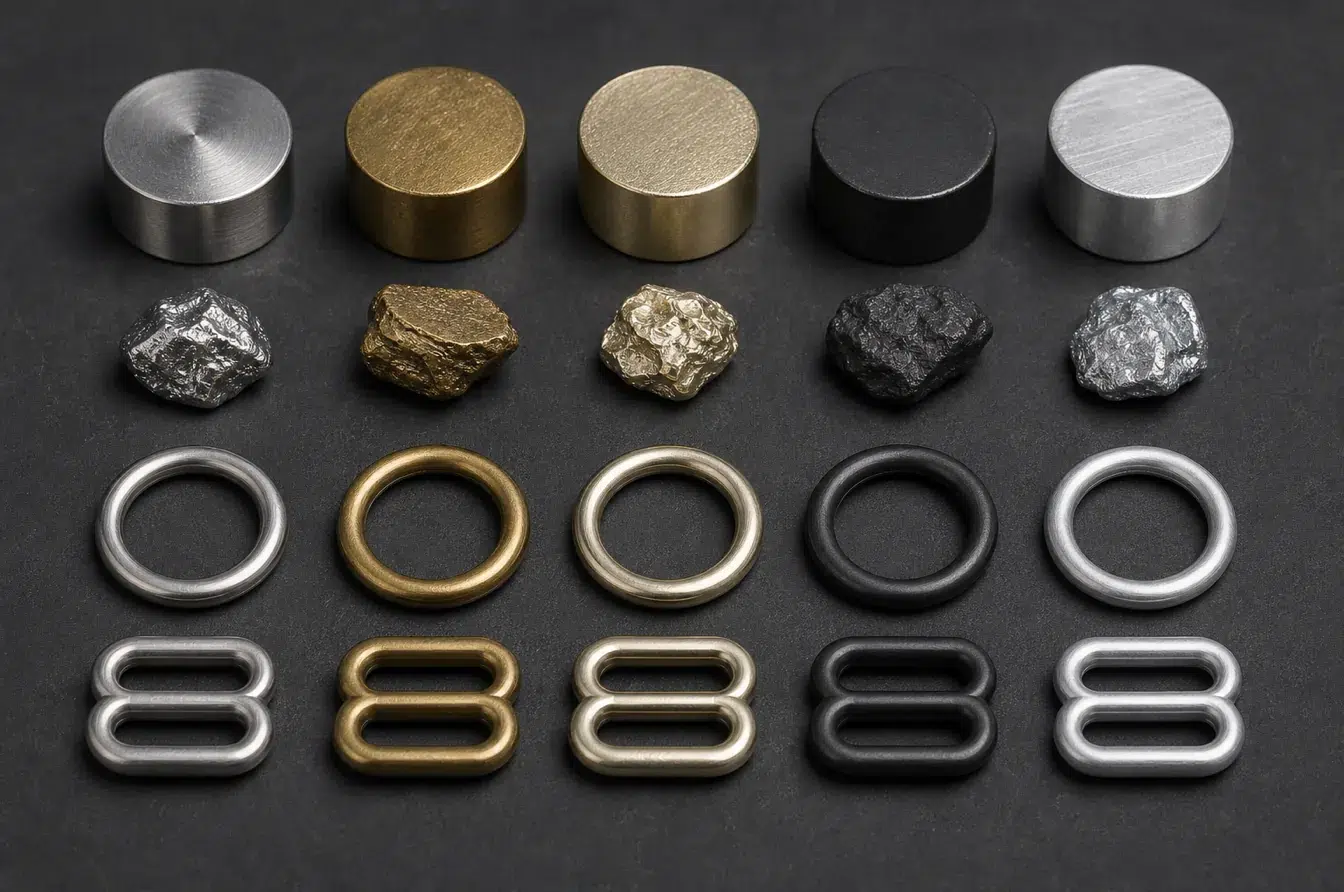
Match the Substrate to the Finish and Geometry
Base-metal selection starts with the component’s shape, load, weight, finish target, and exposure, so each option should be compared against those factors. Stainless steel can provide strong corrosion performance, but the grade and fabrication route matter. Chloride environments can still cause pitting or crevice corrosion, especially at tight gaps, contaminated surfaces, or poorly finished joints. The specification should therefore identify the exact grade and surface process rather than relying on “stainless steel” as a complete description.
Brass can offer good formability, a premium feel, and useful plating compatibility, but alloy selection and finish protection still matter. Unprotected brass can tarnish, and some conditions can promote selective corrosion. Zinc alloy is useful for detailed cast shapes and cost-controlled production, but its swimwear performance usually depends heavily on a continuous, well-prepared barrier coating. Pores, thin edges, impact damage, and uncoated recesses can expose the substrate. Carbon steel can provide strength and economy, but a damaged protective system creates a clear rust risk.
Aluminum may suit lightweight parts when the alloy, anodizing or coating, and geometry are appropriate. It also requires attention to contact with dissimilar metals. No substrate should be selected only from a marketing label; the review must also cover casting porosity, section thickness, forming cracks, welds, solder, machining marks, and contact points because these features affect how the finish covers and survives.
| Base-metal route | Useful design qualities | Main swimwear questions |
|---|---|---|
| Stainless steel | Strength, thin sections, and potential corrosion resistance | Which grade, passivation, polish, joint design, and chloride test condition? |
| Brass | Weight, formability, machining, and plating compatibility | Which alloy, tarnish control, undercoat, topcoat, and nickel-release route? |
| Zinc alloy | Detailed casting, complex logos, and efficient volume production | How are porosity, edges, recesses, barrier layers, and impact damage controlled? |
| Coated steel | Strength and cost efficiency | What happens at cut edges, bends, welds, holes, and coating defects? |
| Aluminum | Low weight and anodized or coated color options | Which alloy, surface preparation, coating, wear condition, and galvanic interface? |
Engineer the Finish Stack and Its Weakest Points
The complete finish stack must be documented. The supplier should describe the cleaning, polishing, activation, underlayer, decorative layer, color layer, sealer, and organic topcoat where used. Electroplating, electrophoretic coatings, lacquers, powder or polymer coatings, and PVD can all be useful, but none is automatically suitable. Performance depends on substrate preparation, layer continuity, thickness distribution, adhesion, flexibility, and the final environment.
A beautiful flat test coupon does not represent every product surface. Deposit thickness can vary on sharp edges, deep recesses, inside corners, holes, rack points, and moving contact zones. Casting pores can remain hidden until cycling begins. Bending after plating can crack a brittle layer. Two coated parts can wear through each other at a slider bar, while a clasp spring may need a different material and finish from the decorative body.
Galvanic interfaces also require review. A stainless pin, brass body, plated steel spring, and wet textile can create several connected materials inside one small closure. The design should avoid trapping electrolyte and should allow rinsing and drying. If dissimilar metals cannot be avoided, the supplier and laboratory should evaluate the assembled combination rather than approve each material separately.
For production control, the specification should define the base-metal grade, finish code, layer sequence, critical thickness targets, approved color and gloss, rack-point location, and allowed surface defects. A signed master sample should be supported by measurable process and inspection requirements. Any change to the casting source, polishing route, plating line, topcoat, or component geometry requires technical review and proportionate revalidation before approval.
What Skin-Contact and Nickel-Release Requirements Should Be Confirmed?
A corrosion-resistant finish is not automatically safe for prolonged contact, especially when rubbing, sweat, chemicals, and wear can expose a nickel-containing layer underneath.
The destination market, contact duration, wearing location, finish construction, and applicable release method must be defined before “nickel-free” or “skin-safe” claims are accepted.
Define the Contact Scenario and Legal Market
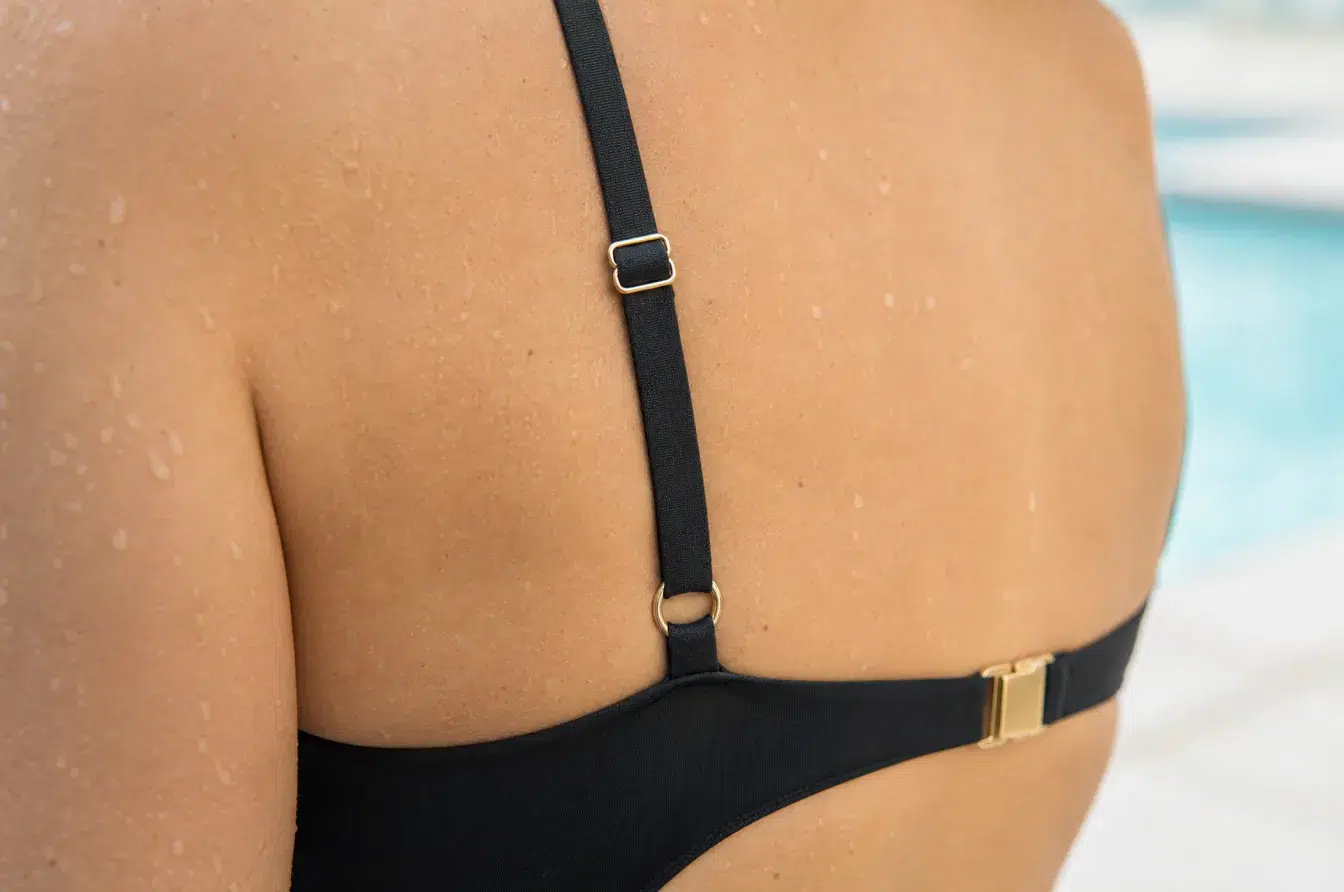
Every metal part should be mapped against the wearer’s body, with contact classified as brief, repeated, or direct and prolonged under normal or reasonably foreseeable use. A ring may look covered on a flat drawing but touch skin when elastic stretches, fabric becomes wet, or the garment shifts. Sliders, clasps, strap ends, zipper parts, logo plates, and their backs can all create direct contact.
For products sold in the European Union, REACH Annex XVII Entry 27 restricts nickel release from articles intended to come into direct and prolonged contact with skin. The limit for that contact category is 0.5 micrograms per square centimeter per week. A qualified laboratory or compliance specialist should confirm the product’s scope, the current legal text, the applicable test method, wear conditioning, sampling, and decision rule for the target market.
Nickel content and nickel release are different measures and must remain clearly distinguished. A component can contain nickel in an alloy or underlayer yet meet a release requirement when the finished system remains effective. Conversely, a “nickel-free plating” statement does not prove that every layer, spring, solder, pin, or production lot is compliant. Supplier declarations and general certificates are useful for traceability, but they do not replace product-specific evidence when testing is required.
| Question | Why it matters | Evidence required |
|---|---|---|
| Which countries will receive the product? | Restrictions, methods, documentation, and enforcement can differ | Market-specific compliance review and current requirement list |
| Which surfaces can touch skin when wet and stretched? | A flat tech pack may hide actual contact | Marked garment drawing and fitted-sample review |
| Is contact direct and prolonged or repeated? | Contact category affects the compliance decision | Intended-use assessment documented by the responsible brand team |
| Does the finish rely on a barrier coating? | Wear, chemicals, and corrosion may expose lower layers | Finish stack, durability conditioning, and release test plan |
| Are all colorways and subcomponents equivalent? | Pigments, topcoats, springs, pins, and suppliers can change | Representative sampling or a justified product-family rationale |
Confirm Safety After Wear and Environmental Conditioning
Nickel release must be considered together with durability because a new barrier may change after rubbing, movement, sunscreen, perspiration, chlorine, or salt exposure. The applicable compliance route may include simulated wear and corrosion conditioning before release testing. The qualified laboratory should select and document the correct method instead of relying on an invented cycle or an untraceable “nickel-free” report.
Skin safety also includes physical condition. The inspection should cover burrs, sharp edges, rough corrosion products, peeling layers, pinch points, uncomfortable pressure, and heat-related discomfort on wearer-facing surfaces. Samples should be examined both dry and wet because lubrication, fabric stretch, and skin pressure change during use. A tiny blister can be a cosmetic defect on the front but a serious comfort issue on the back of a clasp.
Chemical compliance may extend beyond nickel according to the market, brand restricted-substances list, material, coating, and product category. Declarations and test reports should therefore identify the exact component, material, finish, color, supplier, report date, and tested revision. A broad certificate for a plating factory does not prove the result for a specific assembled slider.
Change control is equally important. Switching an underlayer, clear coat, spring supplier, solder, polishing compound, or pigment can alter skin-contact performance even when the visible color remains the same. The production specification should require supplier notification, technical approval, and new evidence when a change can affect restricted substances, release behavior, coating durability, or the surfaces that contact the wearer.
Which Tests Should Verify Color, Corrosion, and Closure Performance Before Production?
A report that says only “passed” cannot support production when the exposure, sample construction, duration, evaluated surfaces, and failure limits are unknown.
The test matrix should be built around real failure modes, with acceptance criteria and report content defined before samples enter the laboratory.
Link Every Test to a Specific Failure Mode
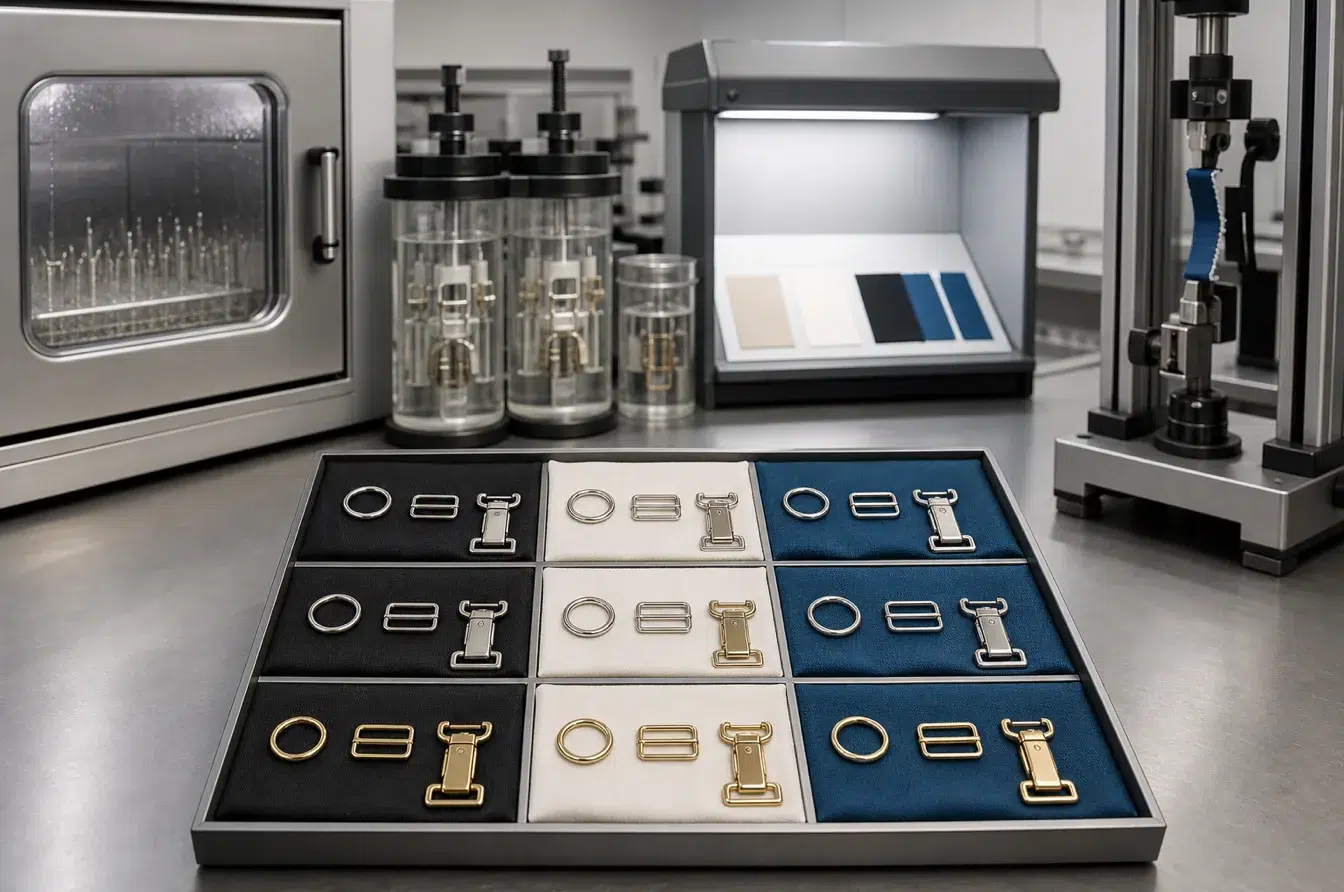
The product risk comes first, not a fashionable number of salt-spray hours, and it should determine the test plan. ISO 9227 salt-spray methods are useful for detecting coating discontinuities and monitoring process consistency. The standard does not provide a universal product exposure period, and it is not intended to rank different materials or predict long-term service life. The method, duration, specimen, and acceptance criteria should therefore be defined for the specific hardware system with the responsible supplier and laboratory.
The matrix contains separate chlorine, seawater, perspiration, cosmetic, care, weathering, and cyclic wet–dry conditions where relevant. ISO 105-E03, ISO 105-E02, ISO 105-E04, and ISO 105-B04 can support evaluation of the adjacent textiles for pool water, seawater, perspiration, and artificial weathering. That evidence should be combined with metal-appropriate corrosion and coating tests; one textile colorfastness result should never stand in for hardware approval.
Mechanical evaluation comes before and after environmental conditioning. It should measure closure security, operating force, slider movement, deformation, and attachment strength across the complete load path of production-representative garments, including the ring or clasp, strap, seam, reinforcement, and setting method. This shows whether corrosion, residue, coating wear, or textile ageing has changed performance.
| Test route | Representative sample | Main evaluations |
|---|---|---|
| Chlorinated-water exposure | Hardware, adjacent fabric, and assembled garment | Finish change, corrosion, staining, textile color, operation, and attachment |
| Seawater exposure | Same construction with hidden surfaces accessible for inspection | Deposits, pitting, crevice attack, tarnish, transfer, and post-rinse appearance |
| Wet–dry cycling | Repeatedly exposed components and assemblies | Delayed corrosion, blistering, peeling, roughness, and residue concentration effects |
| Perspiration and cosmetic compatibility | Wearer-facing hardware against target fabric | Color change, tack, coating damage, transfer, corrosion, and skin-contact concerns |
| Artificial weathering | Every exposed finish color with representative textile | Color stability, clear-coat condition, cracking, fading, and combined light-water effects |
| Mechanical tests before and after conditioning | Production-representative closure and attachment | Operating force, cycle function, pull strength, deformation, and closure retention |
Write Acceptance Criteria and Reports Before Testing
Failure must be described in observable terms, so the criteria should specify which surfaces are critical. Appearance criteria can cover red or white corrosion, tarnish, color change, gloss change, staining of adjacent fabric, blistering, peeling, cracking, pitting, tackiness, and visible residue. A rack point hidden inside a covered attachment may have a different cosmetic limit from the front face.
Functional criteria can include an allowed operating-force range, unrestricted slider travel, closure retention, cycle count, deformation limit, and minimum attachment or pull strength after conditioning. Comfort criteria include no sharp edge, rough corrosion product, pinching, or damaged coating on a skin-facing surface. Numerical limits should be set where measurement is meaningful, while signed limit samples or controlled visual grades should be used where appearance judgment is required.
The report must identify the component part number, drawing revision, production lot, substrate, finish stack, colorway, supplier, and assembly. It should record the solution or contact product, concentration, temperature, exposure time, cycle sequence, rinse, drying condition, sample quantity, equipment, method version, and any deviation. Consistent pre- and post-test photographs and results are required for every evaluated surface, not only the best-looking sample.
Decision rules must also be established before testing. One failed sample should not disappear inside an average. The test plan states whether any visible corrosion is unacceptable, whether retesting is allowed, how many samples are needed, and who approves deviations. Any failure should be traced to material, geometry, surface preparation, plating coverage, assembly, chemical exposure, or garment construction, then the relevant test should be repeated on a controlled revision rather than an undocumented touch-up.
This matrix becomes part of the production specification. Incoming checks, periodic validation, and change control can then reference the same approved construction and limits. That is more reliable than collecting unrelated certificates after development is complete.
Conclusion
Swimwear hardware should be approved only when its appearance, skin safety, movement, attachment, and surrounding fabric remain acceptable through defined, application-specific exposure and care cycles.