- Loading...
Jeans can use strong denim, but weak buttons can still damage the whole product feeling. I have seen this small part change buyer confidence fast.
Jean buttons are not ordinary clothing buttons. They use a cap-and-stud attachment system to hold heavy denim under stress, while also creating a visible brand detail through shape, finish, logo, texture, and production consistency.
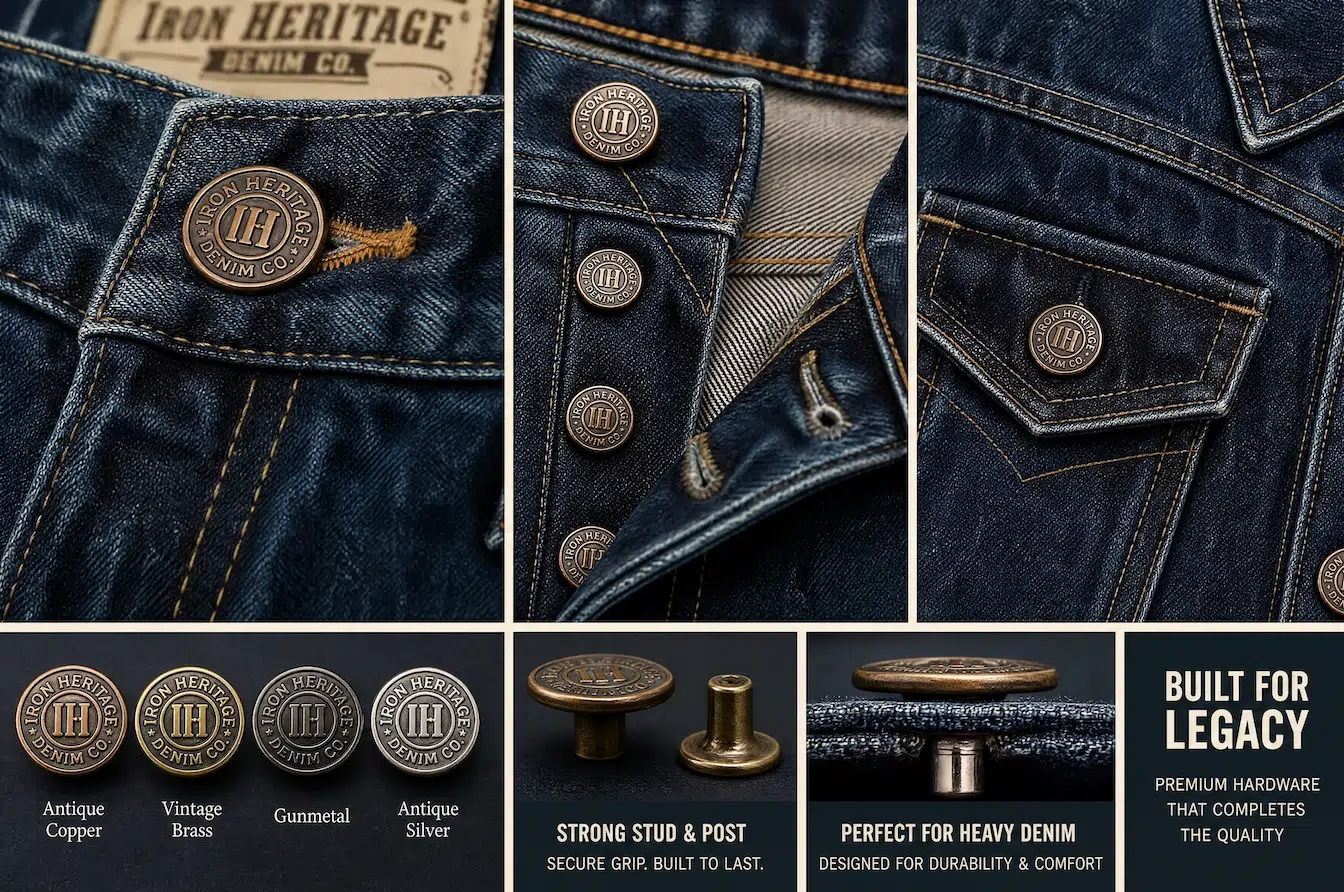
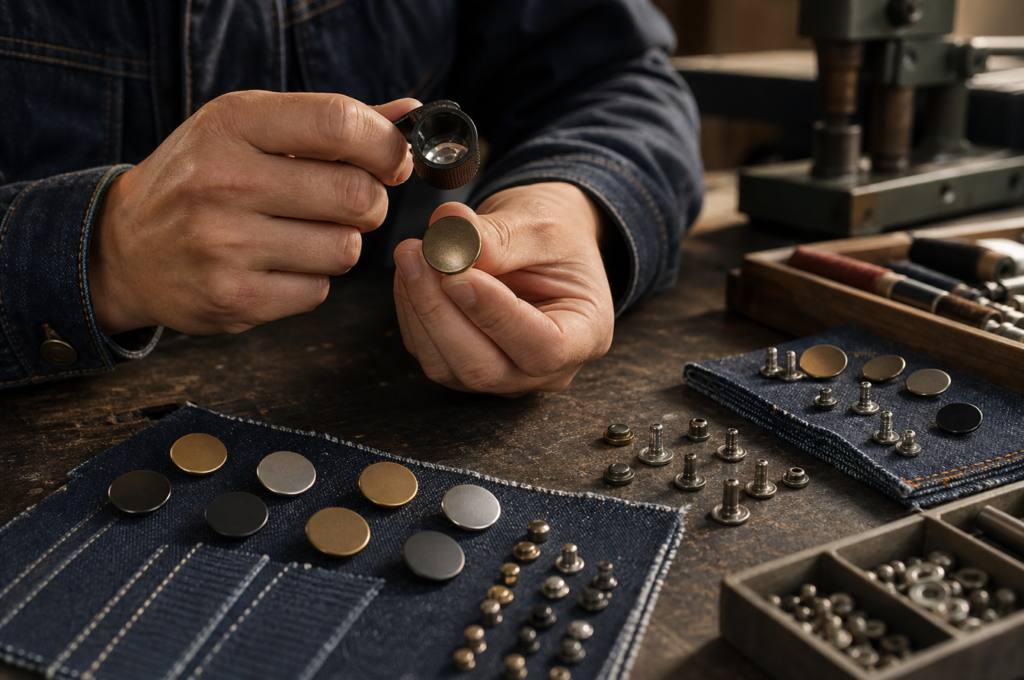
I used to look at jean buttons as simple closure parts. Then I started to work closer with denim products, sample cards, and metal hardware development. I saw that a jean button carries two jobs at the same time. It must hold the waistband, fly, or jacket front under pressure. It must also express the style of the denim product. A plain button can make jeans feel basic. A well-designed button can make the product feel vintage, workwear, premium, or streetwear. This is why I now see jean buttons as both engineering parts and brand signals. The best jean button is not only strong. It also fits the denim weight, the washing effect, the finish direction, and the brand story.
What Is the Small Denim Detail That Buyers Notice First?
A jean button is small, but buyers touch it1 before they study many other details. If it feels weak, the product feels weaker.
Buyers notice jean buttons because they sit at the main closure point of denim products. A strong button improves trust through weight, fixing stability, surface finish, logo clarity, and how well it matches the denim style.
I often see buyers touch the waistband button first when they check jeans. This small action tells them a lot. They can feel whether the button is solid. They can see whether the finish matches the denim wash. They can notice whether the logo is clear. They may not explain it in technical words, but they quickly judge whether the product feels serious.
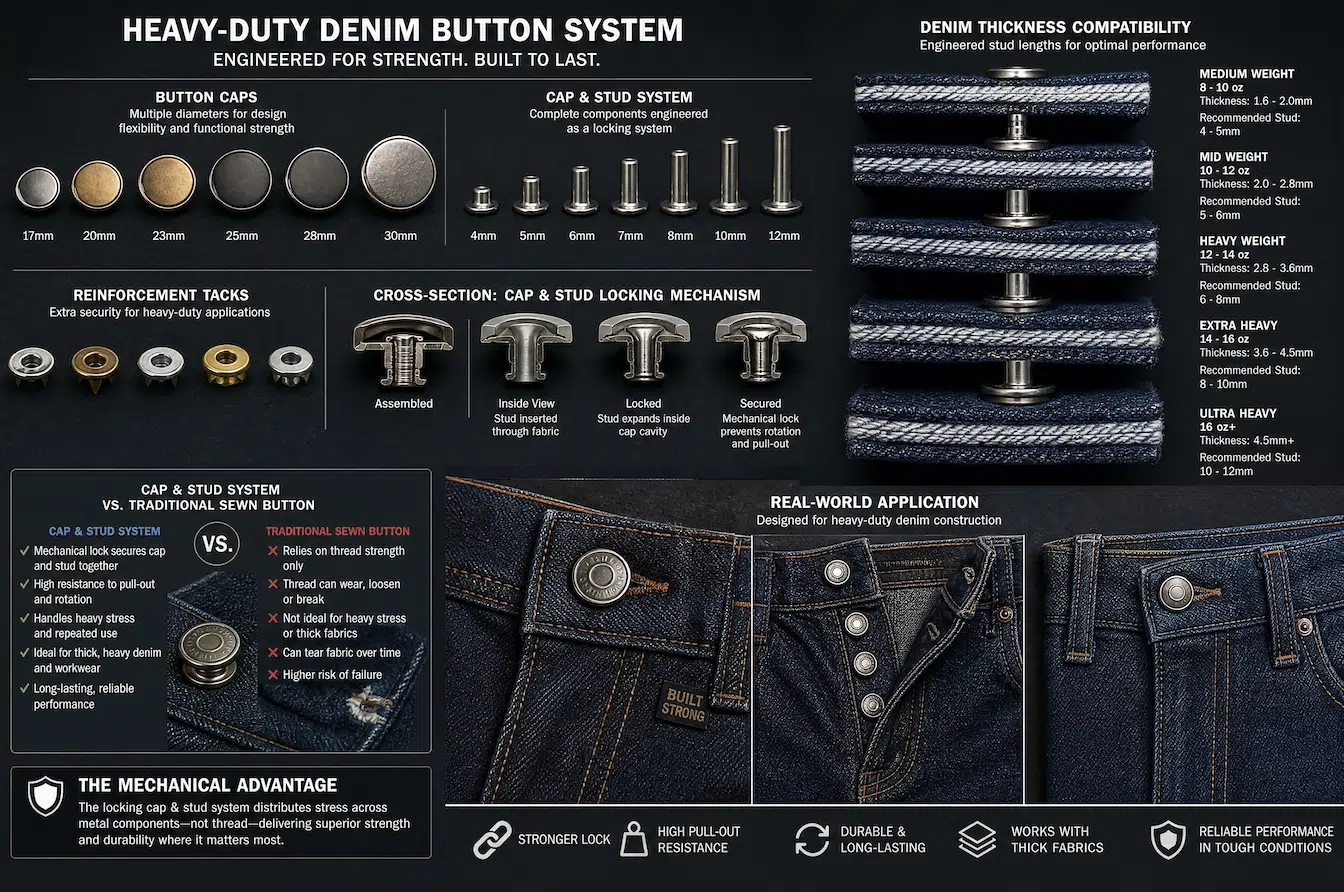
A jean button is different from a regular sewn button. Denim fabric is thick and often faces bending, stretching, pulling, and repeated washing.2 A normal thread-sewn button may not hold well under this kind of stress. A jean button uses a cap-and-stud system.3 The button cap sits on the front side. The tack or nail comes from the back side. When installed by pressure or hammering, the parts lock through physical deformation. This creates stronger attachment for heavy-duty use.
| Buyer Touchpoint | What They Notice | Why It Matters |
|---|---|---|
| Button weight | Solid or weak feeling | Affects perceived denim quality |
| Surface finish | Vintage, clean, bright, or matte | Matches the garment style |
| Logo clarity4 | Sharp or blurry brand mark | Supports brand recognition |
| Edge quality | Smooth or rough edge | Affects touch and product trust |
| Attachment stability | Firm or loose button | Protects real wearing performance |
| Color match | Fits wash and trim system | Supports full product consistency |
I treat the jean button as the first hardware checkpoint on denim. It may be small, but it is positioned where function and brand identity meet. If this point feels right, the whole product starts with stronger trust.
From Jeans to Jackets, How Do Different Jean Buttons Serve Different Denim Products?
Different denim products do not need the same button. Waistbands, fly fronts, jackets, and decorative points all require different button logic.
Different jean buttons serve different denim products by matching stress level, fabric thickness, closure function, and visual style.5 Waistband buttons need stronger holding power, while fly buttons and decorative rivet buttons need smaller size and smoother use.
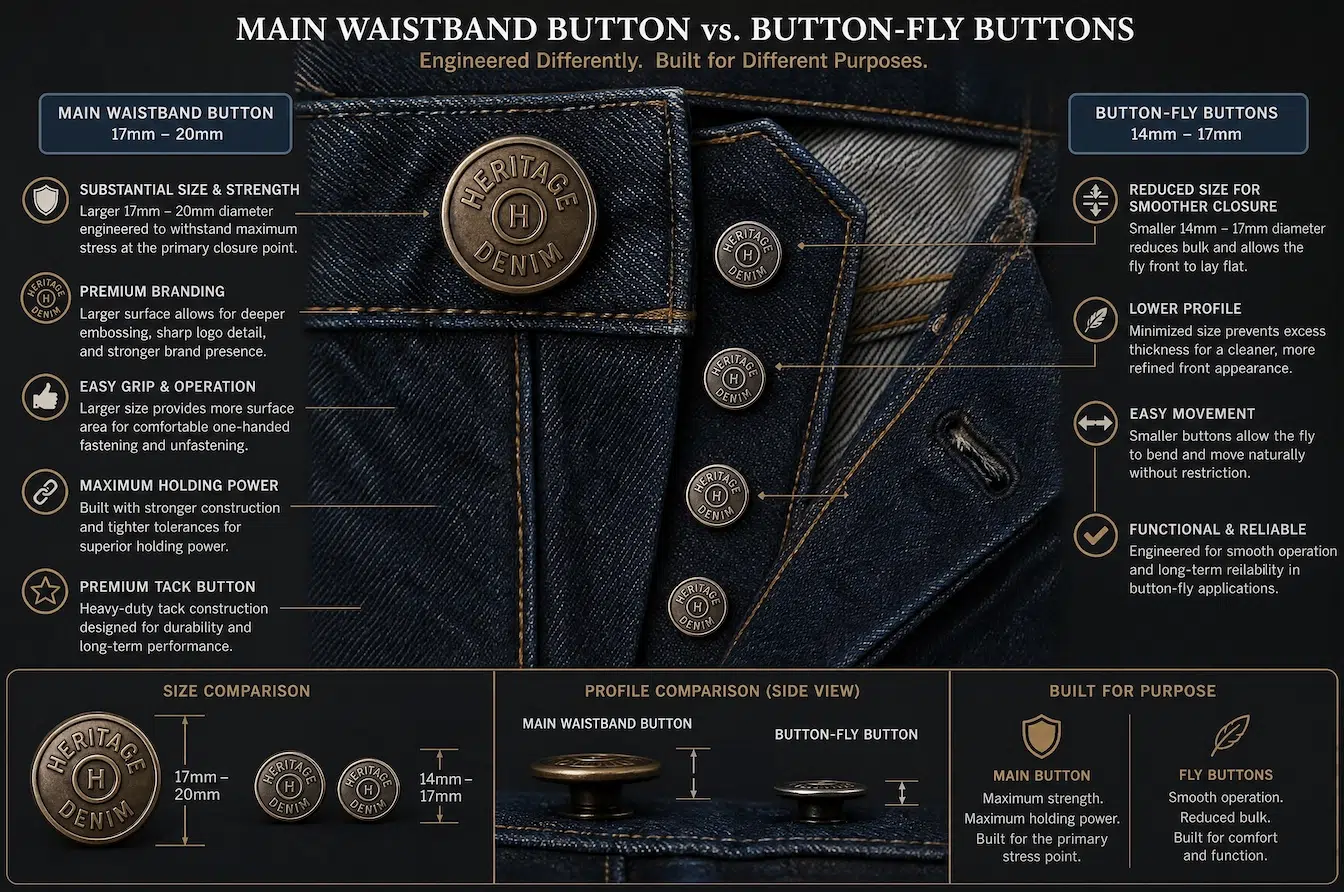
I usually divide jean buttons by use before I look at style. The waistband button is the main stress point.6 It needs strong attachment, good size, and enough surface area for easy use. For many jeans, the main waistband button is around 17 mm to 20 mm.7 This size helps balance grip, strength, and appearance. Button-fly jeans need smaller buttons, often around 14 mm to 17 mm. These buttons must close smoothly without making the fly too bulky. Decorative rivet-style buttons may be around 10 mm to 12 mm. They may support brand detail or work as small visual points.
There are also cultural and style differences. Standard tack buttons are the common modern industrial choice. They are practical and suitable for logo engraving. Donut buttons have a hollow center. They often feel more vintage, military, or workwear-inspired.8 Stud or rivet buttons can support button-fly systems and small functional areas. They should not be treated only as decoration.
| Button Type | Common Use | Style Feeling | Key Production Point |
|---|---|---|---|
| Tack button | Waistbands, jackets, modern denim | Clean, industrial, versatile | Logo and cap surface must stay clear |
| Donut button | Vintage jeans, military denim, workwear | Retro, rugged, historical | Hollow center and plating must be clean |
| Button-fly button | Denim fly closure | Functional and classic | Size must support easy opening |
| Rivet / stud button | Fly systems, small stress points | Utility and reinforcement | Tack length must match fabric thickness |
| Decorative jean button | Pockets, trims, design points | Brand detail and visual accent | Weight should not distort fabric |
I also consider the full denim system. The jean button should match pocket rivets, zippers, leather labels, metal plates, and washing effects. A vintage denim line may need antique brass hardware. A black streetwear jean may need matte black or black nickel. A premium blue denim product may need clean brass, silver, or soft antique finish. The button should not stand alone. It should belong to the full trim story.
How Should I Choose the Right Metal for Weight, Strength, Cost, and Feel?
The metal choice decides how the button feels, how it wears, how much it costs, and how stable it is in production.
The right jean button metal should match denim weight, target price, finish style, logo detail, and durability needs. Brass feels premium, zinc alloy supports flexible design, iron controls cost, and stainless steel offers strength and corrosion resistance.
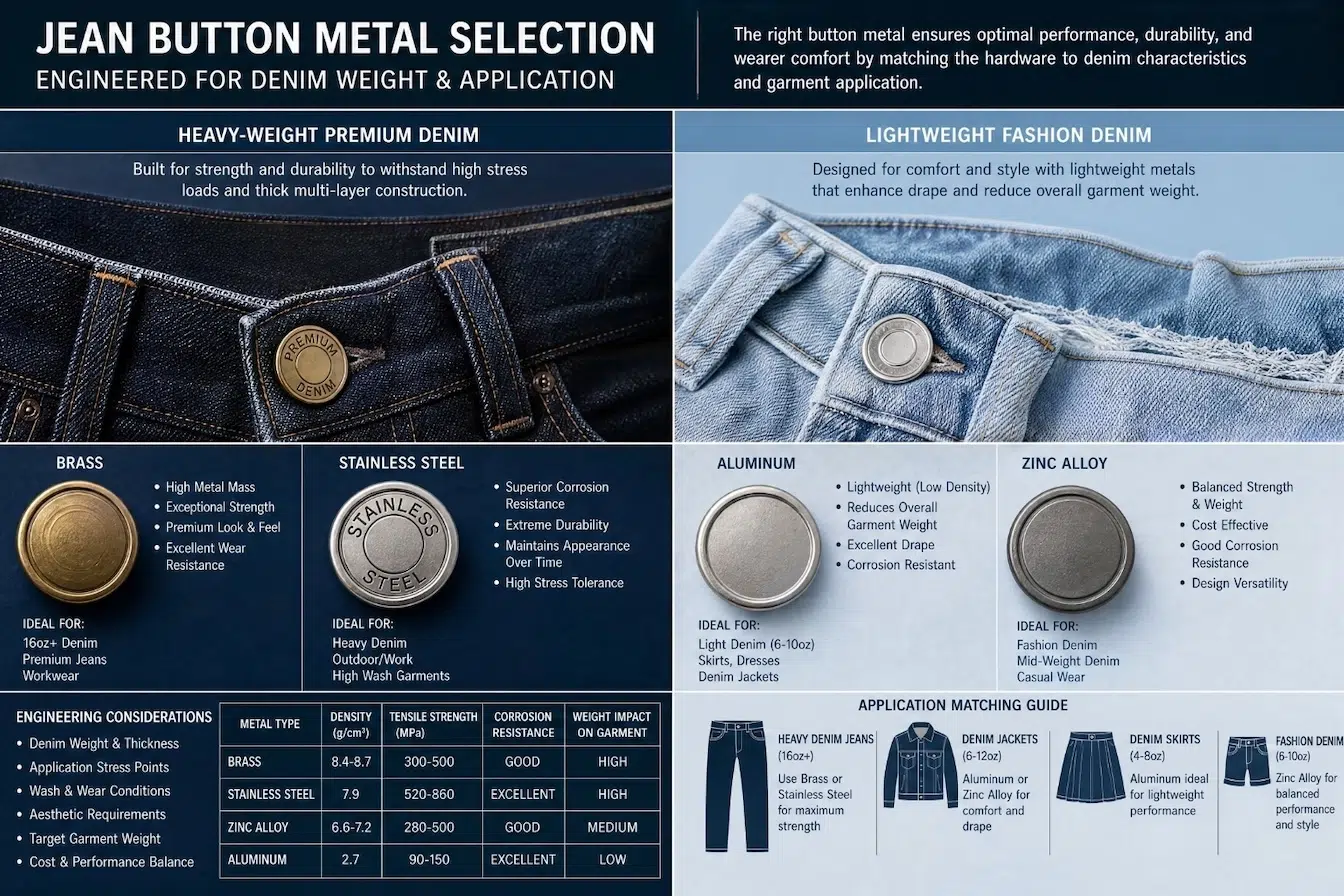
I usually begin with denim weight and product positioning. Heavy denim needs stronger hardware. A light fashion denim skirt or jacket may need a button that looks solid but does not pull the fabric. A premium jean may need a richer metal feel. A fast-moving product may need cost control and stable production. This is where material selection becomes important.
Brass is often used when brands want better plating quality, solid weight, and premium detail.9 It works well for refined finishes and logo work. Zinc alloy can support more flexible shapes and deeper decorative forms.10 It can be useful for fashion denim and custom designs. Iron can help control cost, but it needs good surface protection because corrosion risk is higher.11 Stainless steel is strong and resistant to corrosion, but it can be harder to shape into very fine decorative details.12 Some designs may also use specialty finishes or higher-grade alloys when the brand wants a more unique feeling.
| Metal Choice | Main Advantage | Best Use | Key Risk |
|---|---|---|---|
| Brass | Premium feel, good plating, clear detail | High-end denim, branded buttons | Higher cost than basic metals |
| Zinc alloy | Flexible shapes and decorative depth | Fashion denim, custom designs | Weight and finish need control |
| Iron | Cost control and strong basic structure | Volume denim programs | Needs good anti-rust protection |
| Stainless steel | Strong and corrosion-resistant | Technical or clean modern denim | Harder for detailed logo work |
| Aluminum | Lightweight | Thin denim or special lightweight styles | May need stronger surface coating |
| Recycled metal options | Supports sustainability direction | Responsible denim collections | Material proof and stability must be checked |
I also look at how the metal interacts with washing. Denim often goes through stone wash, enzyme wash, bleaching, garment dyeing, or other finishing processes. The button must survive this environment. The finish must not peel too easily. The metal should not stain the fabric. The button should not deform after washing and wearing. Material choice is not only about cost. It is part of product risk control.
What Engineering Makes Jean Button Attachment Strong Enough?
Jean buttons must handle pulling, bending, stretching, and repeated use. A good-looking button is not enough if it cannot hold.
Strong jean button attachment depends on the cap-and-stud structure13, correct tack length14, controlled installation pressure15, suitable fabric thickness, and pull-strength testing. These details help the button stay locked during real denim wear.
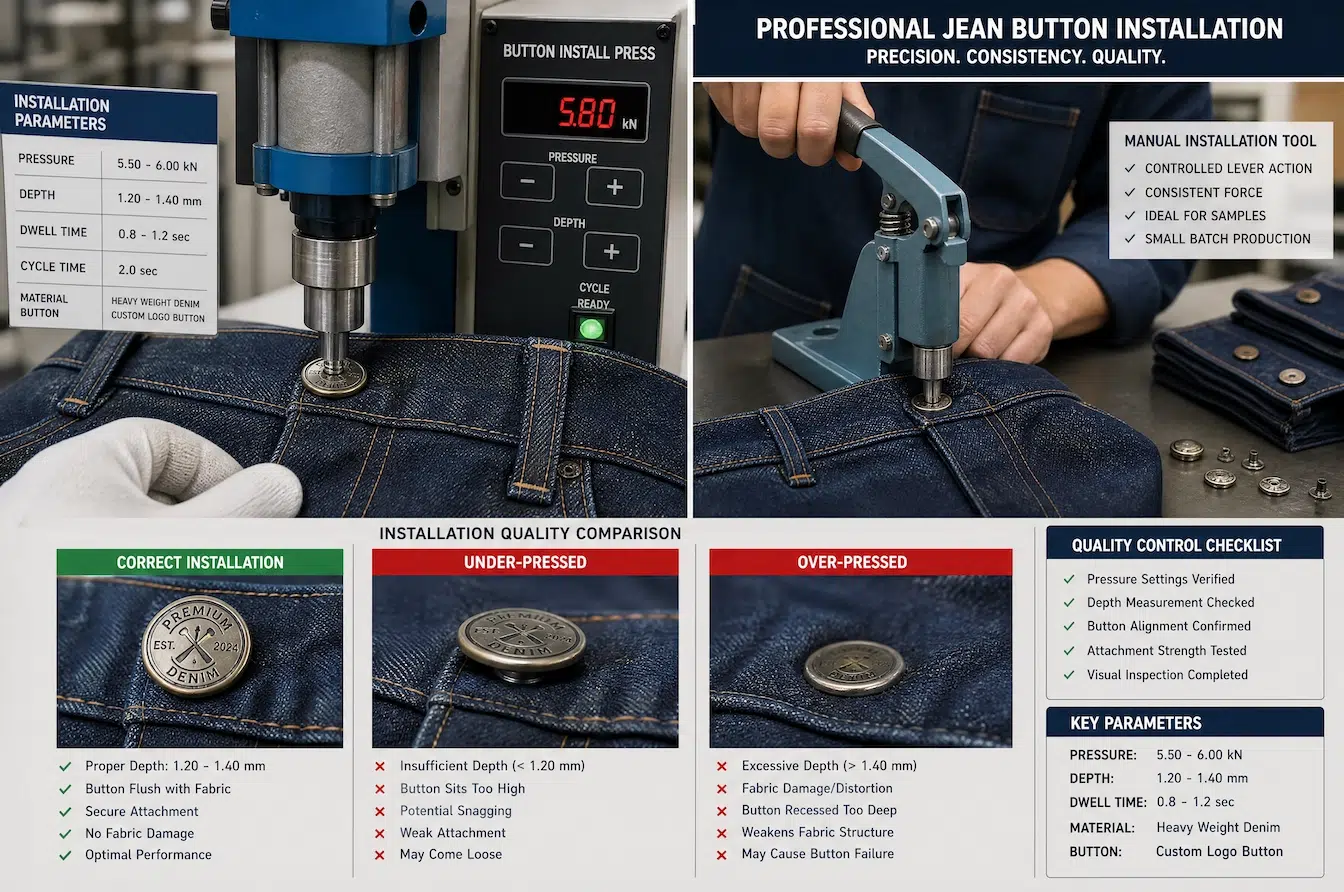
I see jean button strength as a small mechanical system. The button cap and tack must lock together through pressure. During installation, the tack moves through the denim and enters the button cap. The inside structure deforms and locks the two parts. If the tack is too short, it may not lock deeply enough. If it is too long, it may deform poorly or create discomfort. If the installation pressure is too low, the button may loosen. If the pressure is too high, the fabric or button may be damaged.
Denim thickness also matters. A lightweight denim shirt and a heavy 14 oz jean cannot use the same assumption. Different fabric layers, waistband construction, washing shrinkage, and seam thickness can affect the final attachment. This is why I prefer to test buttons on real fabric16, not only on a sample card.
| Engineering Factor | What It Controls | Risk If Wrong |
|---|---|---|
| Tack length | Depth of lock through fabric | Loose button or uncomfortable back |
| Cap structure | Front appearance and locking area | Weak attachment or surface deformation |
| Installation pressure | How parts deform and lock | Fabric damage or loose fixing |
| Fabric thickness | Fit between tack and cap | Poor grip or over-compression |
| Button diameter | Grip and stress distribution | Hard use or weak visual balance |
| Back shape | Comfort against body | Irritation or pressure point |
| Pull test | Real attachment strength | Hidden failure in bulk use |
I also pay attention to human movement. Jeans bend at the waist. People sit, stand, stretch, and pull the waistband many times. Button-fly areas also open and close repeatedly. This is why I do not treat a jean button like a simple surface trim. It is a heavy-duty part. It must pass real stress, not only visual approval.
Which Finishes Tell a Denim Story Through Vintage, Workwear, Premium, and Streetwear Looks?
The finish of a jean button can change the whole denim mood. The same button shape can feel very different with another surface.
Jean button finishes tell a denim story by matching the wash, style, and market position17. Antique brass feels vintage, black nickel feels streetwear, polished silver feels clean, and matte finishes can feel modern and premium.
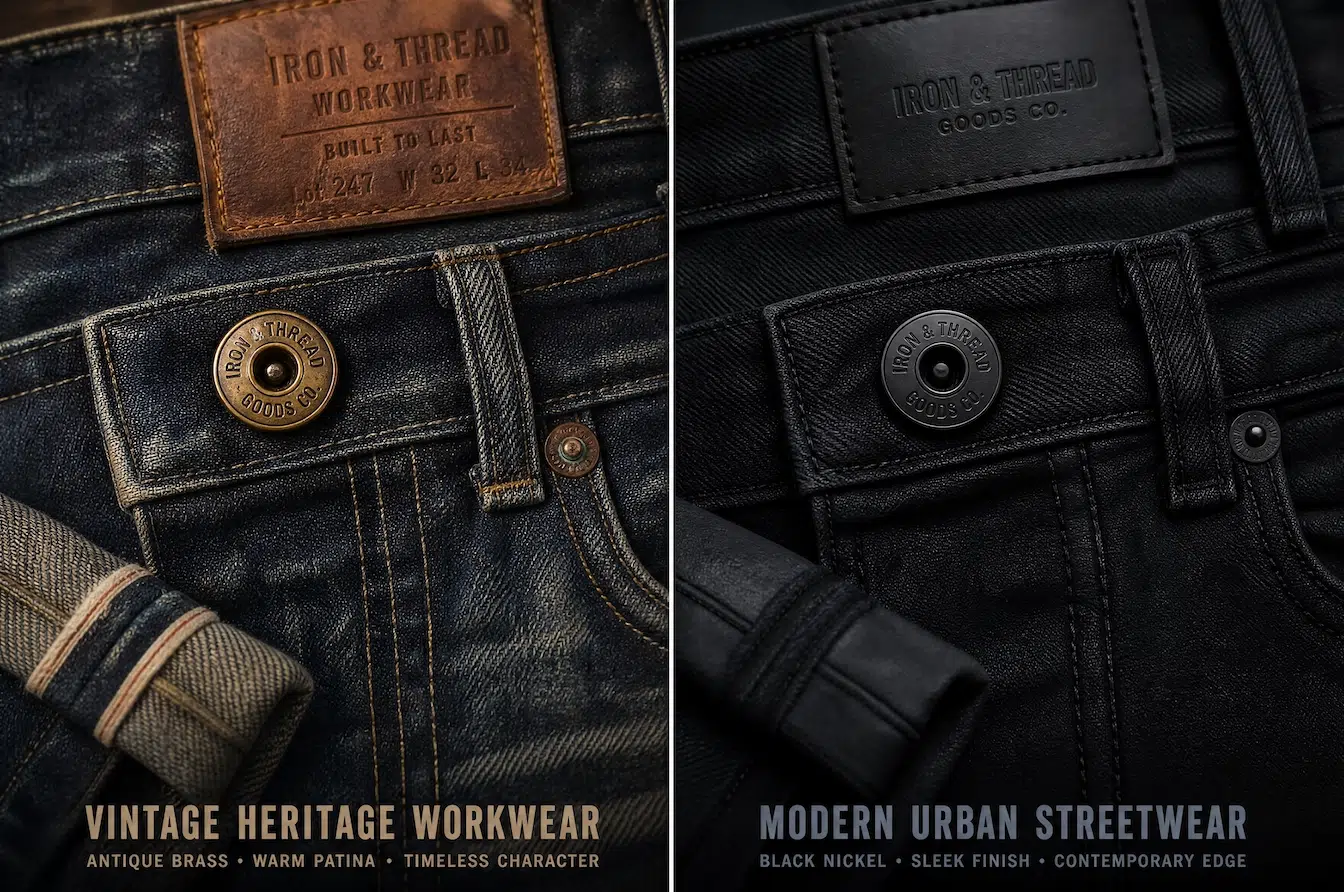
I treat finish selection as part of denim storytelling. Denim is not only blue fabric. It can be raw, washed, faded, black, coated, vintage, luxury, workwear, or streetwear. The button finish should support that direction. Antique brass can create an old workwear feeling18. It works well with faded blue denim, brown leather labels, and copper rivets. Antique copper can feel warm and rugged. Black nickel can feel modern and slightly aggressive. Matte black can work for streetwear or minimal denim. Polished silver can look clean, sharp, and more fashion-driven.
A finish must also survive denim washing and daily wear. A beautiful plated button may look good before washing, but denim production can be harsh19. If the finish scratches, stains, peels, or changes too much, the product loses quality value. Some vintage styles allow controlled aging. Some premium styles need cleaner consistency.
| Finish | Denim Story | Best Match | Production Concern |
|---|---|---|---|
| Antique brass | Vintage, heritage, workwear | Faded denim, brown leather patch | Aging effect must be consistent |
| Antique copper | Rugged, warm, industrial | Classic jeans, rivet systems | Color should match rivets |
| Black nickel | Streetwear, modern, sharp | Black denim, coated denim | Dark finish may hide logo details |
| Matte black | Minimal, technical, urban | Streetwear and clean designs | Coating adhesion must be tested20 |
| Polished silver | Clean, fashion, bright | Modern jackets, premium jeans | Scratches may show |
| Gunmetal | Cool, strong, contemporary | Dark wash and premium denim | Tone must stay stable |
| Brushed finish | Textured, refined, controlled | Premium denim and utility styles | Brush direction must be consistent |
I also like to check the full trim set together. The jean button, rivets, zipper puller, leather label, and metal logo plate should feel connected. If each part uses a different tone, the denim can look unplanned. A strong finish system makes the product feel more complete.
How Can a Jean Button Become a Brand Mark Through Logo Precision, Texture, and Production Control?
A jean button becomes a brand mark when people can recognize the brand from a small metal detail.
A jean button becomes a brand mark through clear logo engraving, controlled texture, stable finish, correct size, and repeatable bulk production. The button should support recognition without weakening function or denim comfort.
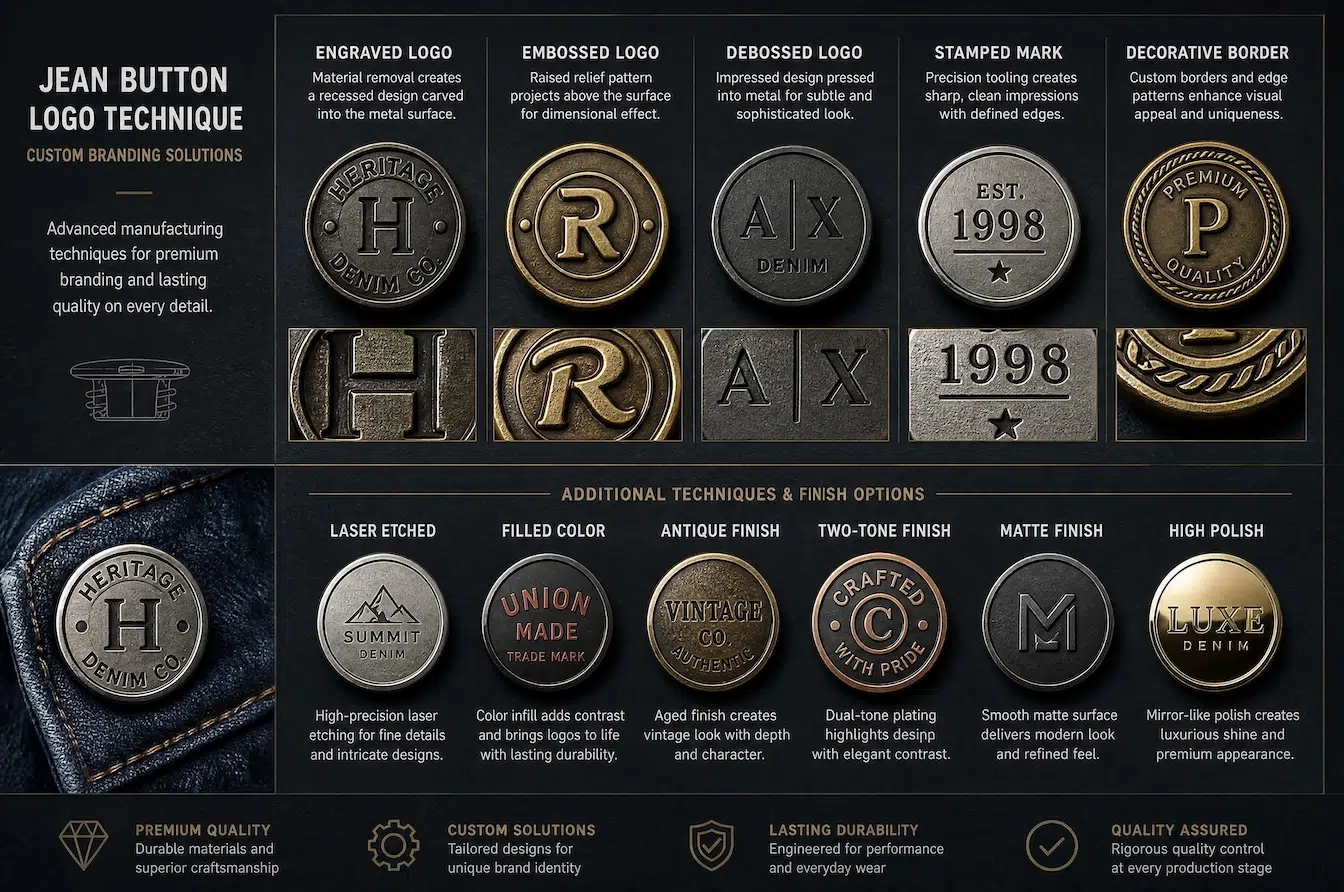
I believe custom jean buttons are one of the most practical brand contact points21 in denim. A customer touches the waistband button often. They see it when wearing, folding, photographing, or selling the product. This means the button can carry the brand in a very natural way. A logo can be engraved, embossed, debossed, stamped, or built into the cap design. The key is not only adding a logo. The key is making the logo clear, balanced, and durable.
Small button size creates limits. Very thin lines may disappear after stamping or plating.22 Small letters may become unclear. Deep textures may affect logo readability. A rough surface may weaken fine details.23 This is why I prefer clean vector artwork and early technical review. The button design must fit the real production process.
| Brand Detail | What It Adds | What I Check |
|---|---|---|
| Engraved logo | Clean brand recognition | Depth and contrast |
| Embossed logo | Strong touch and raised effect | Height and edge sharpness |
| Debossed logo | Subtle and premium feeling | Recess depth and plating flow |
| Border texture | Adds vintage or workwear feeling | Pattern consistency |
| Custom cap shape | Creates unique identity | Wearability and installation |
| Back mark | Hidden official detail | Space and readability |
| Sample card system | Shows trim family | Match with rivets, labels, zippers |
Production control is where the brand mark is protected. The sample may look perfect, but bulk buttons must keep the same logo depth, finish tone, cap shape, and attachment result. I always suggest keeping an approved sample as the reference. I also suggest testing the button on the real denim fabric before bulk approval24. A custom jean button should work as a brand mark, but it must still work first as strong denim hardware.
Conclusion
I see jean buttons as small denim anchors. When structure, metal, finish, logo, and production control work together, hardware becomes brand signature.
-
"Hand-Feel Touch Cues and Their Influences on Consumer … – PMC", https://pmc.ncbi.nlm.nih.gov/articles/PMC6678767/. Research on consumer haptics indicates that tactile interaction with products can shape perceived quality, confidence, and evaluation, supporting the relevance of touch during product inspection. Evidence role: expert_consensus; source type: paper. Supports: Buyers may form quality judgments from touching a jean button before studying other garment details.. Scope note: This evidence supports touch as a general consumer-evaluation mechanism; it does not specifically prove that denim buyers touch the waistband button first. ↩
-
"Fabrication and characterization of stretchable denim fabric using …", https://pmc.ncbi.nlm.nih.gov/articles/PMC8646987/. Textile references describe denim as a durable cotton twill fabric used in garments exposed to wear and laundering, which provides context for the mechanical demands placed on jeans hardware. Evidence role: general_support; source type: education. Supports: Denim garments are relatively thick and are subjected to wear, movement, pulling, and repeated washing.. Scope note: The source would support denim’s general durability and use conditions, not the exact stress level experienced by every jean button design. ↩
-
"40Pcs Iron Jeans Button Tack Buttons Cap Kit With Box For … – eBay", https://www.ebay.com/itm/366121100679. Garment construction references describe jeans buttons as two-part fasteners, typically consisting of a front button and a rear tack or stud that is mechanically set through the fabric. Evidence role: definition; source type: education. Supports: A jean button is commonly built as a two-part cap-and-stud or button-and-tack fastener rather than a thread-sewn button.. Scope note: Terminology may vary by source, with some references using terms such as tack button, rivet button, or shank button. ↩
-
"Neuroscientific Analysis of Logo Design: Implications for Luxury …", https://pmc.ncbi.nlm.nih.gov/articles/PMC12024241/. Branding research finds that visual brand elements such as logos function as recognition cues, supporting the claim that clearer marks can aid brand identification. Evidence role: expert_consensus; source type: paper. Supports: Clear logo execution on a button can support brand recognition.. Scope note: This supports the role of logos in brand recognition generally; it does not directly test logo sharpness on jean buttons specifically. ↩
-
"[PDF] Complete Guide To Sewing – sciphilconf.berkeley.edu", https://sciphilconf.berkeley.edu/index.jsp/mLB3GB/605563/Complete%20Guide%20To%20Sewing.pdf. Apparel construction and garment-engineering sources describe fastener selection as dependent on fabric weight, expected load, closure function, and appearance, which supports the article’s general principle for differentiating denim buttons. Evidence role: general_support; source type: education. Supports: Different jean buttons should be selected according to stress level, fabric thickness, closure function, and visual style.. Scope note: The source may discuss garment fasteners broadly rather than denim buttons exclusively. ↩
-
"My Favorite Trouser-Making Details, Part 2: Adding Internal Buttons", https://www.threadsmagazine.com/2023/07/07/my-favorite-trouser-making-details-part-2-adding-internal-buttons. Garment construction references identify waist closures as load-bearing areas because they secure the garment at the body’s circumference, supporting the claim that a jeans waistband button experiences higher functional stress than decorative or secondary buttons. Evidence role: mechanism; source type: education. Supports: The waistband button is a primary stress point on jeans and therefore needs stronger attachment.. Scope note: The support is likely based on general trouser or garment construction principles rather than a measured stress comparison among every type of denim button. ↩
-
"32 Sets Jeans Buttons Replacement, 17mm and 20mm No-Sew …", https://www.amazon.com/Replacement-EZJIAYOU-Adjustable-Removable-Screwdrivers/dp/B0B3XCJS1T. Button-sizing references and denim hardware specifications commonly place jeans waistband tack buttons in the high-teen millimeter range, providing contextual support for the stated 17–20 mm sizing range. Evidence role: general_support; source type: other. Supports: Many jeans use main waistband buttons of approximately 17 mm to 20 mm.. Scope note: Neutral public sources may document button-size systems or examples rather than establish a universal industry standard for all jeans. ↩
-
"[PDF] A Look at Buttons as Indicators of Chronology and Material Culture", https://trace.tennessee.edu/cgi/viewcontent.cgi?params=/context/utk_chanhonoproj/article/1042/&path_info=Marcel_Sarah_1994.pdf. Historical clothing and military-uniform references document hollow-center metal buttons on workwear and military garments, giving historical context for associating donut buttons with vintage, military, and workwear aesthetics. Evidence role: historical_context; source type: encyclopedia. Supports: Donut buttons have a hollow center and are associated with vintage, military, or workwear styles.. Scope note: Such sources support the historical association of the form, not a universal consumer perception of all donut buttons. ↩
-
"Brass", https://en.wikipedia.org/wiki/Brass. A materials reference or metallurgical source should support that brass is a dense copper alloy with good formability and surface-finishing characteristics, which provides contextual support for its use in higher-detail decorative hardware. Evidence role: general_support; source type: encyclopedia. Supports: Brass is often used for jean buttons when brands want better plating quality, solid weight, and premium detail.. Scope note: This would support brass properties generally, not prove denim brands specifically choose brass for premium positioning. ↩
-
"Microstructural and Mechanical Properties of Zinc Die Casting Alloys", https://www.researchgate.net/publication/224842129_Microstructural_and_Mechanical_Properties_of_Zinc_Die_Casting_Alloys. A die-casting or materials-engineering source should document that zinc alloys are commonly used in die casting because they can reproduce complex shapes with fine dimensional detail, supporting the claim in a general manufacturing context. Evidence role: mechanism; source type: institution. Supports: Zinc alloy supports flexible shapes and deeper decorative forms for jean buttons.. Scope note: The evidence would explain zinc alloy manufacturing capability generally, not evaluate any specific jean-button design. ↩
-
"Corrosion protection performance of silicon-based coatings … – PMC", https://pmc.ncbi.nlm.nih.gov/articles/PMC9131146/. A corrosion-science or educational source should support that iron and plain carbon steels are susceptible to rusting in the presence of oxygen and moisture, explaining why protective coatings are needed for iron-based hardware. Evidence role: mechanism; source type: education. Supports: Iron jean buttons require good surface protection because corrosion risk is higher.. Scope note: This supports the corrosion mechanism and need for protection, but not the comparative cost of iron in jean-button sourcing. ↩
-
"Stainless steel – Wikipedia", https://en.wikipedia.org/wiki/Stainless_steel. A materials reference should support that stainless steels are known for corrosion resistance and high strength, while their work-hardening or forming characteristics can make intricate shaping more demanding than softer casting alloys. Evidence role: general_support; source type: encyclopedia. Supports: Stainless steel offers strength and corrosion resistance but may be harder to shape into very fine decorative details.. Scope note: The source may support stainless steel properties broadly rather than directly comparing jean-button logo-detail performance. ↩
-
"Fasteners Made Easy – BE BOLD. Shape the Future.", https://pubs.nmsu.edu/_c/C232/index.html. A technical source on tack buttons or riveted fasteners can support that jean buttons use a cap-and-stud, or tack-and-button, construction in which the components are mechanically joined through the fabric. Evidence role: definition; source type: institution. Supports: Strong jean button attachment depends in part on the cap-and-stud structure.. Scope note: This supports the fastener structure generally; it may not verify the specific performance of every jean button design. ↩
-
"Fasteners Made Easy – BE BOLD. Shape the Future.", https://pubs.nmsu.edu/_c/C232/index.html. A textile or apparel engineering source can support that the length of a tack or shank must be matched to material thickness so the fastener can clinch or lock properly without causing poor attachment or discomfort. Evidence role: mechanism; source type: education. Supports: Tack length affects whether a jean button locks securely through denim and whether the back side is comfortable.. Scope note: The source may discuss mechanical or apparel fasteners broadly rather than jean buttons exclusively. ↩
-
"The effects of feed force on rivet bucking bar vibrations – PMC", https://pmc.ncbi.nlm.nih.gov/articles/PMC6379920/. A source on press-fit, riveted, or clinched fasteners can support that installation force affects deformation of the components and that insufficient or excessive force can lead respectively to loose joints or damage to the fastener or substrate. Evidence role: mechanism; source type: paper. Supports: Controlled installation pressure is important because too little pressure may cause loosening, while too much pressure may damage the fabric or button.. Scope note: Evidence may be based on general fastening mechanics rather than denim-specific button testing. ↩
-
"Types of Textile lab Testing: Physical & Chemical …", https://darongtester.com/comprehensive-guide-to-textile-testing-ensuring-quality-through-physical-chemical-performance-tests/. Textile testing guidance can support that garment components should be evaluated under representative material and construction conditions because fabric weight, layers, seams, and finishing processes can influence performance. Evidence role: expert_consensus; source type: institution. Supports: Testing jean buttons on real or representative fabric is preferable to relying only on a sample card because fabric thickness and construction affect attachment.. Scope note: This would provide contextual support for representative testing rather than direct proof that every jean button must be tested on production denim. ↩
-
"[PDF] evaluating the role of design in the apparel industry", https://digital.library.unt.edu/ark:/67531/metadc700003/m2/1/high_res_d/thesis.pdf. Research and apparel-design literature treats trims, surface treatments, and material details as part of a garment’s visual identity and market positioning, supporting the use of button finish as a design cue within a denim product system. Evidence role: general_support; source type: education. Supports: Jean button finishes help communicate a denim product’s style direction and market position.. Scope note: This supports the broader design principle rather than proving that any single jean-button finish has a fixed market meaning. ↩
-
"Jeans – Wikipedia", https://en.wikipedia.org/wiki/Jeans. Historical accounts of jeans describe their origins as durable work clothing and note the use of metal rivets in reinforcing early denim garments, providing context for why aged brass or copper-toned hardware can evoke workwear heritage. Evidence role: historical_context; source type: encyclopedia. Supports: Antique brass hardware can evoke a vintage or workwear feeling in denim design.. Scope note: The source would establish the historical association of jeans, metal hardware, and workwear; it would not directly measure consumer perception of antique brass buttons. ↩
-
"[PDF] Washing Defects and Remedial Actions of Denim Garments and …", https://journals.bilpubgroup.com/index.php/jmser/article/download/2941/pdf/0. Textile-finishing literature describes denim washing as involving mechanical abrasion and chemical or enzymatic treatments that can alter garment surfaces and attached components, supporting the claim that hardware finishes must withstand demanding production conditions. Evidence role: mechanism; source type: paper. Supports: Denim washing and finishing processes can be harsh enough to affect plated or coated jean buttons.. Scope note: The evidence would support the general harshness of denim finishing processes, not the failure rate of a specific button finish. ↩
-
"Standard Test Methods for Rating Adhesion by Tape Test", https://www.astm.org/d3359-23.html. Coating standards such as cross-cut or tape adhesion tests provide established methods for evaluating whether a coating remains bonded to a substrate, supporting the need to test adhesion on coated jean buttons before production use. Evidence role: expert_consensus; source type: institution. Supports: Matte or coated jean-button finishes require adhesion testing to reduce peeling or delamination risk.. Scope note: General coating-adhesion standards apply across substrates and coatings; additional denim-wash testing may be needed for the exact button material and finish. ↩
-
"Linking product design to consumer behavior: the moderating …", https://pmc.ncbi.nlm.nih.gov/articles/PMC5957053/. Marketing research on brand touchpoints describes physical product features and repeated consumer interactions as cues that may contribute to brand recognition, supporting the interpretation of a visible and handled waistband button as a possible brand contact point. Evidence role: general_support; source type: paper. Supports: Custom jean buttons can function as practical brand contact points because customers repeatedly see and touch them.. Scope note: This evidence would support the branding mechanism in general, not prove that jean buttons are more effective than other denim details. ↩
-
"Analysis of Tool Geometry for the Stamping Process of Large-Size …", https://pmc.ncbi.nlm.nih.gov/articles/PMC8706949/. Technical literature on metal stamping and electroplating documents that tooling tolerances, deformation, coating thickness, and edge buildup can reduce the definition of fine surface features, supporting the need to simplify very thin button artwork before production. Evidence role: mechanism; source type: research. Supports: Very thin logo lines on jean buttons may lose clarity during stamping or plating.. Scope note: The source may describe general metal manufacturing behavior rather than tests on denim buttons specifically. ↩
-
"Discriminability measures for predicting readability of text on …", https://pubmed.ncbi.nlm.nih.gov/12238520/. Research on visual legibility and surface metrology indicates that contrast, feature resolution, and surface roughness influence the visibility of small marks, which supports the claim that rough button textures can reduce fine logo clarity. Evidence role: mechanism; source type: paper. Supports: Rough button surfaces can make fine logo details less readable.. Scope note: The evidence is likely to be indirect, applying general principles of legibility or surface texture rather than a jean-button-specific experiment. ↩
-
"Inspection Guide for Snap Button & Rivet Attachment Strength", https://www.illumeinternational.com/en/snap-button-rivet-attachment-strength/. Apparel and textile testing standards commonly evaluate fastener attachment strength and garment-component performance under specified fabric and use conditions, supporting the practice of testing buttons on the actual denim before bulk approval. Evidence role: expert_consensus; source type: institution. Supports: Jean buttons should be tested on the real denim fabric before bulk approval to confirm attachment and performance.. Scope note: A standard may establish relevant test methods and quality-control rationale, but it may not prescribe this exact approval workflow for every manufacturer. ↩