- Loading...
Premium hardware often looks simple. Its real risks are hidden inside the metal: poor flow, weak transitions, soft details, and finishes that expose every shortcut.
Lost-wax casting converts a disposable wax pattern into a precise metal component. It remains valuable because it combines complex geometry, material flexibility, fine detail, and production adaptability.
When I evaluate a buckle, clasp, swivel hook, or bag fitting, I do not see hardware as a minor accessory. I see a load-bearing component, a tactile brand signal, and often the first part a customer touches. That is why an ancient casting method still deserves attention in modern product development.
Why Does a 6,000-Year-Old Process Still Matter?
Modern factories can stamp, machine, forge, and pressure-cast metal at extraordinary speed. Yet speed alone cannot solve every combination of geometry, material, volume, and finish.
Lost-wax casting survives because it occupies a useful space between craftsmanship and industrial production: more geometrically flexible than many reusable-mold processes, but repeatable enough for controlled manufacturing.
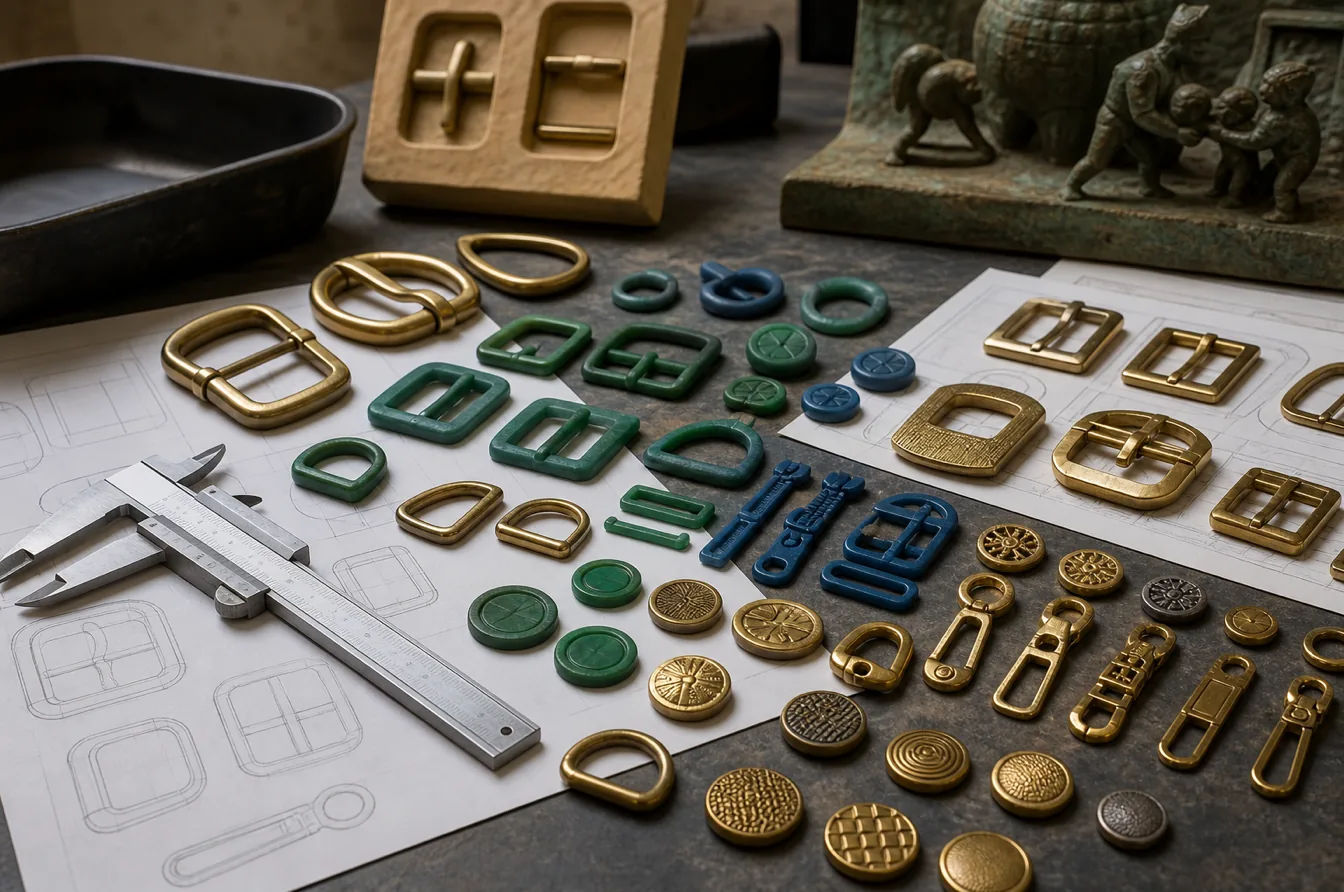
Ancient Logic, Modern Process Control
The central idea is remarkably old. A maker forms an object in wax, surrounds it with a heat-resistant material, removes the wax, and fills the remaining cavity with molten metal. A peer-reviewed Nature Communications study examined a six-millennia-old copper amulet from Mehrgarh and identified it as one of the earliest known lost-wax cast objects. Its small wheel-shaped geometry preserves evidence of an early attempt at precision casting.
The modern industrial name is investment casting. Here, "investment" refers to surrounding, or investing, the pattern in refractory material. The wax disappears, but its exact negative space remains.
The principle has changed less than the controls around it. Ancient craftspeople relied heavily on experience, visual judgment, and locally available clay or plaster-like materials. A modern foundry can control wax-injection pressure, pattern dimensions, slurry viscosity, shell thickness, drying conditions, furnace temperature, alloy chemistry, pouring temperature, and inspection criteria.
Modern production also separates the process into measurable stages:
| Stage | Main Objective | Typical Risk |
|---|---|---|
| Pattern production | Reproduce the intended geometry | Distortion, shrinkage, surface marks |
| Tree assembly | Connect patterns to the feed system | Unbalanced flow or fragile joints |
| Shell building | Create a strong refractory mold | Cracking, uneven thickness, contamination |
| Dewaxing | Remove wax without damaging the shell | Shell cracks or wax residue |
| Casting | Fill every cavity with molten alloy | Misruns, inclusions, shrinkage, gas defects |
| Finishing | Reach the specified appearance and fit | Rounded details, dimensional loss, inconsistent polish |
I therefore treat lost-wax casting as an old idea supported by modern engineering, not as a romantic substitute for process control.
Why Would a Premium Hardware Brand Accept the Longer Cycle?
A reusable steel die is attractive when a brand needs very high volumes of an established design. Lost-wax casting becomes more interesting when the product has sculpted surfaces, recessed details, curved transitions, internal openings, or relatively modest production quantities.
The process is slower because the ceramic shell must be built in layers, dried, dewaxed, fired, filled, cooled, and broken away. Each shell is used only once. However, that disposable mold is also the source of the process’s flexibility. It does not have to open along a fixed parting line to release the final metal component.
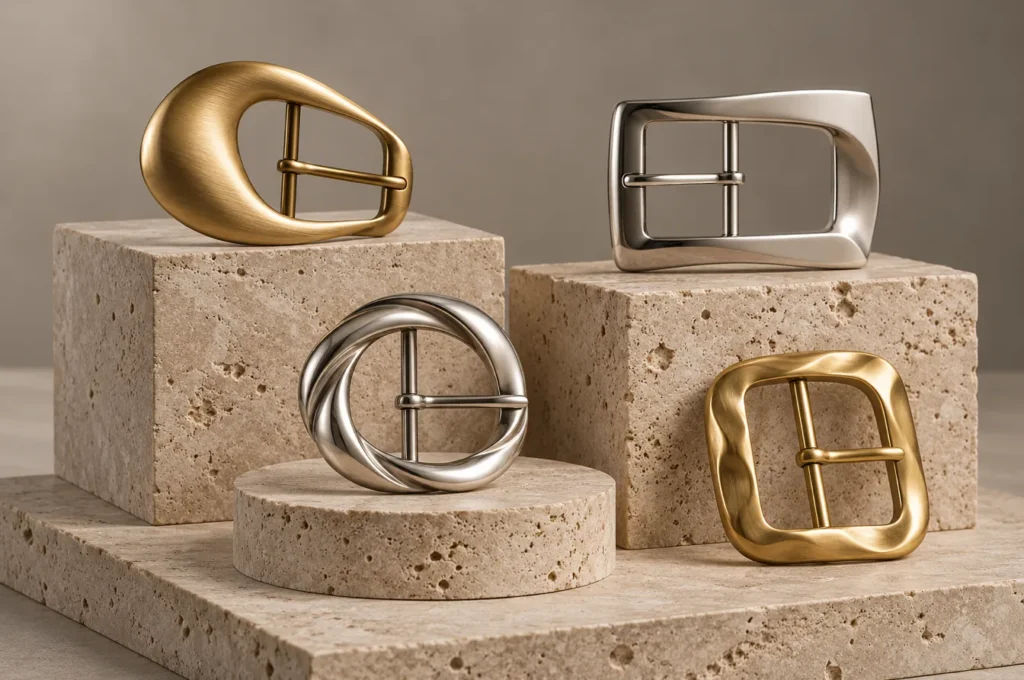
For a premium fitting, this can protect the original design intent. A soft crown, a raised logo, a rounded buckle frame, and a three-dimensional rope motif can be produced as one coherent form instead of being simplified for straight-line tool movement.
The important decision is not whether lost wax is "better" in general. I ask whether it is better for the specific geometry, alloy, order quantity, tolerance, finish, and target cost. That question keeps an ancient technique relevant in an automated factory.
What Really Disappears During Investment Casting?
The wax pattern vanishes, but its geometry survives inside a ceramic shell. Between those events lies a carefully engineered sequence of flow paths, drying cycles, and thermal changes.
Investment casting reproduces a wax pattern by building a refractory shell around it, removing the wax, preheating the empty mold, and filling that cavity with molten alloy.
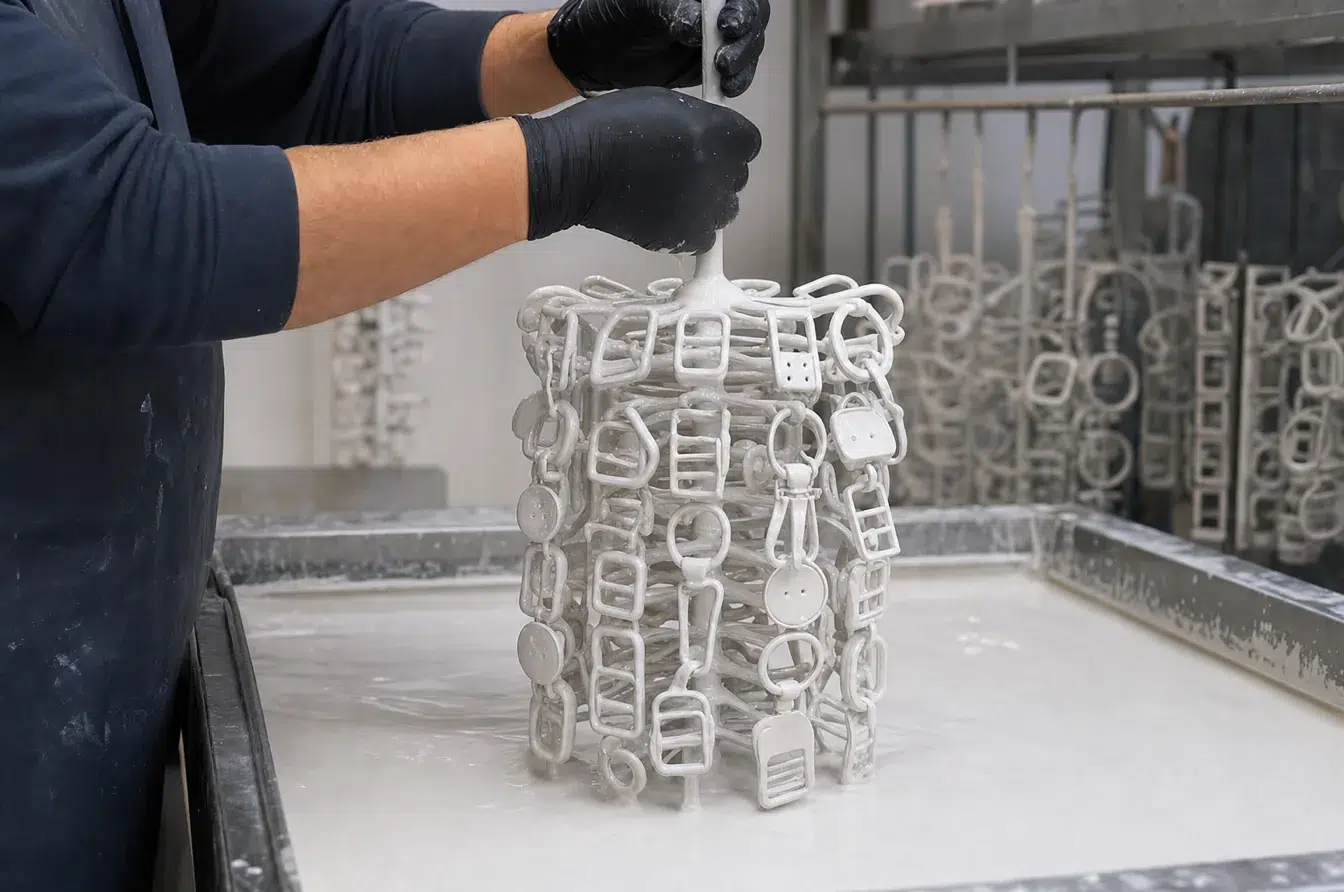
From Wax Pattern to Ceramic Shell
Production begins with a master design. It may originate from a hand model, machined master, CAD file, or approved sample. For repeat orders, wax is commonly injected into a reusable pattern tool. For prototypes and limited runs, castable additive-manufactured patterns can sometimes reduce the need for conventional wax tooling.
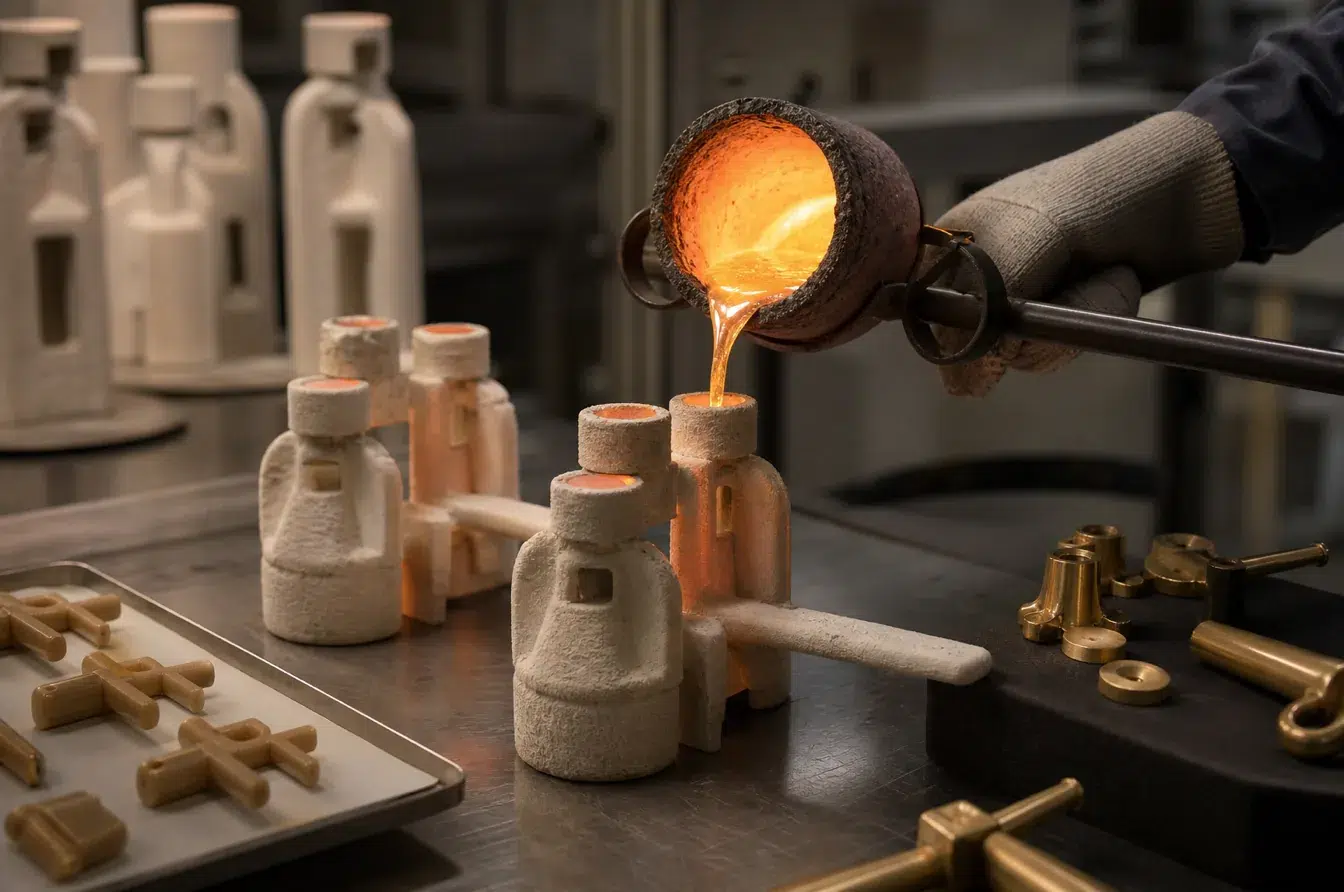
Several wax patterns are then attached to a central wax runner, creating a structure commonly called a tree or cluster. According to the Investment Casting Institute, the central sprue supports multiple patterns and provides a path for molten alloy, while the smaller gates regulate its direction and flow into each cavity.
The completed tree is repeatedly dipped into ceramic slurry and coated with refractory particles. Each layer dries before the next is applied. Fine initial layers capture surface detail; subsequent layers build the mechanical strength required to survive dewaxing and casting.
This is an important correction to simplified descriptions of the process. The wax tree is not normally pushed directly into an already-hot ceramic mass. Industrial shell building occurs through repeated coating and drying. Once the shell is complete, the wax is removed with steam or heat, and the empty shell is fired or preheated before pouring. The Institute’s process overview describes steam-autoclave and flash-fire dewaxing as established routes.
At this stage, the transformation is almost architectural. Heat removes the temporary structure, but the surrounding shell holds every ridge, radius, recess, and texture as an empty volume. Molten metal then occupies the space that wax has surrendered.
Why Is the Sprue System a Fluid-Flow Decision?
The sprue system is sometimes described as a stand for holding wax parts. That is only half its function. During pouring, it becomes the metal-distribution network.
Molten alloy must travel through the main sprue and gates before it loses enough heat to stop flowing. The designer must consider flow distance, section thickness, temperature loss, turbulence, solidification order, and the amount of metal needed to feed contracting regions.
A thin decorative arm may freeze before a heavy buckle frame. A gate that is too small can restrict flow and create an incomplete casting. A poorly placed gate can send hot metal against a delicate shell surface, increase turbulence, or leave a difficult finishing mark. A heavy isolated section may form shrinkage porosity if it solidifies without an adequate supply of liquid metal.
| Potential Defect | Possible Process Cause | Relevant Control |
|---|---|---|
| Incomplete fill or misrun | Metal cools before reaching the full cavity | Gate size, shell temperature, pouring temperature |
| Shrinkage cavity | Heavy section cannot receive liquid feed metal | Gate location, section transitions, solidification planning |
| Gas porosity | Dissolved gas, trapped air, or turbulent filling | Melt practice, venting, flow control |
| Ceramic inclusion | Shell damage or contamination enters the melt | Shell handling, cleaning, controlled pouring |
| Surface roughness | Coarse face coat or poor pattern surface | Wax quality, primary slurry, drying control |
| Distortion | Wax movement or uneven cooling | Pattern support, geometry review, fixturing |
A good sprue layout reduces risk; it does not guarantee a defect-free casting. Lost-wax parts can still contain porosity, inclusions, cracks, or dimensional variation. I would therefore never approve a supplier claim such as "the process naturally produces metal with no bubbles." Quality comes from the combination of design, melt control, gating, shell preparation, finishing, and inspection.
Why Do Solid Brass and Stainless Steel Need Different Thinking?
Material names can create false confidence. "Solid brass" describes both an alloy family and a product construction, while "stainless steel" covers many grades with different casting behavior.
Investment casting can process both brass and stainless steel, but alloy selection, section design, melting practice, shrinkage control, and finishing requirements must be evaluated separately.
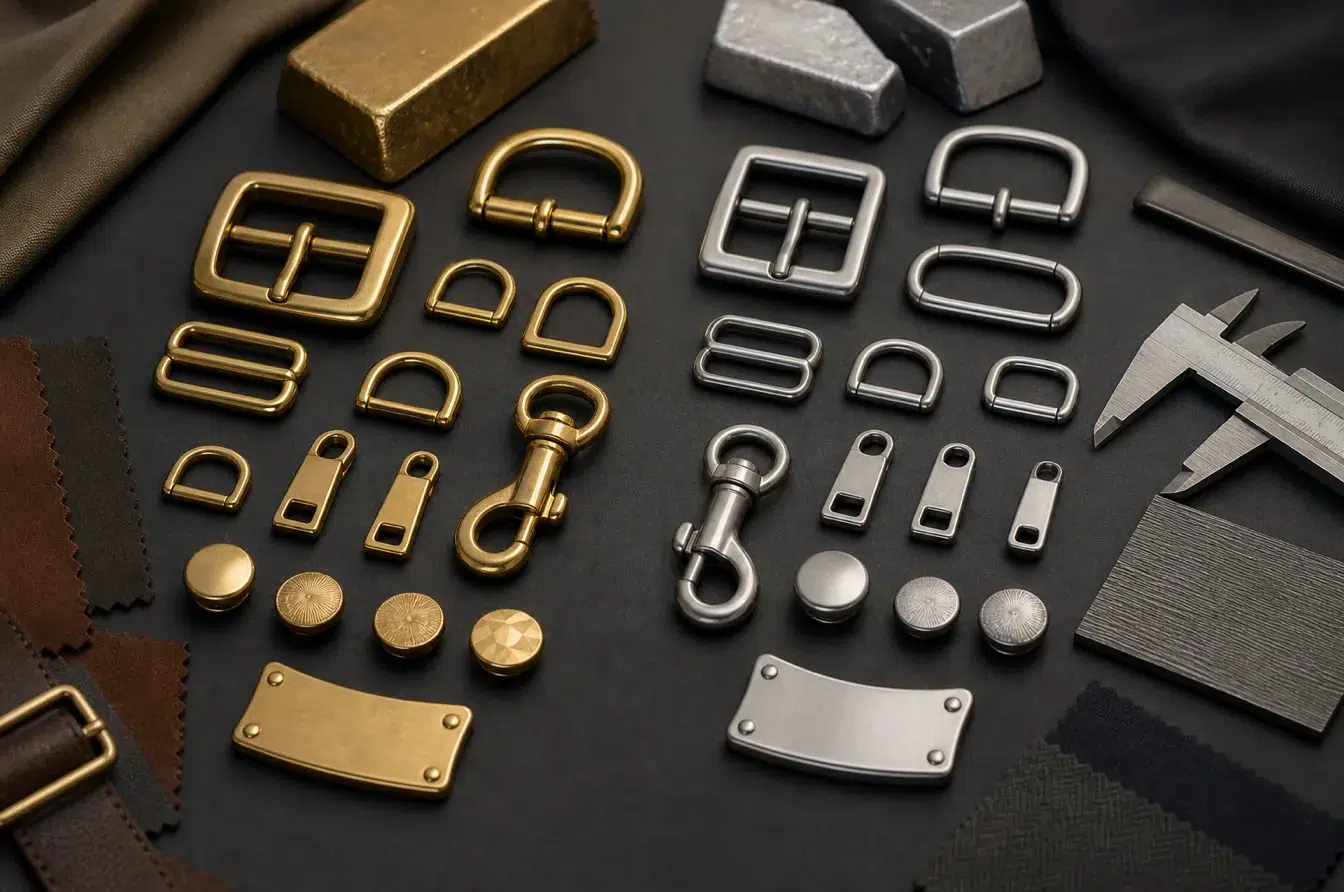
What Creates the Appeal of Solid-Brass Hardware?
The weight of a solid-brass fitting comes primarily from its alloy density and solid cross-section, not from lost-wax casting by itself. A buckle cast with a fully solid frame will usually feel more substantial than a thin stamped shell because it contains more metal.
That mass affects more than the scale reading. It changes the sound of a clasp closing, the balance of a shoulder strap, the resistance felt when a swivel turns, and the way a finished product communicates value in the hand.
Lost-wax casting also supports smooth transitions between structural and decorative features. A thick load-bearing loop can flow into a sculpted body without the seams associated with joining multiple stamped parts. Logos, recessed lines, organic textures, and rounded backs can be incorporated into the pattern, although every feature must still be reviewed for metal flow, finishing access, and wax-tool release.
"Solid brass," however, is not a complete quality specification. Designers should also confirm alloy composition, lead requirements, mechanical properties, dimensional tolerance, polishing standard, and the complete finishing system. A poorly controlled brass casting can still contain porosity or inclusions. An unsuitable lacquer or plating process can still fail even when the base metal is good.
Why Is Stainless Steel More Demanding?
Stainless steels are poured at much higher temperatures than common zinc alloys, and many grades present demanding shrinkage, fluidity, oxidation, or hot-cracking behavior. The ceramic shell must withstand the thermal load without breaking down or reacting excessively with the metal.
Investment casting is valuable here because refractory shells can support high-temperature alloys and reproduce near-net-shape geometry. The process is widely used beyond decorative hardware in applications such as turbines, transportation components, medical equipment, and industrial machinery.
That capability does not make all stainless grades interchangeable. A foundry may select a cast stainless grade for corrosion resistance, strength, polishability, weldability, or heat-treatment response. Melt protection, deoxidation practice, shell chemistry, gating, and post-casting heat treatment may change with the alloy and required performance.
| Design Question | Solid Brass | Stainless Steel |
|---|---|---|
| Why choose it? | Warm color, substantial feel, decorative finishing potential | Strength, corrosion resistance, cool-toned appearance |
| Main casting concern | Flow, shrinkage, alloy chemistry, surface porosity | High pouring temperature, oxidation, shrinkage, grade-specific castability |
| Finishing options | Natural polish, antiquing, plating, lacquer | Mechanical polish, brushing, blasting, PVD or other specified treatments |
| What must be specified? | Alloy, lead limits, finish system, coating performance | Exact grade, heat treatment, passivation and finish requirements |
| Common mistake | Treating "solid brass" as a complete specification | Treating every stainless grade as having the same behavior |
I select the alloy and the process together. Choosing stainless steel after the mold and gating strategy have already been fixed can create expensive redesign work.
When Does Lost Wax Beat Sand Casting or Zinc Die Casting?
Casting comparisons often crown one process as the universal winner. In practice, each method solves a different combination of volume, geometry, material, surface, and tooling economics.
Lost wax is strongest for detailed, three-dimensional parts and flexible alloy choices. Sand casting favors simpler tooling and substantial sections, while zinc die casting excels at high-volume repeatability and short cycles.
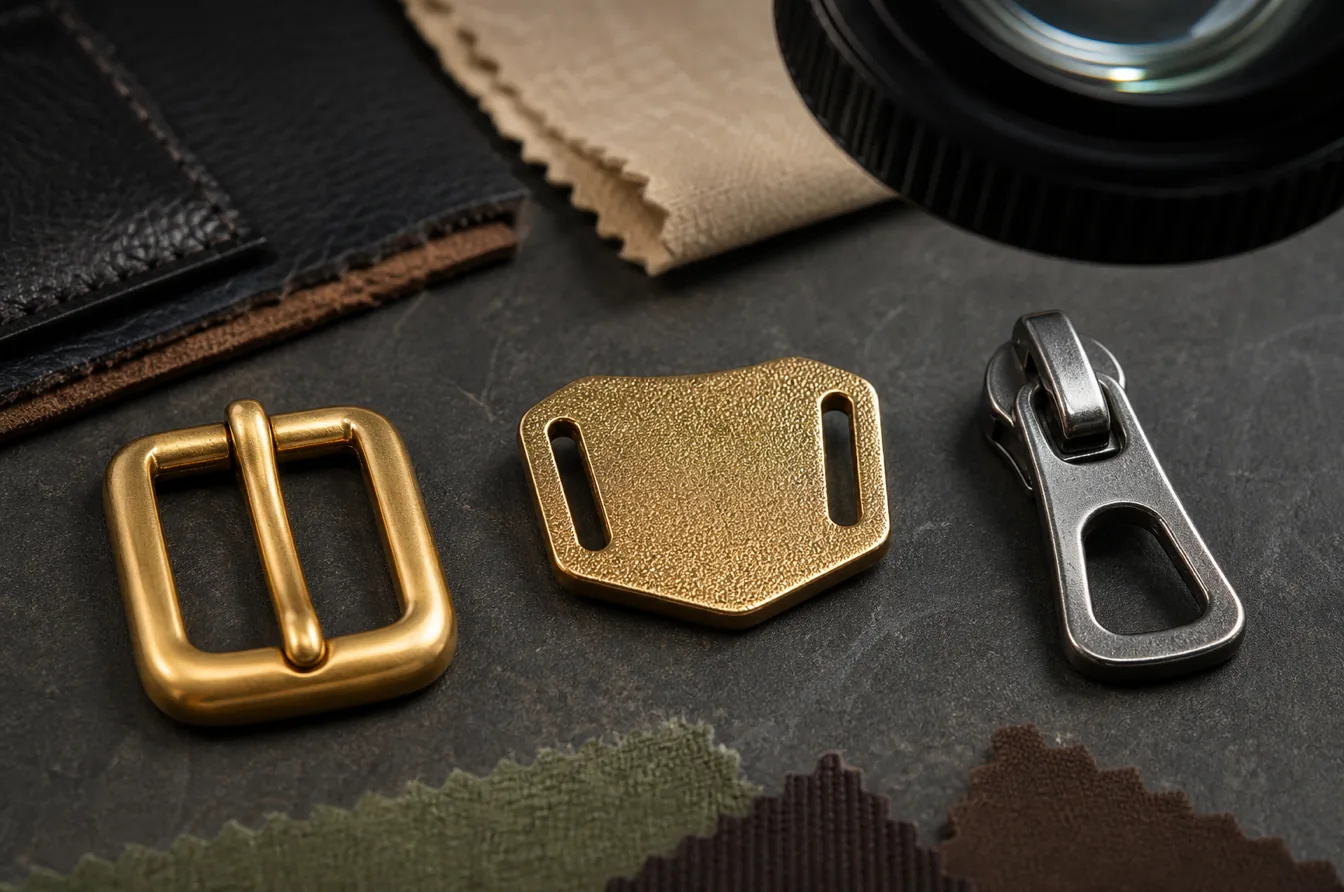
A More Honest Process Comparison
High-pressure zinc die casting can produce complex, dimensionally stable components with excellent surface quality. The North American Die Casting Association emphasizes zinc’s ability to achieve complex shapes, close tolerances, efficient production, and surfaces that accept decorative finishes.
Its limitation is not an inability to make detail. The main commercial constraint is the cost and architecture of the reusable steel die. The die must open, release the part, and survive repeated high-pressure cycles. Slides, moving cores, and other mechanisms can create undercuts, but they add cost and maintenance risk.
Sand casting works differently. It can be economical for lower quantities, larger components, and shapes that do not justify expensive permanent tooling. Its surface and fine-detail capability are generally less refined than investment casting, although results vary greatly with the sand system, pattern, alloy, and foundry.
| Factor | Lost-Wax Casting | Sand Casting | Zinc Die Casting |
|---|---|---|---|
| Typical mold | Disposable ceramic shell | Disposable sand mold | Reusable steel die |
| Detail capability | High | Moderate | High |
| Three-dimensional freedom | High, subject to pattern and flow limits | Moderate; cores can add complexity | High, but constrained by die release and tooling mechanisms |
| Tooling investment | Low to medium; depends on pattern method | Usually relatively low | Usually high |
| Unit cost at scale | Moderate to high | Moderate | Low at sufficiently high volume |
| Production speed | Slow | Moderate | Fast |
| Best volume range | Prototype to medium volume | Low to medium volume | Medium to very high volume |
| Common hardware alloys | Brass, bronze, stainless steel and others | Brass, bronze, aluminum, iron and others | Primarily zinc, aluminum, magnesium and selected copper alloys |
| Surface starting point | Fine, but still requires finishing | More textured | Smooth and repeatable |
| Main commercial advantage | Geometry and material flexibility | Accessible tooling and broad size range | High-output repeatability |
The table is a starting point, not a quotation sheet. Part size, annual volume, tolerance, alloy price, cavity count, reject rate, and finishing labor can reverse a general cost assumption.
How Do Geometry and Finishing Change the Decision?
Lost-wax casting is useful when a design would force an elaborate parting line or multiple moving actions in a pressure die. Because the ceramic shell is destroyed after casting, the metal part does not need to be ejected from it in the same way.
However, the wax pattern may still need to come out of a reusable wax-injection tool. Severe undercuts can therefore move the problem upstream unless the supplier uses flexible tooling, soluble cores, assembled wax patterns, or printed expendable patterns.
Surface quality also needs a realistic definition. Investment casting can preserve fine textures and eliminate the conventional parting line associated with a two-half metal die, but it does not produce a finished luxury surface directly from the shell. Gate removal, grinding, tumbling, polishing, blasting, plating, coating, and inspection may still be required.
The casting surface is the starting point for finishing. If the underlying metal contains exposed porosity, deep grinding marks, or rounded details, mirror polishing will make those problems more visible. I therefore review finishing allowances during the design stage rather than treating polishing as a rescue operation at the end.
What Quality Standards Turn a Casting into Premium Hardware?
A beautiful casting can still fail through poor dimensions, uncontrolled polishing, weak finish adhesion, or inconsistent moving parts. Premium quality depends on the complete production route.
A premium hardware standard connects process selection with dimensional control, surface preparation, functional inspection, and finish performance. Lost wax is only one part of that system.
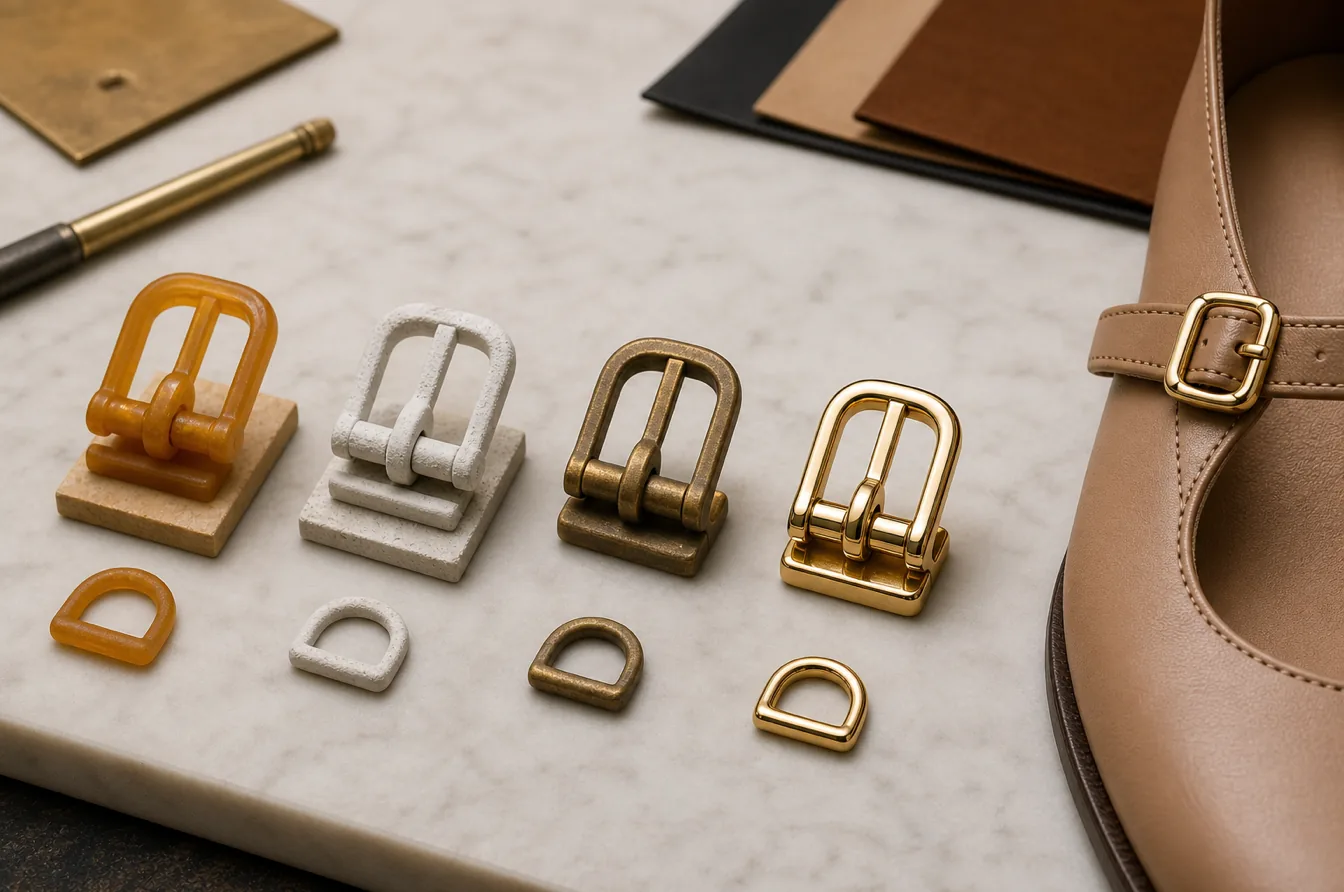
How Does a Solid-Brass Buckle Travel from Wax to Finished Hardware?
Consider a representative sculpted heel-bar buckle whose geometry has been approved for lost-wax production. At Lustrim, I would begin with its application and possible failure modes, not appearance alone. The selected process must support the buckle’s structure, movement, finish, order quantity, and target cost as one connected specification.
First, the designer defines the frame thickness, strap clearance, pin movement, load path, logo depth, edge radii, and intended finish. The toolmaker then compensates for wax and metal shrinkage before producing the wax-pattern tool.
Wax buckle patterns are injected, checked, and attached to a tree. Gate positions are selected so metal can reach the frame and pin-support areas without leaving removal scars on the most visible surfaces. The tree receives multiple ceramic coats, dries, and enters the dewaxing and firing stages.
Molten brass fills the hot shell. After cooling, the shell is broken away and individual buckles are cut from the tree. Gate remnants are ground down, but the operator must preserve the intended frame profile. The parts then move through tumbling and polishing. If the specification requires an antique, plated, or coated finish, surface preparation becomes critical because every scratch or pore can affect the final appearance.
Finally, the buckle is inspected for dimensions, pin movement, surface consistency, finish adhesion, and any agreed mechanical requirement. The result is not valuable simply because wax disappeared. It is valuable because each stage protected the original design.
Does Durable Hardware Automatically Mean Sustainable Hardware?
Durability can support a more responsible product strategy, but lost-wax casting is not automatically sustainable. The process consumes energy for melting and shell firing, uses a single-use ceramic mold, and generates gates, runners, shell debris, and finishing waste.
A stronger sustainability argument begins with service life. If a buckle remains functional through years of movement, moisture, abrasion, and repair, the bag or belt around it has a better chance of staying in use. Replaceable and repairable hardware can extend that effect.
I would evaluate the following points instead of relying on a broad green claim:
- Is the alloy chemistry documented and suitable for the intended market?
- Are sprues and rejected metal separated and recycled where technically appropriate?
- Can the finish survive realistic abrasion, sweat, salt-spray, or chemical exposure?
- Is the component designed for repair or replacement?
- Has unnecessary mass been removed without weakening critical load paths?
- Can the supplier document defect control and reduce avoidable scrap?
- Will the design remain useful beyond a short trend cycle?
The "buy once, use for years" philosophy is achieved through alloy choice, structure, surface engineering, inspection, and repairability. Lost-wax casting can support that philosophy, but it cannot create it alone.
Conclusion
Lost-wax casting respects hardware as a designed object, not a minor accessory. Its lasting value comes from combining geometric freedom, material knowledge, controlled finishing, and time.